
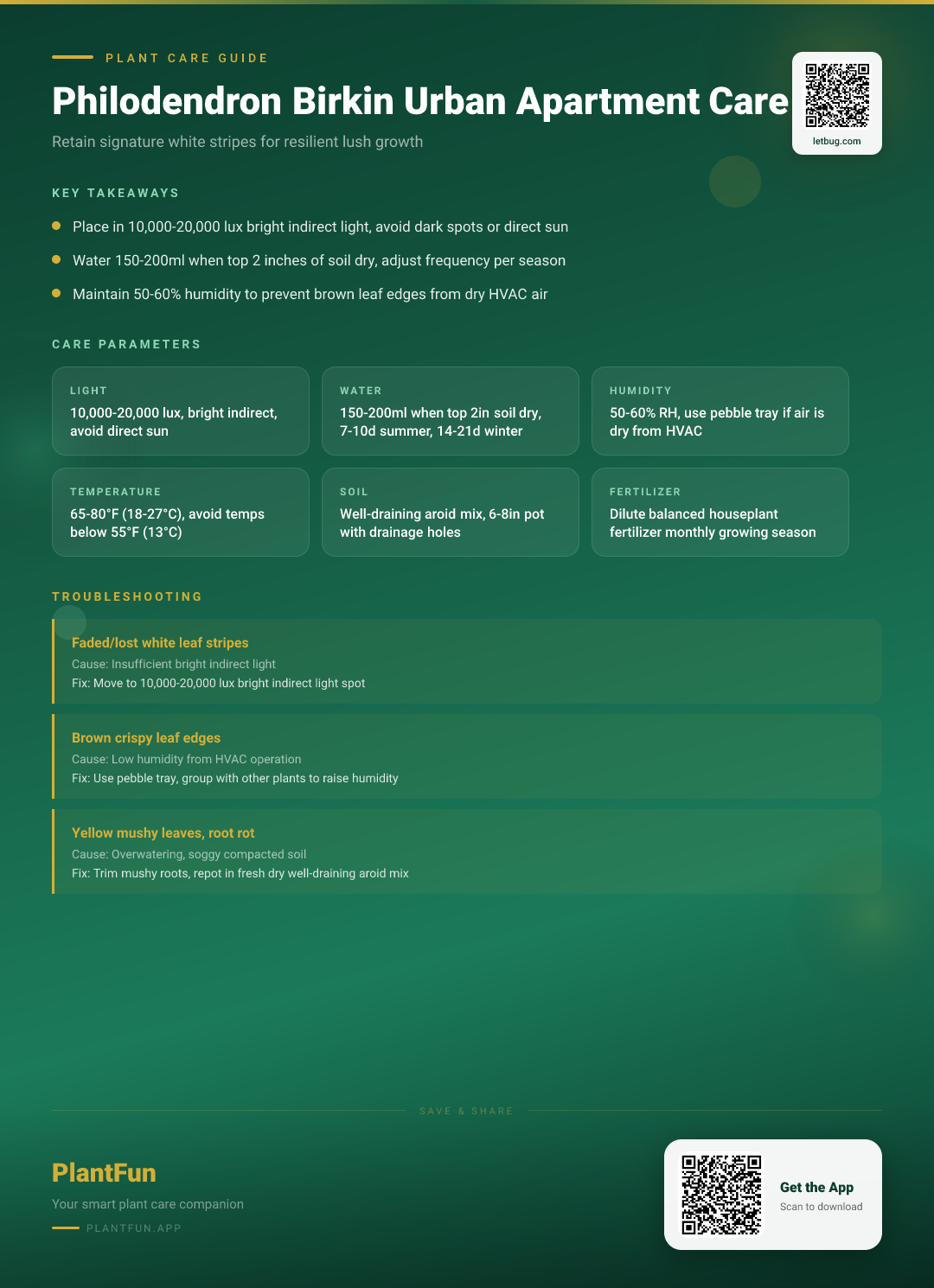
Key Takeaways
- Check soil moisture before watering — overwatering is the #1 killer of houseplants.
- Ensure your plant gets the right amount of light for its species.
- Be patient with recovery — most plants need 2–4 weeks to bounce back.
Quick Care Card: Apartment-Tailored Philodendron Birkin Thresholds
| Care Factor | Measurable Threshold | Apartment-Specific Notes |
|---|---|---|
| Light | 10,000–20,000 lux bright indirect | No direct midday sun, no dark entryways |
| Water | 150–200ml when top 2 inches of soil are dry | 7–10 days summer, 14–21 days winter |
| Humidity | 50–60% relative humidity | Adjust for heating/AC cycles |
| Temperature | 65–80°F (18–27°C), no lower than 55°F (13°C) | Keep away from drafty windows/AC vents |
| Soil | Well-draining aroid mix | Perlite + orchid bark + coco coir 1:1:1 ratio |
| Fertilizer | ½ strength balanced liquid fertilizer, once monthly spring/summer only | Skip fertilizing in low light or winter |
| Toxicity | Toxic to cats, dogs, and humans if ingested | Place on high shelves out of reach of pets/kids |
Why Generic Birkin Care Fails in Typical Apartments
Philodendron Birkin care for beginners is often frustrating because most generic guides assume you have consistent humidity, unobstructed natural light, and ample floor space — three things rarely found in standard urban apartments. Three unique apartment constraints are the leading cause of Birkin stress:
- Fluctuating humidity from HVAC systems, which can drop to 20% or lower during winter heating season
- Limited natural light, with many studios only having one north-facing window that delivers less than 5,000 lux of light
- Tight shelf and counter space that forces owners to place plants in suboptimal spots like dark entryways or drafty window sills
Myth vs. Reality: Myth: Birkins need full sun to retain their white stripes. Reality: Direct midday sun will burn their delicate leaves in as little as 30 minutes in south-facing apartment windows.
Three quick visual cues your Birkin is struggling:
- Crispy brown leaf edges (dry air from HVAC)
- Faded or completely lost white variegation (insufficient light)
- Yellow mushy lower leaves (overwatering, the #1 cause of Birkin death in apartments (NC State Extension, 2026))
7-Step Philodendron Birkin Care Checklist for Apartments
Each step includes a quick fix for existing stress symptoms and a prevention step to support consistent Philodendron Birkin resilient growth without leaf drop or lost variegation.
Step 1: Light Calibration for Apartment Layouts
The official Philodendron Birkin light requirement is 10,000–20,000 lux of bright indirect light (NC State Extension, 2026). The best apartment placement is 2–3 feet away from a south or east-facing window, behind a sheer curtain to filter harsh direct sun. Common mistake: Placing in dark entryways (less than 5,000 lux) that causes variegation loss, or directly in a south-facing window that burns leaf edges.
Quick fix for burnt or faded leaves: Trim damaged leaves with sterile shears, move the plant 2 feet further back from the window or to an east-facing spot. Use a cheap light meter to test levels, or try our light meter for houseplants guide to calibrate without special tools. Prevention: Rotate the plant ¼ turn every 2 weeks to ensure even light exposure on all sides. For very low-light apartments, add a full-spectrum grow light 12 inches above the plant for 10–12 hours a day.
Step 2: Watering Schedule for Inconsistent Apartment Temperatures
Water 150–200ml when the top 2 inches of soil are completely dry (quick test: stick your index finger 2 inches into the soil, if no soil sticks to your finger it’s time to water). This translates to every 7–10 days for Philodendron Birkin summer watering, and 14–21 days for Philodendron Birkin winter care (Akramian et al., 2024). Common mistake: Following a rigid weekly schedule instead of checking soil moisture, which leads to overwatering, the top Birkin killer in apartments.
Philodendron Birkin overwatering fix: Tip the pot to drain excess water, gently remove the plant from its pot, brush away soggy soil, trim any mushy brown roots with sterile shears, repot in dry well-draining aroid mix, and hold off watering for 1 week. Prevention: Use a pot with drainage holes, and never let the plant sit in a saucer of standing water for more than 15 minutes.
Step 3: Humidity Adjustments for HVAC-Heated/Cooled Spaces
The ideal Philodendron Birkin humidity level is 50–60% relative humidity (Tasnim et al., 2025). Common mistake: Ignoring humidity drops from winter heating or summer AC, which causes crispy brown leaf edges.
Philodendron Birkin brown leaf edges fix: Trim damaged edges with clean shears, and place the plant on a pebble tray (fill a tray with pebbles and water, set the pot on top so it’s not sitting in water). Prevention: Group your Birkin with other tropical plants to create a humidity-boosting microclimate, or use a small humidifier near the plant in winter. For more low-effort tips, check our humidity hacks for HVAC apartments guide.
Step 4: Temperature Regulation for Drafty Apartment Spots
The ideal temperature range for Birkins is 65–80°F (18–27°C), never expose to temperatures below 55°F (13°C) (NC State Extension, 2026). Common mistake: Placing the plant near drafty windows, AC vents, or exterior doors, which causes leaf drop and stunted growth.
Quick fix for draft damage: Remove any wilted or discolored leaves, move the plant to a spot with consistent temperatures away from drafts. If your windows are drafty in winter, use a window insulation film or keep the plant on an interior shelf at least 3 feet away from exterior glass. Prevention: Use a cheap indoor thermometer to monitor temperatures near your plant’s spot, and avoid moving it between hot and cold areas frequently.
Step 5: Soil & Potting for Small Apartment Shelf Space
Use a well-draining aroid mix (1 part perlite, 1 part orchid bark, 1 part coco coir) in a 6–8 inch pot with drainage holes, which fits perfectly on most apartment shelves and counters for Philodendron Birkin small space care (NC State Extension, 2026). As noted by the ASPCA (2026), Birkins are toxic to pets and kids, so a high shelf is the ideal placement to keep it out of reach. Common mistake: Using heavy potting soil that retains too much moisture, or using a pot that’s too big which increases overwatering risk.
Quick fix for root bound plants (stunted growth, roots growing out of drainage holes): Gently loosen the root ball, trim any circling roots, repot in a pot that’s 1–2 inches larger than the current one, using fresh aroid mix. You can find our recommended mixes in the best aroid soil mixes for small apartments guide. Prevention: Check for root bound signs once a year in spring, and only repot when necessary to avoid taking up extra shelf space.
Step 6: Fertilizing for Slow Growth in Low-Light Apartments
Dilute balanced liquid fertilizer (10-10-10 NPK) to ½ strength, apply once a month only in spring and summer (Akramian et al., 2024). Common mistake: Over-fertilizing, especially in low-light apartments where the plant uses fewer nutrients, which causes brown leaf tips and salt build up in soil.
Quick fix for fertilizer burn: Flush the soil with 3 times the pot volume of filtered water to wash away excess salt, hold off fertilizing for 3 months. Prevention: Skip fertilizing completely in winter, or if your plant is in a spot with less than 10,000 lux of light.
Step 7: Pruning for Lush Growth in Tight Spaces
Use sterile shears to cut leggy, stretched growth just above a leaf node (the bump on the stem where leaves grow) to encourage new, full foliage. Common mistake: Letting stretched growth from low light take over, which makes the plant look sparse and takes up more shelf space.
Quick fix for sparse, stretched Birkins: Trim back leggy stems to 4–6 inches above the soil line, move the plant to a brighter spot, and new full growth will emerge in 4–6 weeks. Prevention: Prune 1–2 times a year in spring to keep the plant compact and perfect for small shelf spaces.
Seasonal Birkin Apartment Care Calendar
| Season | Watering Schedule | Light Adjustment | Humidity Adjustment | Fertilizer |
|---|---|---|---|---|
| Winter (Dec–Feb) | Every 14–21 days, only when top 2 inches of soil are dry | Move closer to south-facing window if light levels drop below 10,000 lux | Use pebble tray or humidifier to counteract heating-related dry air | Skip entirely |
| Spring (Mar–May) | Every 10–14 days, increase as temperatures rise | Rotate weekly for even exposure, add sheer curtain if sun gets stronger | Increase humidity as AC turns on for the first time | Apply ½ strength fertilizer once per month |
| Summer (Jun–Aug) | Every 7–10 days, check soil more frequently during heat waves | Keep 2–3 feet away from south-facing windows to avoid sun burn | Group with other plants to maintain humidity during AC cycles | Apply ½ strength fertilizer once per month |
| Fall (Sep–Nov) | Every 10–14 days, reduce frequency as temperatures drop | Move away from drafty exterior doors and windows | Adjust humidity as heating turns on | Stop fertilizing by mid-October |
Voice Search FAQ
Why is my Philodendron Birkin losing its white stripes?
The most common cause of lost variegation is insufficient light (less than 10,000 lux) (NC State Extension, 2026). Birkins produce white variegation only when they get enough bright indirect light to support the extra pigment production. Fix it by moving the plant to a brighter spot (2–3 feet from an east or south-facing window) or adding a grow light. Stems that have already lost variegation won’t get stripes back, so trim them to encourage new variegated growth.
Can I keep my Philodendron Birkin in a windowless apartment?
Philodendron Birkin can grow in low light only if you supplement with a full-spectrum grow light (10–12 hours per day, 12 inches above the plant) (Akramian et al., 2024). Without supplemental light, the plant will lose its variegation, become leggy, and eventually die. If you don’t want to use a grow light, a windowless apartment is not a suitable spot for a Birkin.
How often do I need to water my Philodendron Birkin in winter?
In winter, water your Birkin only when the top 2 inches of soil are completely dry, which works out to every 14–21 days for most heated apartments (Tasnim et al., 2025). Avoid following a rigid schedule, as homes with very dry heating may need to water slightly more often, while cooler apartments may go 3 weeks or more between waterings. Always test soil moisture with your finger before watering to avoid overwatering.
References
- NC State Extension. (2026). Philodendron Birkin — NC State Extension Gardener Plant Toolbox. https://plants.ces.ncsu.edu/plants/birkin-care/. Accessed 2026-03-06.
- Akramian, M.; Khaleghi, A.; Salehi Arjmand, H. (2024). Optimization of plant growth regulators for in vitro mass propagation of Philodendron cv. Birkin through shoot tip culture. Greenhouse Plant Production Journal. https://doi.org/10.61186/gppj.1.1.55. Accessed 2026-03-06.
- Tasnim, N.; Rahman, K.; Sarker, S. (2025). In vitro Mass Propagation of Philodendron cv. ‘Birkin’ through Direct and Indirect Organogenesis. Plant Tissue Culture and Biotechnology. https://doi.org/10.3329/ptcb.v35i1.82285. Accessed 2026-03-06.
- ASPCA. (2026). Toxic and Non-Toxic Plants List — ASPCA. https://www.aspca.org/pet-care/animal-poison-control/toxic-and-non-toxic-plants. Accessed 2026-03-06.
Optional Helper: Plantfun.App
Plantfun.App identifies your plants by photo, diagnoses pests and diseases with clear fixes, and creates personalised watering and light schedules that adapt to your home conditions — a handy companion for putting this guide into daily practice.
Found an error or have suggestions? We'd love your feedback.
Need help identifying this problem?
Get instant identification, personalized care schedules, and effective pest treatment plans directly on your phone.
Sponsored • We may earn a commission from app downloads
Related Guides
The Complete Philodendron Birkin Care Checklist for Resilient Growth in Typical Apartments
Keep your Philodendron Birkin thriving in your apartment with our science-backed checklist. Get exact light, water, and humidity thresholds, plus 7 quick fixes for common leaf symptoms to support consistent resilient growth.
Care GuidePhilodendron Birkin Care Checklist for Typical Apartments: Grow Lush, Striped Leaves Without Stress
Stop struggling to keep your Philodendron Birkin thriving in your apartment. Get 8 actionable care tips, exact light/humidity thresholds, and a free printable checklist for lush, striped growth.
Care GuideThe Complete Philodendron Birkin Care Checklist for Resilient Growth in Average Apartments
Grow a lush, striped Philodendron Birkin even in a standard apartment. Get exact light levels, watering amounts, and a seasonal care checklist to avoid yellow leaves and stunted growth.
Pest ControlAnts on Plants: What They Mean and What to Do
Ants usually aren't eating your plant. They are farming other pests.