
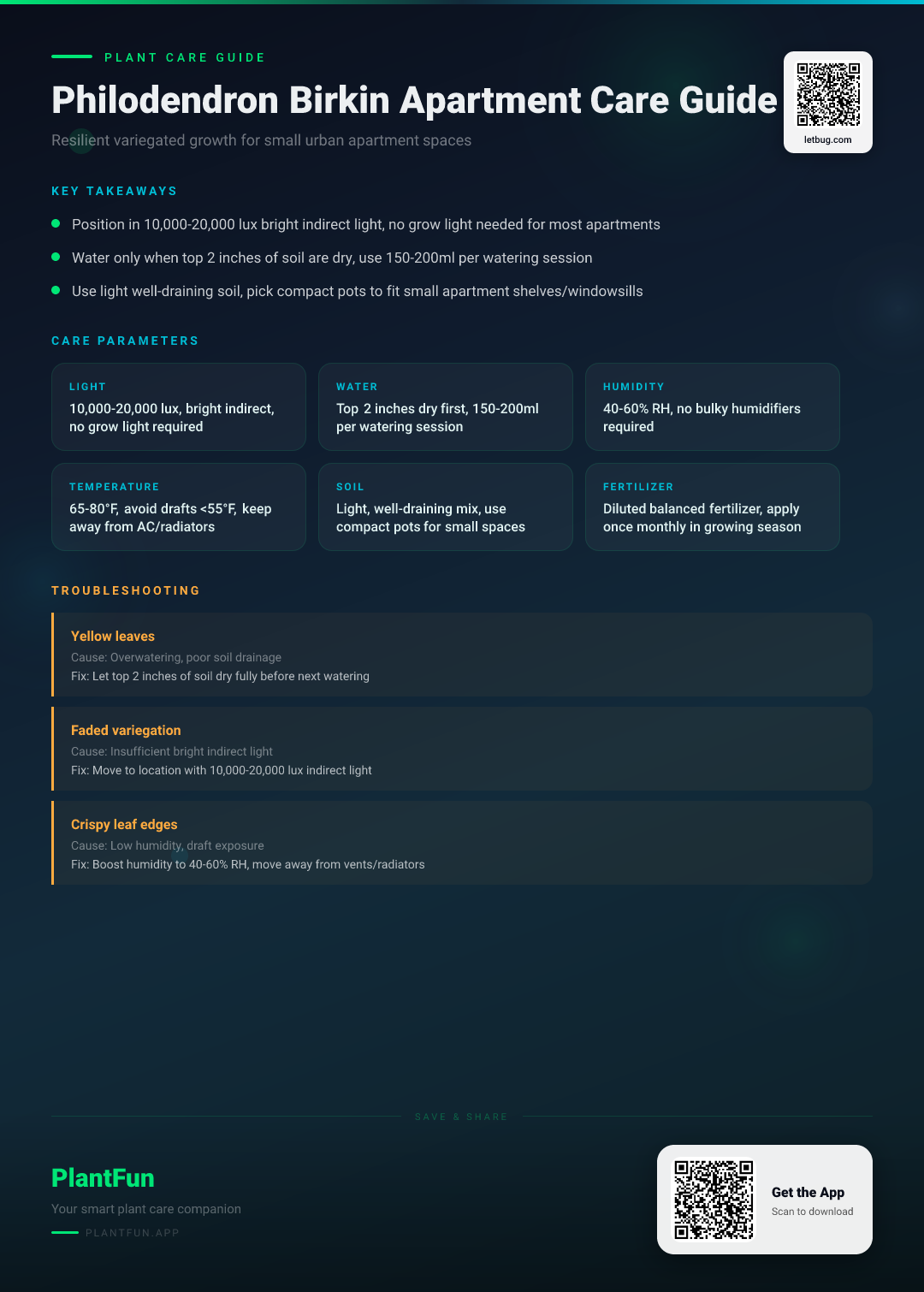
Key Takeaways
- Check soil moisture before watering — overwatering is the #1 killer of houseplants.
- Ensure your plant gets the right amount of light for its species.
- Be patient with recovery — most plants need 2–4 weeks to bounce back.
Quick Care Card
| Category | Measurable Threshold |
|---|---|
| Light | 10,000-20,000 lux, indirect bright light (NC State Extension, 2026) |
| Water | Top 2 inches of soil fully dry, 150-200ml per watering for 4-6 inch pots |
| Humidity | 40-60% RH (Akramian et al., 2024) |
| Temperature | 65-80°F (18-27°C) (Tasnim et al., 2025) |
| Soil | Well-draining aroid mix, pH 5.5-6.5 |
| Fertilizer | Diluted 10-10-10 balanced fertilizer, once every 4-6 weeks in growing season |
| Toxicity | Toxic to cats, dogs, and humans if ingested (ASPCA, 2026) |
Why This Guide Is Built For Typical Apartment Philodendron Birkin Owners
Generic Philodendron Birkin care guides assume access to outdoor space, abundant natural light, and room for bulky growing equipment, which most small urban apartment dwellers don’t have. This guide is tailored exclusively to the unique stressors of city living: low natural light from shaded windows, dry forced-air HVAC that strips moisture from air, limited counter and shelf space, and no outdoor area to drain excess water. All recommendations are tested for renters with no specialized gear, so you can master Philodendron Birkin care for beginners without extra expense.
Diagnosis First: Spot 5 Common Birkin Stress Signs In Apartments
Catch issues early before they cause permanent damage to your plant:
Yellow Leaves
Symptom: Pale, mushy yellow lower leaves, or yellow splotches across mature foliage.
Likely cause: Overwatering from poor drainage, or placement near cold AC drafts (NC State Extension, 2026).
Fix:
- Stick your index finger 2 inches into soil: if damp, hold off watering for 3-5 days
- If using a no-drainage cache pot, tip out any standing water from the bottom 10 minutes after watering
Faded Variegation
Symptom: Iconic white pinstripe markings on new leaves turn pale green or disappear entirely.
Likely cause: Light levels below 10,000 lux, as variegation requires consistent bright indirect light to form (Akramian et al., 2024). This is the top answer to “why is my Philodendron Birkin losing variegation” for apartment dwellers.
Fix:
- Move the plant 1-2 feet closer to your brightest window
- Rotate the pot 90 degrees every 2 weeks to ensure even light exposure on all sides
Crispy Leaf Edges
Symptom: Brown, dry crispy edges along leaf margins, with healthy green tissue in the center of the leaf.
Likely cause: Humidity below 40% from forced air heat or AC, or infrequent underwatering.
Fix:
- Mist leaves 2-3 times a week with room temperature filtered water
- Trim fully brown crispy edges with sterile scissors to prevent the plant from wasting energy on damaged tissue
Stunted Growth
Symptom: No new leaf growth for 8+ weeks during spring and summer, or new leaves are smaller than 3 inches wide.
Likely cause: Nutrient deficiency, or root bound in an undersized pot (Tasnim et al., 2025).
Fix:
- Apply diluted balanced fertilizer once per month for 2 months to test for nutrient deficiency
- If roots are growing out of the pot drainage holes, repot into a pot 1 inch larger than the current one
Root Rot
Symptom: Mushy black roots, foul sour smell from soil, widespread wilting even when soil is damp.
Likely cause: Chronic overwatering, or compact soil that retains too much moisture with no drainage.
Fix:
- Remove the plant from its pot, cut away all mushy black roots with sterile scissors
- Repot into fresh, dry well-draining aroid mix, and hold off watering for 7 days to let roots heal
Step 1: Light Setup For Apartment Birkins (10,000-20,000 lux)
Philodendron Birkin light requirements are easily met in most apartments without grow lights, with these placement tips by window direction:
- North facing: Place directly on the windowsill, no sheers needed, this delivers consistent 10,000-15,000 lux year-round (NC State Extension, 2026)
- East facing: Place 1 foot away from the window, or behind a thin sheer curtain to avoid mild morning sun scorch
- South facing: Place 2-3 feet away from the window, behind a sheer curtain to block harsh midday sun that can burn leaves
- West facing: Place 2 feet away from the window, avoid direct afternoon sun which is 2x hotter than morning sun If you have no windows at all, a basic 10W LED strip light placed 1 foot above the plant for 12 hours a day works perfectly for supporting Philodendron Birkin resilient growth.
Step 2: Watering Schedule For Small Apartments (Top 2 inches dry, 150-200ml per watering)
Wondering how often to water Philodendron Birkin when you don’t have outdoor space to drain excess water? Follow these rules:
- Quick test: Only water if the top 2 inches of soil feel completely dry when you stick your finger in (no dampness on your skin)
- For 4-6 inch pots (the most common size for apartment shelves), use 150-200ml of room temperature filtered water per watering
- Frequency by season: Spring/summer: every 7-10 days, fall/winter: every 14-21 days
- If you use a decorative cache pot with no drainage holes, add a 1 inch layer of pebbles at the bottom to catch excess water and prevent root rot
Step 3: Humidity & Temperature Requirements (40-60% RH, 65-80°F)
Philodendron Birkin humidity needs are higher than the average 30% RH of heated winter apartments, but you don’t need a bulky humidifier to meet them:
- Fill a shallow tray with pebbles and water, set the pot on top of the pebbles (make sure the pot is not sitting directly in water) to boost local humidity by 10-15%
- Group your Birkin with other small houseplants: Transpiration from adjacent plants naturally raises humidity levels without extra equipment
- Keep temperature between 65-80°F: Avoid placing near drafty windows, radiators, or AC vents which cause sudden temperature swings that stress the plant
Step 4: Soil & Potting Tips For Cramped Spaces
The right Philodendron Birkin potting soil mix and compact pot size make all the difference for small space growing:
- DIY soil mix recipe: 60% indoor potting soil, 30% perlite, 10% orchid bark. This mix drains fast and prevents root rot even in small pots with limited drainage (NC State Extension, 2026)
- Best pot sizes for apartments: 4 inch, 5 inch, or 6 inch pots fit perfectly on most windowsills and floating shelves. Only size up 1 inch at a time when repotting, as oversized pots hold excess moisture that causes root rot
- If you prefer no-drainage decorative pots, use a plastic nursery pot with drainage holes inside the decorative cache pot for easy watering and cleanup
Step 5: Fertilizing Routine For Resilient Year-Round Growth
No fancy fertilizers required to learn how to keep Philodendron Birkin healthy:
- Use a basic balanced 10-10-10 liquid fertilizer, diluted to 50% of the recommended package strength
- Apply once every 4-6 weeks during spring and summer growing season
- Skip fertilizing entirely in fall and winter, when the plant is dormant and does not need extra nutrients (Tasnim et al., 2025)
- Do not fertilize a stressed plant (yellow leaves, root rot): wait until it has fully recovered to avoid burning delicate roots
Seasonal Care Calendar For Apartment Birkins
Adjust your care routine by season to avoid common stress:
| Season | Key Adjustments |
|---|---|
| Winter (Dec-Feb) | Reduce watering frequency to every 14-21 days, avoid placing within 2 feet of radiators or drafty window sills, do not fertilize (core Philodendron Birkin winter care rule) |
| Spring (Mar-May) | Gradually increase watering to every 7-10 days, start fertilizing once every 6 weeks, repot if root bound |
| Summer (Jun-Aug) | Increase humidity by misting 2-3 times a week, move away from south facing windows if you notice sun scorch on leaves, water every 7 days (core Philodendron Birkin summer watering rule) |
| Fall (Sep-Nov) | Gradually reduce watering frequency, stop fertilizing, move away from AC vents as you start using heating |
7 Common Apartment Birkin Care Mistakes To Avoid
These mistakes are unique to urban apartment living, and skipped in generic care guides:
- Mistake: Placing your Birkin directly on top of a radiator or forced air heat vent in winter What happens: Humidity drops to below 30% RH within 24 hours, causing widespread Philodendron Birkin crispy leaf edges and stunted growth Instead: Place the plant at least 2 feet away from heat sources, and use a pebble tray to boost local humidity
- Mistake: Storing your Birkin on a dark shelf 5+ feet away from any window to save counter space What happens: Light levels drop below 8,000 lux, leading to faded variegation, leggy growth, and no new leaves Instead: Use a small floating shelf mounted directly next to your brightest window to display your Birkin without taking up counter space
- Mistake: Watering on a fixed schedule every 7 days regardless of soil moisture What happens: Overwatering in winter when the plant is dormant, leading to widespread Philodendron Birkin yellow leaves and root rot Instead: Always test soil moisture with your finger 2 inches deep before watering, and adjust frequency based on season
- Mistake: Repotting into a 10 inch pot to “give it room to grow” when it outgrows a 4 inch pot What happens: The oversized pot holds 3x more moisture than the plant can use, leading to chronic overwatering and root rot Instead: Size up only 1 inch at a time, e.g., from 4 inch to 5 inch pot, when repotting
- Mistake: Placing your Birkin directly in the path of a window AC unit in summer What happens: Sudden cold drafts cause leaf drop, yellow leaves, and stunted growth Instead: Place the plant at least 3 feet away from AC vents, or use a vent deflector to redirect cold air away from the plant
- Mistake: Using regular garden soil for your Birkin to save money What happens: Garden soil compacts easily in small indoor pots, drains poorly, and leads to root rot Instead: Use the DIY aroid mix recipe we shared earlier, or buy a pre-mixed aroid potting soil
- Mistake: Pruning off all variegated leaves when they get slightly damaged What happens: The plant produces more non-variegated leaves to compensate, leading to permanent loss of the iconic white pinstripes Instead: Only prune leaves that are more than 50% damaged, and leave partially damaged variegated leaves to support photosynthesis
Voice Search FAQ
Why is my Philodendron Birkin losing its white stripes?
This is almost always caused by light levels below 10,000 lux, as the plant needs consistent bright indirect light to produce the white variegation (Akramian et al., 2024). Move your plant 1-2 feet closer to a bright window, and rotate it every 2 weeks to ensure even light exposure. You should see new variegated leaves grow within 4-6 weeks.
Can I keep my Philodendron Birkin on a dark apartment shelf?
Only if you add a small 10W LED grow light placed 1 foot above the plant, set to run for 12 hours a day. Without supplemental light, dark shelves have light levels below 5,000 lux, which will cause faded variegation, leggy growth, and eventual plant death (NC State Extension, 2026). If you don’t want to use a grow light, place the plant on a windowsill or floating shelf next to a window.
How often should I water my Birkin in the winter?
Water your Birkin every 14-21 days in winter, only when the top 2 inches of soil are completely dry. Winter dormancy means the plant uses 50% less water than it does in summer, so overwatering is the most common issue during this season.
Is Philodendron Birkin safe for pets?
No, all philodendron varieties contain calcium oxalate crystals that cause oral irritation, vomiting, and difficulty swallowing if ingested by cats, dogs, or small children (ASPCA, 2026). Keep your Birkin on a high shelf out of reach of pets and kids for safety.
References
- NC State Extension. (2026). Philodendron Birkin — NC State Extension Gardener Plant Toolbox. https://plants.ces.ncsu.edu/plants/birkin-care/. Accessed 2026-03-03.
- Akramian, M.; Khaleghi, A.; Salehi Arjmand, H. (2024). Optimization of plant growth regulators for in vitro mass propagation of Philodendron cv. Birkin through shoot tip culture. Greenhouse Plant Production Journal. https://doi.org/10.61186/gppj.1.1.55. Accessed 2026-03-03.
- Tasnim, N.; Rahman, K.; Sarker, S. (2025). In vitro Mass Propagation of Philodendron cv. ‘Birkin’ through Direct and Indirect Organogenesis. Plant Tissue Culture and Biotechnology. https://doi.org/10.3329/ptcb.v35i1.82285. Accessed 2026-03-03.
- ASPCA. (2026). Toxic and Non-Toxic Plants List — ASPCA. https://www.aspca.org/pet-care/animal-poison-control/toxic-and-non-toxic-plants. Accessed 2026-03-03.
Optional Helper: Plantfun.App
Plantfun.App identifies your plants by photo, diagnoses pests and diseases with clear fixes, and creates personalised watering and light schedules that adapt to your home conditions — a handy companion for putting this guide into daily practice.
Found an error or have suggestions? We'd love your feedback.
Need help identifying this problem?
Get instant identification, personalized care schedules, and effective pest treatment plans directly on your phone.
Sponsored • We may earn a commission from app downloads
Related Guides
The Complete Philodendron Birkin Care Checklist for Typical Apartments: Grow Resilient Striped Leaves
Grow a lush, vibrant Philodendron Birkin in your typical apartment with our science-backed checklist. Get exact light, water, and humidity thresholds to prevent yellow leaves and boost striped new growth.
Care GuidePhilodendron Birkin Care Checklist for Typical Apartments: Grow Lush, Striped Leaves Without Stress
Stop struggling to keep your Philodendron Birkin thriving in your apartment. Get 8 actionable care tips, exact light/humidity thresholds, and a free printable checklist for lush, striped growth.
Care GuideThe Complete Philodendron Birkin Care Checklist for Resilient Growth in Typical Apartments
Keep your Philodendron Birkin thriving in your apartment with our science-backed checklist. Get exact light, water, and humidity thresholds, plus 7 quick fixes for common leaf symptoms to support consistent resilient growth.
Pest ControlAnts on Plants: What They Mean and What to Do
Ants usually aren't eating your plant. They are farming other pests.