
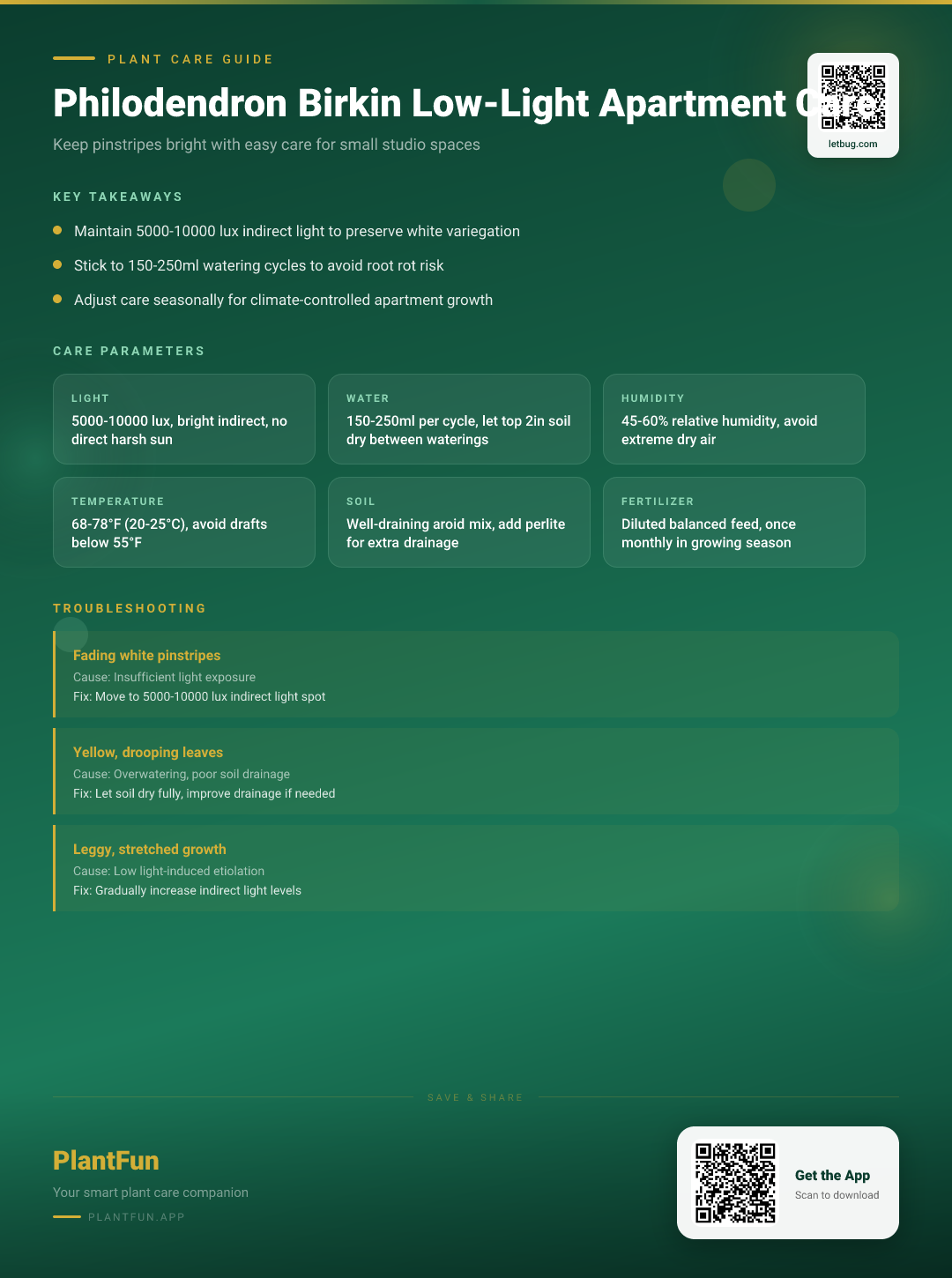
Key Takeaways
- Check soil moisture before watering — overwatering is the #1 killer of houseplants.
- Ensure your plant gets the right amount of light for its species.
- Be patient with recovery — most plants need 2–4 weeks to bounce back.
Quick Care Card
| Feature | Requirement |
|---|---|
| Light | 5,000–10,000 lux (bright, indirect) |
| Water | 150ml–250ml per cycle (top 2” dry) |
| Humidity | 45%–60% |
| Temperature | 68°F–78°F (20°C–25°C) |
| Soil | Chunky, well-draining aroid mix |
| Fertilizer | Balanced liquid (10-10-10) monthly |
| Toxicity | Toxic to cats and dogs (ASPCA, 2026) |
TL;DR: Why Your Birkin Needs Special Attention in Small Spaces
When I first started keeping a Philodendron Birkin in my studio apartment, I made the classic mistake of placing it in a “dim corner” for aesthetic reasons. Within weeks, the iconic cream-colored pinstripes vanished. To keep a Birkin happy in limited space, you must prioritize light intensity over proximity to a window. If your plant is reverting to solid green, it is starving for energy. Provide at least 5,000 lux of light and ensure your watering cycle matches the slower evaporation rate of a climate-controlled apartment.
Understanding the Birkin’s Variegation: Why Light is Your Most Important Variable
The Birkin is a naturally occurring mutation of the Philodendron ‘Rojo Congo’. Its signature pinstripes are unstable; they rely on photosynthesis to maintain their unique pigment distribution. According to NC State Extension (2026), these plants thrive in bright, indirect light. When light levels drop, the plant produces more chlorophyll to compensate, causing the cream streaks to be overtaken by deep green. Proper light exposure is essential for maintaining this aesthetic (Akramian et al., 2024).
The Low-Light Studio Reality: Assessing Your Apartment’s Actual Foot-Candles
In a studio apartment, “low light” is often a death sentence for variegated foliage. I suggest using a light meter app on your phone to measure the actual lux reaching your plant. If you are consistently under 3,000 lux, your Birkin will struggle. Move your plant to within three feet of an east-facing window or use a dedicated LED grow light to ensure the 5,000–10,000 lux threshold is met.
Step-by-Step Care Guide: From Substrate Selection to Precise Watering Intervals
- Substrate Selection: Use a mix of 50% peat-based potting soil, 25% perlite, and 25% orchid bark to ensure proper aeration (NC State Extension, 2026).
- Watering: In an apartment, air circulation is often lower. Only water when the top 2 inches of soil feel dry. Use 150ml–250ml of room-temperature water per session.
- Humidity Control: Group your plants to create a microclimate, or use a tray of pebbles and water to maintain 45–60% humidity.
- Placement: Keep the plant 2–3 feet from a bright window to avoid leaf scorch, which can happen if direct sun hits the delicate variegated sections.
- Maintenance: Regularly wipe leaves with a damp cloth to remove dust, which can block the light needed for variegation.
- Safety: Because this plant is toxic to pets, place it on a high shelf or plant stand out of reach (ASPCA, 2026).
Seasonal Adjustments: Managing Growth Rhythms in Climate-Controlled Apartments
Your apartment’s HVAC system significantly impacts plant health. During summer, the increased heat may require more frequent watering (every 7–10 days). In winter, when the heating is on, the air becomes arid; increase misting or humidity to prevent crispy leaf edges. Studies have shown that managing the growth environment is critical for the stability of plant tissue cultures in this species (Tasnim et al., 2025).
Troubleshooting Common Symptoms: Identifying Signs of Etiolation vs. Leaf Scorch
Lost Variegation (Turning Green)
Symptom: The white pinstripes are fading and the leaves are becoming solid dark green.
Likely cause: Insufficient light intensity (etiolation).
Fix:
- Move the plant closer to a natural light source.
- If space is limited, supplement with a full-spectrum LED grow light.
Brown, Crispy Leaf Edges
Symptom: The tips of the leaves are dry and turning brown.
Likely cause: Low humidity or inconsistent watering.
Fix:
- Use a humidifier near the plant to raise ambient moisture.
- Stick to a consistent watering schedule using the “finger-dry” test.
Yellowing Lower Leaves
Symptom: Older, bottom leaves turning yellow and mushy.
Likely cause: Overwatering or poor drainage.
Fix:
- Check the drainage holes to ensure they aren’t blocked.
- Allow the soil to dry out significantly before the next watering.
Voice Search FAQ
Why is my Philodendron Birkin losing its white stripes? It is likely receiving too little light, causing the plant to produce more chlorophyll to survive, which masks the variegation.
How often should I water my Philodendron Birkin in a small apartment? Do not follow a calendar. Instead, check the top 2 inches of soil. If it is dry, add 150ml–250ml of water. In low-light apartment conditions, this is usually every 10–14 days.
Can my Philodendron survive if it’s five feet away from the window? In most apartments, five feet is too far. Your plant will likely lose its variegation. Move it to within three feet or supplement with artificial lighting.
Common Mistakes to Avoid
-
Mistake: Using dense, heavy garden soil.
What happens: The roots suffocate and rot.
Instead: Use a well-draining aroid mix with orchid bark. -
Mistake: Over-fertilizing.
What happens: Salt buildup, which causes root burn.
Instead: Fertilize only during the growing season (spring/summer) at half-strength.
References
- Akramian, M.; Khaleghi, A.; Salehi Arjmand, H. (2024). Optimization of plant growth regulators for in vitro mass propagation of Philodendron cv. Birkin through shoot tip culture. Greenhouse Plant Production Journal. https://doi.org/10.61186/gppj.1.1.55. Accessed 2026-03-19.
- Tasnim, N.; Rahman, K.; Sarker, S. (2025). In vitro Mass Propagation of Philodendron cv. ‘Birkin’ through Direct and Indirect Organogenesis. Plant Tissue Culture and Biotechnology. https://doi.org/10.3329/ptcb.v35i1.82285. Accessed 2026-03-19.
- ASPCA. (2026). Toxic and Non-Toxic Plants List — ASPCA. https://www.aspca.org/pet-care/animal-poison-control/toxic-and-non-toxic-plants. Accessed 2026-03-19.
- NC State Extension. (2026). Philodendron Birkin — NC State Extension Gardener Plant Toolbox. https://plants.ces.ncsu.edu/plants/birkin-care/. Accessed 2026-03-19.
Optional Helper: Plantfun.App
Plantfun.App identifies your plants by photo, diagnoses pests and diseases with clear fixes, and creates personalised watering and light schedules that adapt to your home conditions — a handy companion for putting this guide into daily practice.
Found an error or have suggestions? We'd love your feedback.
Need help identifying this problem?
Get instant identification, personalized care schedules, and effective pest treatment plans directly on your phone.
Sponsored • We may earn a commission from app downloads
Related Guides
Philodendron Birkin Care in Low-Light Apartments: A Budget-Friendly Guide to Resilient Growth
Boost your Philodendron Birkin's growth without spending on expensive gear. Discover 4 expert-tested hacks for maintaining vibrant pinstripe leaves in any apartment.
Care GuidePhilodendron Birkin Care: A 7-Step Recovery Guide for Dimly Lit Apartment Living Rooms
Revive your fading Philodendron Birkin with expert light and moisture protocols. Get specific lux thresholds and recovery steps to restore vibrant pinstripes.
Care GuidePhilodendron Birkin in a Low-Light Apartment: The Only Care Guide You’ll Ever Need
Boost your Philodendron Birkin's variegation with 4 simple environmental adjustments. Learn the exact light, water, and humidity levels for thriving in apartments.
Pest ControlAnts on Plants: What They Mean and What to Do
Ants usually aren't eating your plant. They are farming other pests.