
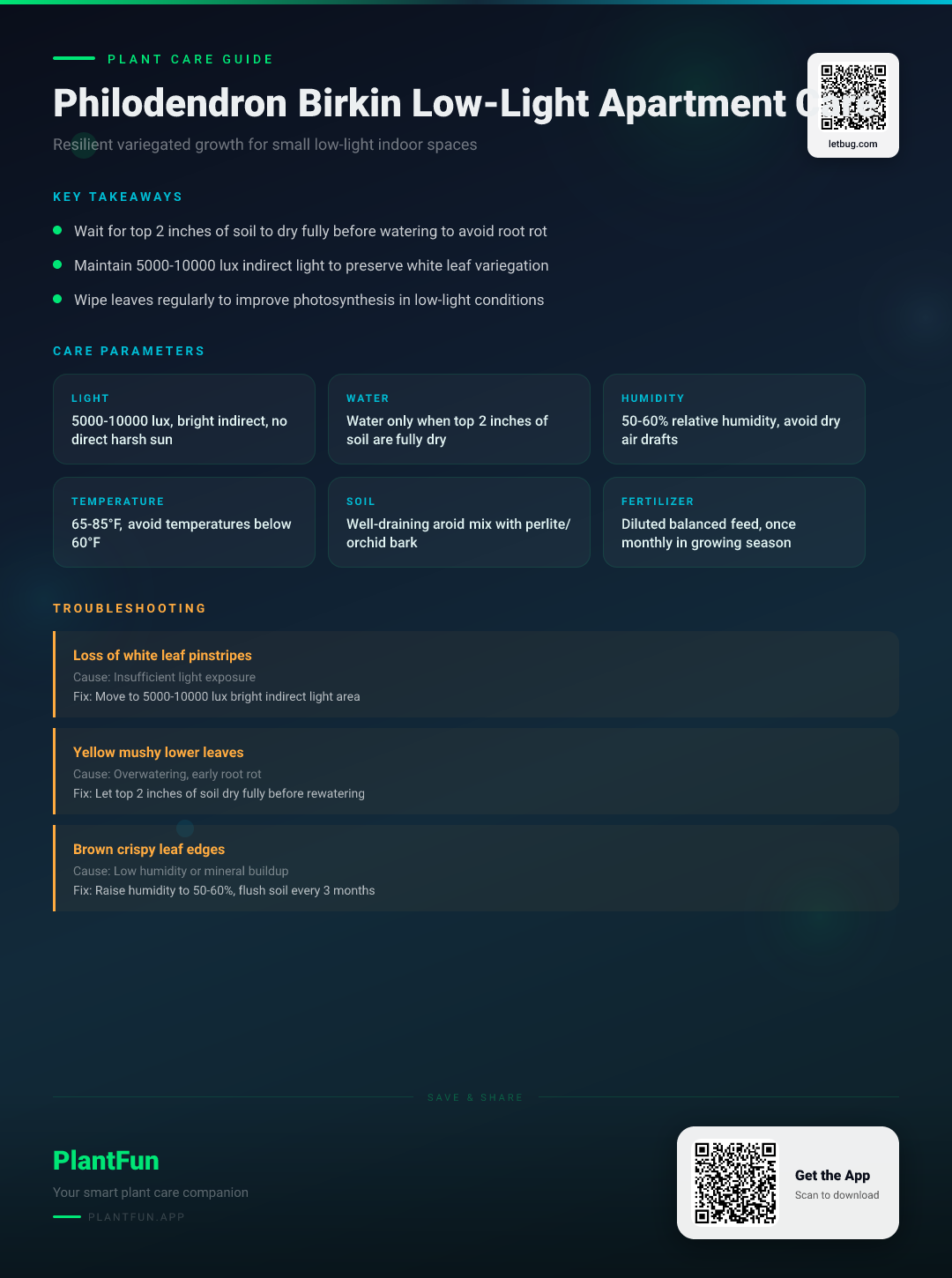
Key Takeaways
- Check soil moisture before watering — overwatering is the #1 killer of houseplants.
- Ensure your plant gets the right amount of light for its species.
- Be patient with recovery — most plants need 2–4 weeks to bounce back.
Quick Care Card: Essential thresholds for Philodendron Birkin vitality
| Category | Requirement |
|---|---|
| Light | Bright, indirect (5,000–10,000 lux) |
| Water | Dry top 2 inches before re-watering |
| Humidity | 50-60% relative humidity |
| Temperature | 65°F–80°F (18°C–27°C) |
| Soil | Chunky, well-draining aroid mix |
| Fertilizer | Balanced liquid feed, monthly in summer |
| Toxicity | Toxic to cats and dogs (ASPCA, 2026) |
TL;DR: The 30-second summary for busy apartment dwellers
To keep your Philodendron Birkin happy in a low-light apartment, prioritize consistent light and careful watering. Place it near an east-facing window to maintain those signature pinstripes. Always check that the top two inches of soil are dry before watering to prevent root rot. Maintain 50-60% humidity to encourage growth, and remember that this plant is toxic to pets (ASPCA, 2026).
Why Your Philodendron Birkin Needs Specialized Care in Low-Light Apartments
When I first got my Philodendron Birkin, I made the mistake of placing it in a dark corner far from any windows. Within weeks, the plant began to revert, losing its iconic white variegation as it desperately tried to maximize chlorophyll production in the shade. Unlike some hardier foliage plants, the Birkin is a compact cultivar that requires specific environmental inputs to maintain its genetic expression of pinstripes. Apartment living often presents challenges like stagnant air and inconsistent light, which we can counteract with strategic placement.
Understanding Light: Maintaining 5,000–10,000 lux without burning the variegation
The Philodendron Birkin thrives when it receives bright, indirect light. In my experience, anything below 3,000 lux will cause the plant to stretch (etiolate) and lose its signature white lines. You want to aim for the 5,000–10,000 lux range. If you are in a small apartment, placing the plant on a side table within three feet of an unobstructed window is usually ideal. Avoid harsh, direct afternoon sun, which can scorch the sensitive leaves.
Watering Mastery: Why the 2-inch top-soil rule prevents root rot in low light
Watering is the most frequent point of failure for indoor gardeners. Because low-light apartments result in slower evaporation rates, the soil stays wet longer. I always use the “finger test”: push your index finger two inches into the soil. If it feels damp, wait. If it is dry to the touch, it is time to water. This approach is essential for preventing root rot, a common issue in indoor environments (NC State Extension, 2026).
Humidity & Temperature: Keeping your plant in the 50-60% sweet spot for optimal growth
These plants are tropical by nature. While they tolerate standard home temperatures of 65°F–80°F, they suffer in the dry air common during winter heating. I find that grouping plants together creates a microclimate that boosts ambient humidity. If your apartment dips below 40% humidity, a small humidifier or a pebble tray can help keep the foliage crisp and vibrant.
The Seasonal Routine: Adjusting your moisture and light strategy from winter to summer
- Spring/Summer: This is the primary houseplant growth cycle. As light increases, growth accelerates. I increase my watering frequency and introduce a balanced liquid fertilizer diluted to half-strength.
- Autumn/Winter: As light levels drop, growth slows significantly. I reduce watering by about 30% and pause all fertilization. This prevents mineral salt buildup in the soil, which can harm the root system.
Common Mistakes to Avoid: From mineral buildup to over-fertilization
-
Mistake: Using dense, garden-variety soil.
What happens: The roots suffocate from lack of oxygen.
Instead: Use an airy, chunky soil mix containing bark, perlite, and coco coir. -
Mistake: Letting the plant sit in standing water.
What happens: Root rot occurs rapidly in low-light conditions.
Instead: Always empty your cachepot or saucer 15 minutes after watering.
FAQ: Why is my Philodendron Birkin losing its white pinstripes?
This is usually a light-related issue. If the plant is not receiving enough light, it compensates by producing more green chlorophyll, causing the white variegation to fade. Moving it slightly closer to a light source usually restores the pattern in new growth.
FAQ: Can I leave my Philodendron Birkin in a windowless hallway?
No. While the plant is resilient, it will not survive long-term in a windowless room. Photosynthesis requires light; without it, the plant will eventually exhaust its stored energy reserves.
FAQ: How often should I wipe the leaves to improve photosynthesis?
I recommend wiping the leaves with a damp, soft cloth once every two weeks. Dust blocks the stomata and reduces the surface area available for photosynthesis, which is critical when your plant is already competing for limited light in an apartment.
Expert Tips for Resilient Growth in Small Spaces
- Rotate Regularly: Turn your pot a quarter turn every time you water to ensure even growth on all sides.
- Pruning: If you notice a leaf turning completely green, you can prune it back to encourage the plant to focus energy on variegated sections, though this is purely aesthetic (Akramian et al., 2024).
- Propagation: If the plant gets too large for your apartment shelf, consider division, which is a common method for maintaining manageable sizes (Tasnim et al., 2025).
References
- Akramian, M.; Khaleghi, A.; Salehi Arjmand, H. (2024). Optimization of plant growth regulators for in vitro mass propagation of Philodendron cv. Birkin through shoot tip culture. Greenhouse Plant Production Journal. https://doi.org/10.61186/gppj.1.1.55. Accessed 2026-03-12.
- Tasnim, N.; Rahman, K.; Sarker, S. (2025). In vitro Mass Propagation of Philodendron cv. ‘Birkin’ through Direct and Indirect Organogenesis. Plant Tissue Culture and Biotechnology. https://doi.org/10.3329/ptcb.v35i1.82285. Accessed 2026-03-12.
- ASPCA. (2026). Toxic and Non-Toxic Plants List — ASPCA. https://www.aspca.org/pet-care/animal-poison-control/toxic-and-non-toxic-plants. Accessed 2026-03-12.
- NC State Extension. (2026). Philodendron Birkin — NC State Extension Gardener Plant Toolbox. https://plants.ces.ncsu.edu/plants/birkin-care/. Accessed 2026-03-12.
Optional Helper: Plantfun.App
Plantfun.App identifies your plants by photo, diagnoses pests and diseases with clear fixes, and creates personalised watering and light schedules that adapt to your home conditions — a handy companion for putting this guide into daily practice.
Found an error or have suggestions? We'd love your feedback.
Need help identifying this problem?
Get instant identification, personalized care schedules, and effective pest treatment plans directly on your phone.
Sponsored • We may earn a commission from app downloads
Related Guides
Philodendron Birkin in Small Urban Apartments: The Resilient Growth Care Checklist You’ll Ever Need
Grow a lush, variegated Philodendron Birkin even in a cramped city apartment. Get exact light, water, and humidity thresholds plus a 12-point checklist to avoid common stress and support year-round resilient growth.
Care GuideThe Complete Philodendron Birkin Care Checklist for Resilient Growth in Small Urban Apartments
Skip expensive plant gadgets with this actionable Philodendron Birkin care checklist. Get exact light, water, and soil specs to grow lush, pinstriped plants in any standard urban apartment.
Care GuideThe Complete Philodendron Birkin Care Checklist for Resilient Growth in Typical Apartments
Keep your Philodendron Birkin thriving in your apartment with our science-backed checklist. Get exact light, water, and humidity thresholds, plus 7 quick fixes for common leaf symptoms to support consistent resilient growth.
Pest ControlAnts on Plants: What They Mean and What to Do
Ants usually aren't eating your plant. They are farming other pests.