
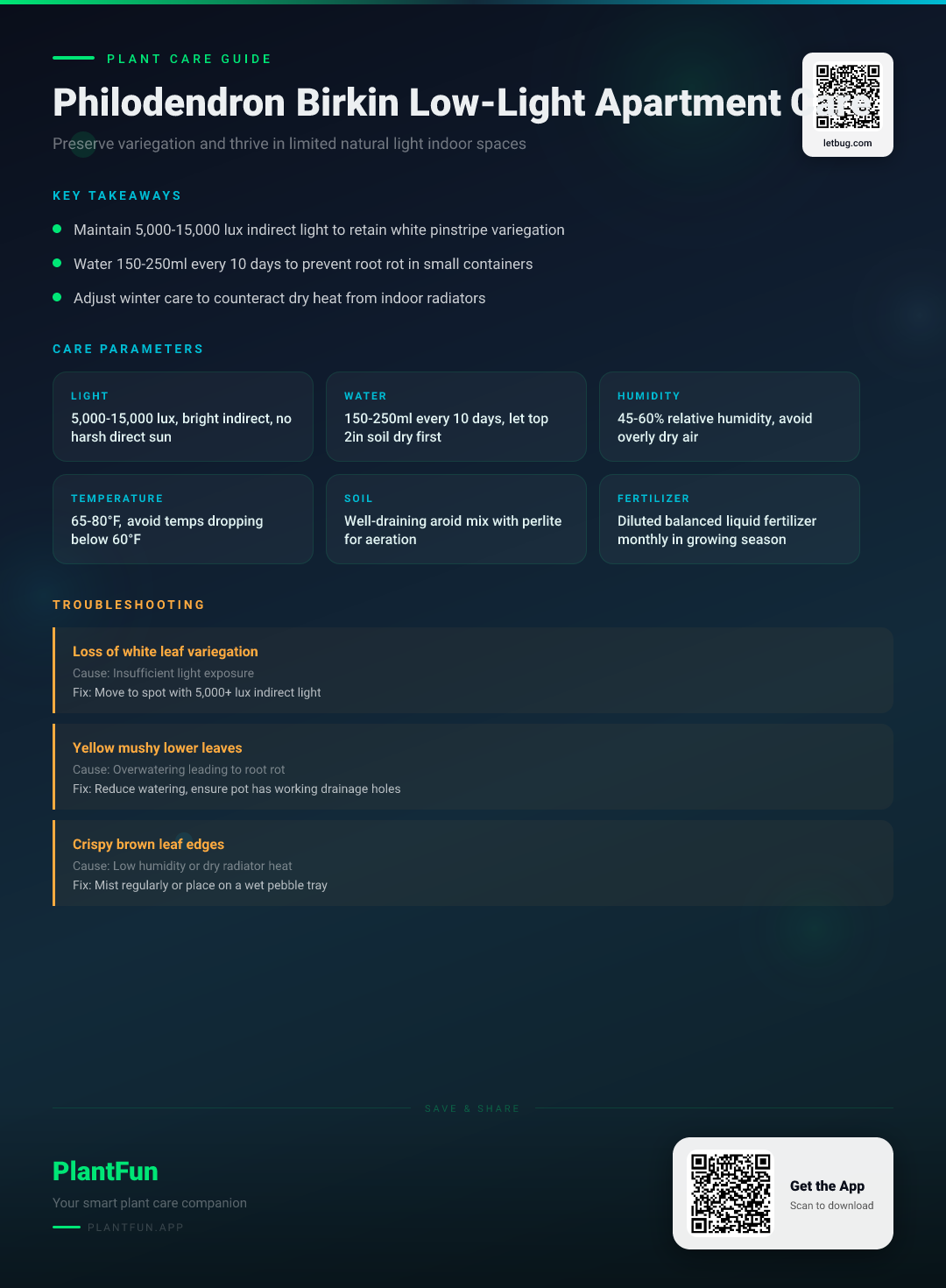
Key Takeaways
- Check soil moisture before watering — overwatering is the #1 killer of houseplants.
- Ensure your plant gets the right amount of light for its species.
- Be patient with recovery — most plants need 2–4 weeks to bounce back.
TL;DR: Why Your Birkin Needs a Micro-Climate Strategy
When I first brought home my Philodendron Birkin, I tucked it into a dark corner, thinking it would love the “low-light” tolerance I’d read about online. Within a month, the vibrant white pinstripes vanished, and it turned deep, solid green. A Philodendron Birkin in low light isn’t “thriving”—it’s surviving. To maintain those signature white stripes, you need to prioritize high-intensity indirect light and manage soil moisture with surgical precision. If your apartment lacks a sun-drenched balcony, you must rotate the plant to ensure even exposure and stabilize its surrounding micro-climate to prevent the variegation from reverting.
Quick Care Card: Essential Data
| Feature | Requirement |
|---|---|
| Light | 5,000–15,000 lux (Bright, indirect) |
| Humidity | 45–60% |
| Temp | 65–80°F |
| Water | 150–250ml per 10-day cycle |
| Soil | Well-draining aroid mix |
| Fertilizer | Balanced liquid 10-10-10 (monthly) |
| Toxicity | Toxic to pets (ASPCA, 2026) |
Understanding the Birkin’s Variegation Science: Why Light Dictates Pattern
The Philodendron Birkin is a unique mutation. Its ability to produce those crisp white lines relies on light-sensitive chlorophyll production. Research into in vitro propagation suggests that hormonal balances and light exposure are the primary drivers of shoot tip development (Akramian et al., 2024). When the plant is starved of light, it compensates by producing more chlorophyll to maximize energy, which physically masks the white variegation and turns the leaves dark green (NC State Extension, 2026). Without adequate light intensity, the plant simply lacks the energy to maintain the metabolic cost of variegation (Tasnim et al., 2025).
Step-by-Step: Mastering Light Levels in North-Facing Apartment Windows
In my experience, a north-facing window is rarely enough to keep a Birkin striking. Here is how I manage light in a small space:
- Placement: Move the plant within 2 feet of your brightest window.
- The Lux Test: If you don’t have a light meter, use a free phone app to ensure your plant is receiving at least 5,000 lux for 6–8 hours daily.
- Rotation: Rotate the pot 90 degrees every time you water to prevent the side furthest from the light from “stretching” or losing its pattern.
- Supplementing: If your apartment is consistently dim, a small full-spectrum LED clip-on lamp can provide the necessary intensity to stop the plant from turning solid green.
The Watering Equation: How to Prevent Root Rot in Small-Space Containers
One common mistake I see is the “calendar approach” to watering. The best soil for Philodendron Birkin is airy and fast-draining, typically consisting of potting mix, perlite, and bark.
- The Finger Test: Before adding 150-250ml of water, push your index finger 2 inches into the soil. If it’s damp, walk away.
- Drainage: Ensure your pot has physical drainage holes. My plants often live in ceramic cachepots, but I keep them in plastic nursery liners to ensure I can dump excess water that drains through.
Humidity Hacks: Keeping Pinstripes Crisp Without a Humidifier
I’ve found that while a Birkin doesn’t need a rainforest, it performs best at 45-60% humidity (NC State Extension, 2026).
- Group Therapy: Place your Birkin near other plants. They create a small zone of transpiration that slightly elevates localized humidity.
- The Pebble Tray: Fill a shallow tray with stones and water, then sit the pot on top. Just ensure the roots aren’t touching the water, or you risk root rot.
Seasonal Care Calendar: Adjusting for Apartment Radiator Heat
Winter in an apartment means dry, radiator-heated air. This is death to variegated foliage.
- November – March: Keep the Birkin away from heat vents. The dry heat causes browning tips. Increase your humidity efforts during these months.
- April – October: The plant will enter a growth phase. Increase your liquid fertilizer frequency slightly, but never exceed the recommended dosage, as over-fertilizing can lead to leaf burn.
Common Mistakes: Why You Are Over-Fertilizing Your Philodendron
- Mistake: Feeding every time you water.
- What happens: Fertilizer salts build up in the soil, burning the roots and causing yellowing tips.
- Instead: Fertilize only once a month during the growing season with a diluted 10-10-10 solution.
Voice FAQ
Why is my Philodendron Birkin losing its white stripes? It is likely experiencing a lack of light. The plant is essentially “overclocking” its chlorophyll production to compensate for dim conditions (NC State Extension, 2026).
How often should I actually water my Birkin in the winter? Do not stick to a schedule. Even in winter, check the soil moisture. My Birkins typically need less water when the ambient temperature is lower, often stretching the 10-day cycle to 14 days.
Can I keep my Philodendron Birkin on a bookshelf away from a window? Technically, the plant can survive there, but it will lose its variegation and become leggy. If you want to keep it on a shelf, add a grow light.
References and Botanical Sources
- Akramian, M., Khaleghi, A., & Salehi Arjmand, H. (2024). Optimization of plant growth regulators for in vitro mass propagation of Philodendron cv. Birkin through shoot tip culture. Greenhouse Plant Production Journal. https://doi.org/10.61186/gppj.1.1.55. Accessed 2026-03-10.
- Tasnim, N., Rahman, K., & Sarker, S. (2025). In vitro Mass Propagation of Philodendron cv. ‘Birkin’ through Direct and Indirect Organogenesis. Plant Tissue Culture and Biotechnology. https://doi.org/10.3329/ptcb.v35i1.82285. Accessed 2026-03-10.
- ASPCA. (2026). Toxic and Non-Toxic Plants List — ASPCA. https://www.aspca.org/pet-care/animal-poison-control/toxic-and-non-toxic-plants. Accessed 2026-03-10.
- NC State Extension. (2026). Philodendron Birkin — NC State Extension Gardener Plant Toolbox. https://plants.ces.ncsu.edu/plants/birkin-care/. Accessed 2026-03-10.
Optional Helper: Plantfun.App
Plantfun.App identifies your plants by photo, diagnoses pests and diseases with clear fixes, and creates personalised watering and light schedules that adapt to your home conditions — a handy companion for putting this guide into daily practice.
Found an error or have suggestions? We'd love your feedback.
Need help identifying this problem?
Get instant identification, personalized care schedules, and effective pest treatment plans directly on your phone.
Sponsored • We may earn a commission from app downloads
Related Guides
Philodendron Birkin Care in Your Apartment: The Ultimate Guide to Resilient, Variegated Growth
Transform your Philodendron Birkin into a lush, vibrant showpiece. Follow our 4-point care checklist to master the perfect light, water, and humidity balance.
Care GuidePhilodendron Birkin Care in Apartment Settings: A Data-Driven Guide for Resilient Growth
Boost your Philodendron Birkin's variegation with exact light and water metrics. Learn the 3-step recovery process for common apartment growing issues today.
Care GuideThe Complete Philodendron Birkin Care Checklist for Resilient Growth in Typical Apartments
Keep your Philodendron Birkin thriving in your apartment with our science-backed checklist. Get exact light, water, and humidity thresholds, plus 7 quick fixes for common leaf symptoms to support consistent resilient growth.
Pest ControlAnts on Plants: What They Mean and What to Do
Ants usually aren't eating your plant. They are farming other pests.