
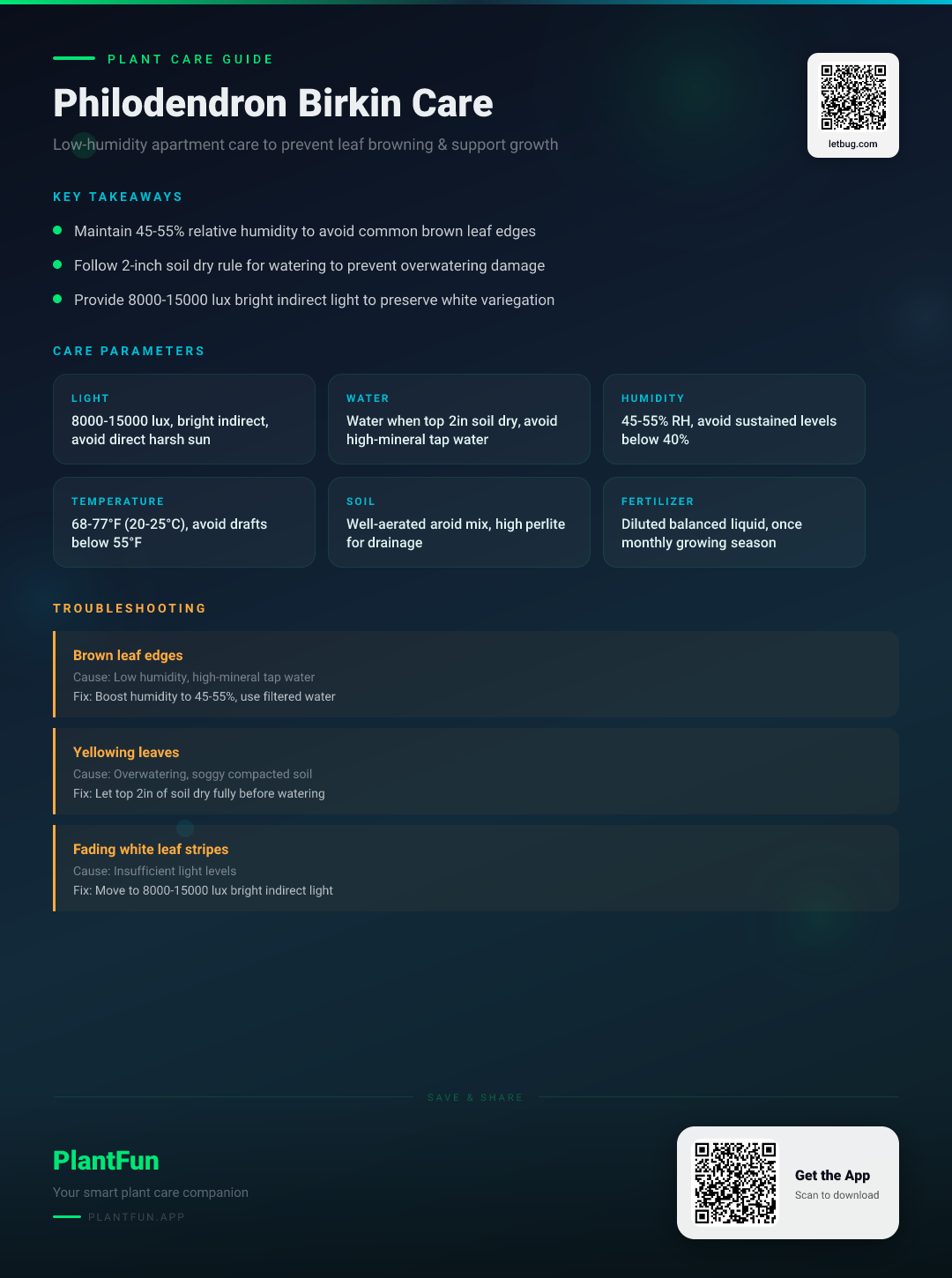
Key Takeaways
- Check soil moisture before watering — overwatering is the #1 killer of houseplants.
- Ensure your plant gets the right amount of light for its species.
- Be patient with recovery — most plants need 2–4 weeks to bounce back.
Quick Care Card: Essential thresholds for the Birkin
| Feature | Requirement |
|---|---|
| Light | 8,000–15,000 lux (Bright, indirect) |
| Watering | Allow top 2 inches of soil to dry |
| Humidity | 45–55% Relative Humidity (RH) |
| Temperature | 68–77°F (20–25°C) |
| Soil | Chunky, well-aerated aroid mix |
| Fertilizer | Balanced liquid feed, monthly (spring/summer) |
| Toxicity | Toxic to cats and dogs (ASPCA, 2026) |
TL;DR: Why your apartment humidity is the hidden enemy
Most apartment dwellers struggle with the Philodendron Birkin because modern HVAC systems strip air of its moisture, often dropping humidity below 30%. When the ambient humidity falls this low, the plant’s transpiration rate spikes, leading to crispy brown edges and fading variegation. To keep your Birkin thriving, prioritize stable humidity between 45–55% and ensure your light levels are consistent rather than intense.
Understanding the Birkin’s natural needs vs. apartment realities
When I first brought home my Philodendron Birkin, I placed it on a radiator-adjacent bookshelf. Within weeks, the lush green leaves were marring with unsightly brown tips. I realized then that my apartment environment—with its fluctuating heating and cooling cycles—was the primary antagonist. While this plant is a cultivar of the Philodendron erubescens, it lacks the same vigor as its parent species. According to NC State Extension (2026), these plants require consistent moisture without being waterlogged, a balance that is difficult to maintain in a dry, low-airflow apartment.
Light Requirements: Targeting 8,000-15,000 lux for stable variegation
Variegation in the Birkin is light-dependent. If your plant is placed in a dim corner, it will revert to plain, dark green. Conversely, direct sunlight will scorch those delicate white pinstripes. I use a simple light meter app to target 8,000 to 15,000 lux. If you don’t have a meter, visualize this: your plant should be able to “see” a wide expanse of sky, but never the sun itself.
Watering Mastery: Using the 2-inch rule and avoiding tap water minerals
Overwatering is the fastest route to root rot, especially in the low light of winter. I follow the “2-inch rule”: push your finger into the potting medium. If it feels dry up to your second knuckle, it is time to water. I also avoid hard tap water; the high chlorine and mineral content can cause salt buildup in the soil, which manifests as yellowing leaf spots. Using filtered or distilled water has significantly improved my plant’s health (NC State Extension, 2026).
Humidity & Temperature: Maintaining 45-55% RH and 68-77°F (20-25°C)
These plants are sensitive to the micro-climates of living rooms. Cold drafts from AC units or hot air from vents are detrimental. I keep mine in a room that stays between 68–77°F. If your humidity drops below 40%, placing the plant on a pebble tray or grouping it with other plants will help create a localized buffer of humidity.
Seasonal Care Calendar: Adjusting for low winter light and summer growth
- Spring/Summer: This is the primary growth phase. Increase watering frequency and apply a balanced houseplant fertilizer once a month.
- Autumn/Winter: As growth slows, reduce water. Ensure the plant is not sitting in a cold draft. If growth stops, cease fertilization until days lengthen (Akramian et al., 2024).
Step-by-Step: Troubleshooting brown leaf edges and yellowing spots
Brown Leaf Edges
Symptom: The tips of the leaves are dry, brittle, and brown.
Likely cause: Low humidity or inconsistent watering.
Fix:
- Increase ambient humidity using a room humidifier.
- Check the soil moisture; if it is bone dry, ensure a consistent watering schedule.
Yellowing Leaves
Symptom: Older leaves are turning yellow and drooping.
Likely cause: Overwatering leading to oxygen starvation in the roots.
Fix:
- Stop watering immediately and check the pot for drainage holes.
- Repot into a chunkier, better-draining soil mix.
Fading White Pinstripes
Symptom: The white patterns are disappearing and the leaves are becoming solid dark green.
Likely cause: Insufficient light.
Fix:
- Move the plant closer to an east-facing window.
- Increase light exposure by a few hours each day.
Myth-Busting: Why misting is not the solution for dry apartment air
I often see advice suggesting that misting leaves increases humidity. Botanically, this is a myth. Misting only provides temporary moisture to the leaf surface and can actually invite fungal pathogens like leaf spot disease if the water doesn’t evaporate quickly enough. Instead of misting, use a small room humidifier to maintain stable humidity levels for the entire plant.
FAQ
Can I keep my Philodendron Birkin in an air-conditioned bedroom? Yes, but keep it at least 5 feet away from the AC vent. The cold, dry air blast is a recipe for brown, crispy edges.
Why is my Philodendron Birkin losing its white stripes? It is likely receiving too little light. Move it to a brighter spot, but avoid direct sun to prevent leaf burn.
How do I know if I am overwatering my Philodendron Birkin? If the soil stays soggy for more than 4-5 days, or if you notice yellowing leaves near the base of the plant, you are likely overwatering. Always use the 2-inch finger test.
Advanced Tips: Substrate mixes for better drainage and aeration
I recommend a high-porosity mix: 40% high-quality potting soil, 30% perlite, and 30% orchid bark. This mix mimics the epiphytic nature of the Philodendron genus, allowing excess water to drain quickly while maintaining enough moisture for the roots. Propagation studies have shown that maintaining the right physiological conditions in the substrate is key to shoot development and overall plant vitality (Tasnim et al., 2025).
Optional Helper: Plantfun.App
Plantfun.App identifies your plants by photo, diagnoses pests and diseases with clear fixes, and creates personalised watering and light schedules that adapt to your home conditions — a handy companion for putting this guide into daily practice.
Summary: The resilient growth checklist
- Position 2-3 feet from a bright window.
- Use distilled water at room temperature.
- Maintain 45-55% humidity.
- Use a well-draining, chunky soil mix.
- Keep away from heating/cooling vents.
- Note: The ASPCA (2026) classifies this plant as toxic to pets if ingested.
References
- Akramian, M.; Khaleghi, A.; Salehi Arjmand, H. (2024). Optimization of plant growth regulators for in vitro mass propagation of Philodendron cv. Birkin through shoot tip culture. Greenhouse Plant Production Journal. https://doi.org/10.61186/gppj.1.1.55. Accessed 2026-03-15.
- Tasnim, N.; Rahman, K.; Sarker, S. (2025). In vitro Mass Propagation of Philodendron cv. ‘Birkin’ through Direct and Indirect Organogenesis. Plant Tissue Culture and Biotechnology. https://doi.org/10.3329/ptcb.v35i1.82285. Accessed 2026-03-15.
- ASPCA. (2026). Toxic and Non-Toxic Plants List — ASPCA. https://www.aspca.org/pet-care/animal-poison-control/toxic-and-non-toxic-plants. Accessed 2026-03-15.
- NC State Extension. (2026). Philodendron Birkin — NC State Extension Gardener Plant Toolbox. https://plants.ces.ncsu.edu/plants/birkin-care/. Accessed 2026-03-15.
Found an error or have suggestions? We'd love your feedback.
Need help identifying this problem?
Get instant identification, personalized care schedules, and effective pest treatment plans directly on your phone.
Sponsored • We may earn a commission from app downloads
Related Guides
Philodendron Birkin Care Checklist for Resilient Growth in Small Apartments on a Budget
Grow a lush, stripey Philodendron Birkin in your apartment without expensive gear. Get exact light levels, watering volumes, and a free budget checklist to prevent yellow leaves and boost growth.
Care GuideThe Complete Philodendron Birkin Care Checklist for Typical Apartments: Grow Resilient Striped Leaves
Grow a lush, vibrant Philodendron Birkin in your typical apartment with our science-backed checklist. Get exact light, water, and humidity thresholds to prevent yellow leaves and boost striped new growth.
Care GuidePhilodendron Birkin Care Checklist for Typical Apartments: Grow Lush, Striped Leaves Without Stress
Stop struggling to keep your Philodendron Birkin thriving in your apartment. Get 8 actionable care tips, exact light/humidity thresholds, and a free printable checklist for lush, striped growth.
Pest ControlAnts on Plants: What They Mean and What to Do
Ants usually aren't eating your plant. They are farming other pests.