
Key Takeaways
- Check soil moisture before watering — overwatering is the #1 killer of houseplants.
- Ensure your plant gets the right amount of light for its species.
- Be patient with recovery — most plants need 2–4 weeks to bounce back.
TL;DR: Success in Dry Spaces
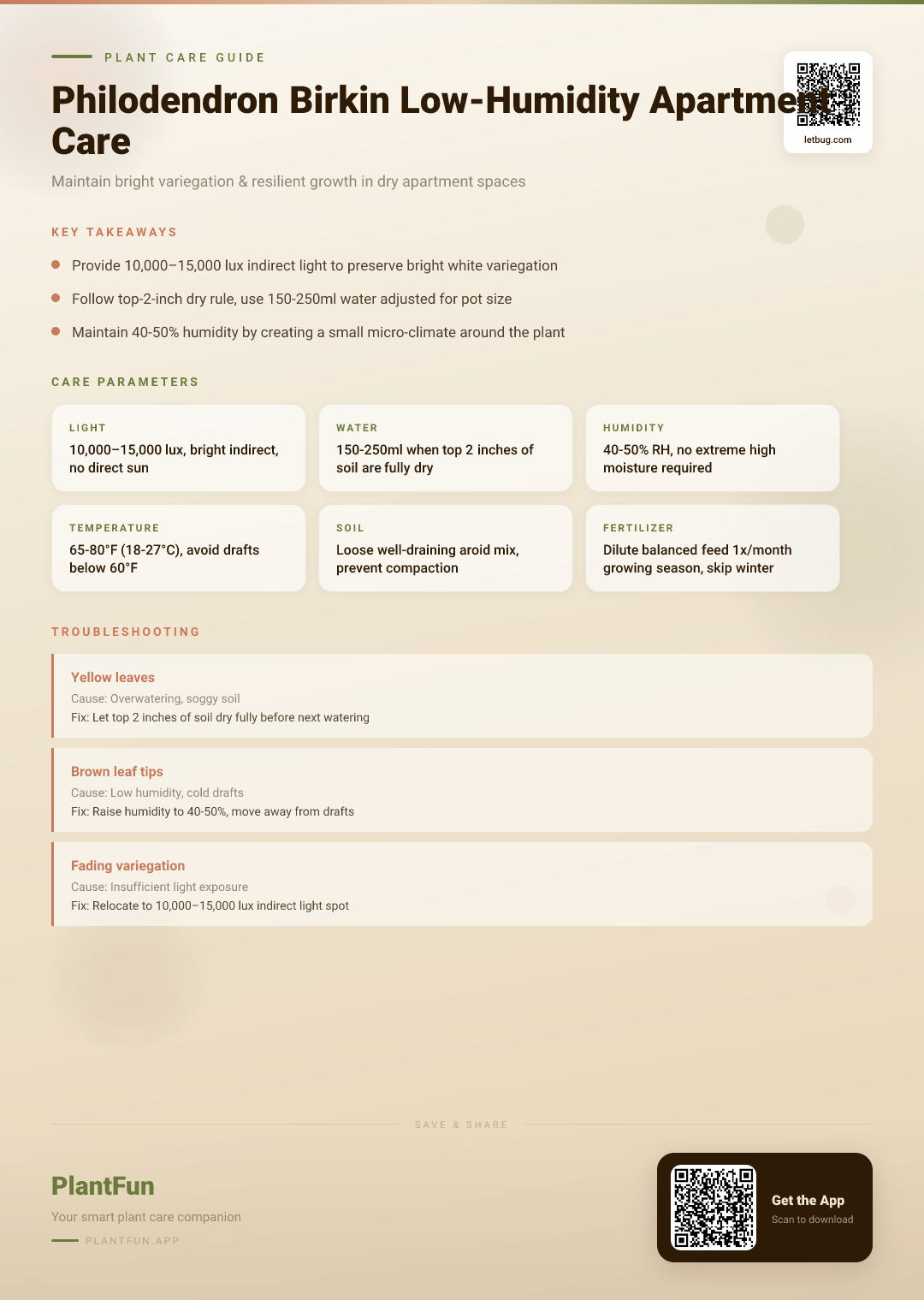
To keep your Philodendron Birkin thriving in an apartment, focus on bright, indirect light (10,000–15,000 lux) and consistent moisture. Avoid dry air by clustering plants or using a pebble tray to maintain humidity around 40–50%. If your plant begins to lose its signature pinstriped variegation, it is almost certainly a sign of insufficient light. Water only when the top two inches of soil are dry to prevent root rot, as improper moisture management is the primary cause of yellowing leaves (NC State Extension, 2026).
Quick Care Card: Essential Thresholds for Success
| Feature | Threshold |
|---|---|
| Light | 10,000–15,000 lux (Bright, indirect) |
| Water | Top 2 inches dry (150–250ml) |
| Humidity | 40–50% (Ideal) |
| Temperature | 65–80°F (18–27°C) |
| Soil | Well-draining, airy mix |
| Fertilizer | Balanced liquid (diluted) in spring/summer |
| Toxicity | Toxic to cats and dogs (ASPCA, 2026) |
Understanding Your Birkin: Why Low Humidity Stresses This Tropical Hybrid
When I first brought my Philodendron Birkin home, I placed it directly on a radiator cover—a rookie mistake. Within a week, the leaf edges turned crispy. This plant is a stable mutation of Philodendron ‘Rojo Congo’, and its physiological needs reflect its tropical lineage. In low-humidity apartments, the transpiration rate increases, meaning the plant loses water through its leaves faster than its roots can supply it (Akramian et al., 2024). This stress often manifests as the plant “reverting” or losing its iconic white variegation as it prioritizes chlorophyll production to compensate for metabolic stress.
Step 1: Calibrating Light (10,000–15,000 lux) for Stable Variegation
Variegation in Philodendron ‘Birkin’ is light-dependent. If your plant is turning dark green, it is hunting for more energy. Aim for 10,000–15,000 lux. If you don’t have a light meter, imagine placing the plant where it can ‘see’ the sky, but the sun never hits the leaves directly. A spot 2–3 feet from a south-facing window is usually ideal.
Step 2: The ‘Top-Two-Inch’ Watering Rule (150–250ml depending on pot size)
Overwatering is the fastest way to kill a Birkin. Use the “finger test”: push your index finger into the soil up to the second knuckle. If the soil is still damp, wait. When you do water, apply 150–250ml, ensuring it drains freely from the bottom. Never let your Birkin sit in a saucer of standing water, as this encourages root rot.
Step 3: Creating a Micro-Climate: Humidity Solutions for 40-50% Ranges
In a standard apartment, humidity often drops below 30% during winter. To mimic the humidity levels required for optimal tissue health, I cluster my Birkins with other foliage plants. This creates a localized micro-climate where water vapor from transpiration is trapped in the center of the plant group.
Step 4: Temperature Control: Keeping it between 65-80°F (18-27°C)
This plant prefers stable indoor temperatures. Avoid placing it near HVAC vents or drafty windows. Extreme temperature fluctuations can inhibit the direct organogenesis required for healthy, variegated growth (Tasnim et al., 2025).
Step 5: Seasonal Adjustments: How Winter Air Affects Your Philodendron
Winter is when your plant is most at risk. With heating systems active, air becomes arid. Increase your reliance on the pebble tray method: place a tray filled with pebbles and water beneath your pot (ensuring the pot doesn’t touch the water) to raise ambient humidity (NC State Extension, 2026).
Symptom-to-Action: Diagnosing Yellowing vs. Brown Leaf Tips
Yellowing Lower Leaves
Symptom: Leaves turn yellow and soft at the base.
Likely cause: Overwatering or poor drainage leading to root saturation.
Fix:
- Check soil moisture immediately; if soggy, repot into a chunky aroid mix.
- Reduce water volume by 25% for the next two cycles.
Brown, Crispy Leaf Tips
Symptom: Edges of leaves are brown, dry, and brittle.
Likely cause: Low ambient humidity or localized heat stress.
Fix:
- Move the plant away from radiators or air vents.
- Increase ambient humidity via grouping or a humidifier.
Voice Search FAQ: Why is my Philodendron Birkin losing its stripes?
This is typically a light issue. The white stripes are areas with less chlorophyll. If the plant feels it is not receiving enough light to survive, it will revert to green leaves to maximize photosynthesis (Akramian et al., 2024). Move it to a brighter spot.
Voice Search FAQ: How do I increase humidity for my plant in a small apartment?
Beyond grouping, you can place your plant in a bathroom that gets natural light (the shower steam is excellent) or use a small, dedicated humidifier nearby to keep levels steady at 40–50%.
Voice Search FAQ: Can I move my Birkin closer to a radiator during winter?
No. Radiators create hot, dry air that will desiccate the foliage rapidly. Always maintain at least a 5-foot distance from any direct heat source.
Common Mistakes: Avoiding Over-Fertilization and Soil Compaction
- Mistake: Using standard potting soil without amendments. What happens: Soil compacts, suffocating roots. Instead: Use an aroid mix containing bark, perlite, and coco coir for better aeration.
- Mistake: Heavy fertilization in winter. What happens: Nutrient burn and root stress. Instead: Only fertilize with a balanced liquid feed during the active growth phase (spring/summer).
References
- Akramian, M.; Khaleghi, A.; Salehi Arjmand, H. (2024). Optimization of plant growth regulators for in vitro mass propagation of Philodendron cv. Birkin through shoot tip culture. Greenhouse Plant Production Journal. https://doi.org/10.61186/gppj.1.1.55. Accessed 2026-03-19.
- Tasnim, N.; Rahman, K.; Sarker, S. (2025). In vitro Mass Propagation of Philodendron cv. ‘Birkin’ through Direct and Indirect Organogenesis. Plant Tissue Culture and Biotechnology. https://doi.org/10.3329/ptcb.v35i1.82285. Accessed 2026-03-19.
- ASPCA. (2026). Toxic and Non-Toxic Plants List — ASPCA. https://www.aspca.org/pet-care/animal-poison-control/toxic-and-non-toxic-plants. Accessed 2026-03-19.
- NC State Extension. (2026). Philodendron Birkin — NC State Extension Gardener Plant Toolbox. https://plants.ces.ncsu.edu/plants/birkin-care/. Accessed 2026-03-19.
Optional Helper: Plantfun.App
Plantfun.App identifies your plants by photo, diagnoses pests and diseases with clear fixes, and creates personalised watering and light schedules that adapt to your home conditions — a handy companion for putting this guide into daily practice.
Found an error or have suggestions? We'd love your feedback.
Need help identifying this problem?
Get instant identification, personalized care schedules, and effective pest treatment plans directly on your phone.
Sponsored • We may earn a commission from app downloads
Related Guides
Philodendron Birkin in a Low-Humidity Apartment: The Ultimate Care Guide to Preventing Leaf Browning
Revive your Philodendron Birkin with expert care steps. Learn to balance 40-50% humidity and specific light levels to stop leaf browning and encourage growth.
Care GuidePhilodendron Birkin Care Checklist for Resilient Growth in Small Apartments on a Budget
Grow a lush, stripey Philodendron Birkin in your apartment without expensive gear. Get exact light levels, watering volumes, and a free budget checklist to prevent yellow leaves and boost growth.
Care GuidePhilodendron Birkin Care in Your Apartment: The Ultimate Guide to Resilient, Variegated Growth
Transform your Philodendron Birkin into a lush, vibrant showpiece. Follow our 4-point care checklist to master the perfect light, water, and humidity balance.
Pest ControlAnts on Plants: What They Mean and What to Do
Ants usually aren't eating your plant. They are farming other pests.