
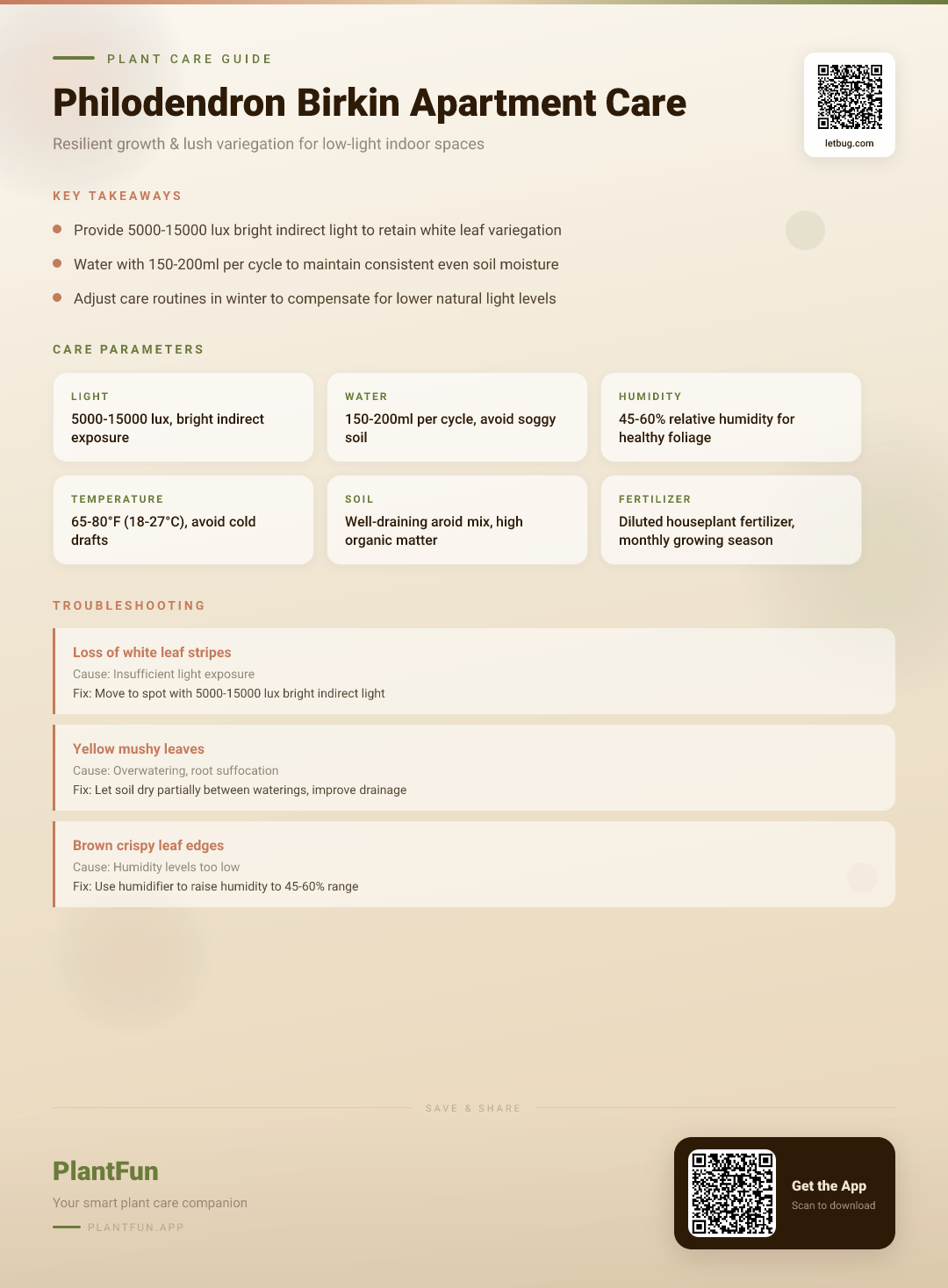
Key Takeaways
- Check soil moisture before watering — overwatering is the #1 killer of houseplants.
- Ensure your plant gets the right amount of light for its species.
- Be patient with recovery — most plants need 2–4 weeks to bounce back.
Quick Care Card: Essential Thresholds for Apartment Resiliency
| Feature | Requirement |
|---|---|
| Light | 5,000–15,000 Lux (Bright Indirect) |
| Water | Allow top 50% of soil to dry |
| Humidity | 45–60% constant |
| Temperature | 65–80°F (18–27°C) |
| Soil | Aroid mix: Bark, perlite, coco coir |
| Fertilizer | Balanced liquid feed (monthly) |
| Toxicity | Toxic to cats and dogs (ASPCA, 2026) |
TL;DR: Why Your Birkin Needs Specific Apartment Care
The Philodendron Birkin is prized for its pinstriped variegation, but in dim apartments, it often reverts to solid green. To maintain its signature look, it requires consistent bright indirect light—ideally 5,000 to 15,000 lux—and a highly aerated soil mix that prevents root suffocation in lower-light, lower-airflow environments (NC State Extension, 2026). If your plant is losing its stripes, it is likely signaling a lack of intensity in its light source.
My Experience: The “Reversion” Reality
When I first brought my Philodendron Birkin into my north-facing apartment, I made the mistake of tucking it into a dark corner. Within weeks, the beautiful white pinstripes began to disappear, and the leaves grew smaller. I realized that my apartment’s light wasn’t just “low”; it was insufficient to support the high metabolic cost of variegated tissue. By moving it to a spot just two feet from a window and switching to a chunky, free-draining soil mix, I restored the plant’s structural integrity and aesthetic charm.
Understanding Your Birkin’s Light Requirements: 5,000 to 15,000 Lux for Bright Indirect Exposure
In commercial greenhouses, plants are grown under optimal conditions, often supplemented by industrial lighting (Akramian et al., 2024). In an apartment, you must simulate this. If your light levels drop below 5,000 lux, the plant cannot photosynthesize effectively, leading to leggy growth. Using a light meter or a smartphone app, aim for the 5,000–15,000 lux range. Avoid direct afternoon sun, which can scorch the foliage.
The Watering Science: How to Measure 150-200ml for Consistent Soil Moisture
Overwatering is the primary cause of decline in indoor Philodendron. I recommend using a measured approach: 150-200ml of water is generally sufficient for a 6-inch pot, but always test the soil first. Stick your finger two inches deep; if it feels damp, wait. This prevents the anaerobic conditions that lead to root rot.
Optimizing Humidity: Maintaining 45-60% for Healthy Foliage Development
Modern apartments often suffer from low humidity, especially in winter. Because Philodendron Birkin develops through specific organogenesis processes, stable humidity is essential for leaf health (Tasnim et al., 2025). Aim for 45-60% humidity. If your air is drier, a small pebble tray or a humidifier nearby can provide the necessary microclimate.
Temperature Control: Keeping Your Space at 65-80°F (18-27°C) for Optimal Metabolism
Temperature fluctuations in apartments—often near drafty windows or heaters—can stress the plant. Consistent room temperatures between 65-80°F (18-27°C) ensure the plant’s metabolism remains steady, supporting steady leaf production (NC State Extension, 2026).
Step-by-Step Guide to Resilient Apartment Growth
- Check your soil: If the soil is dense, repot into a mix of 50% potting soil and 50% perlite/bark to ensure proper gas exchange at the roots.
- Measure the light: Use a light meter to ensure your placement reaches at least 5,000 lux.
- Water precisely: Use a calibrated container to provide 150-200ml, ensuring water drains freely from the bottom holes.
- Monitor foliage: Look for the signature stripes. If new leaves are solid green, move the plant closer to the light source.
- Clean the leaves: Use a damp cloth to remove dust every two weeks, which helps the plant absorb more light (NC State Extension, 2026).
The Seasonal Care Calendar: Adjusting for Winter Light Drops
In winter, natural light levels decrease significantly in most apartments. During this time, consider moving your plant to the brightest window available, or supplement with a dedicated grow light to keep the plant in its active growth phase.
Common Mistakes: Avoiding Root Suffocation and Variegation Loss
- Mistake: Using standard garden soil. What happens: Compaction leads to root rot. Instead: Use an airy, well-draining aroid mix.
- Mistake: Ignoring the “fingertip test.” What happens: Watering on a schedule regardless of moisture levels. Instead: Always check the top 2 inches of soil before adding more water.
Voice Search FAQ
Why is my Philodendron Birkin losing its white stripes?
This is typically a sign of insufficient light. The plant is trying to maximize chlorophyll production to compensate for low light, effectively “reverting” to solid green.
How do I know if my Philodendron Birkin is getting enough light in my living room?
If the plant is stretching (stems getting longer between leaves) or losing its variegation, it is not receiving enough light. It should be positioned where it can “see” the sky.
Can I use a regular houseplant fertilizer for my Birkin?
Yes, a balanced, water-soluble fertilizer applied at half-strength during the growing season is excellent for supporting consistent growth (Akramian et al., 2024).
References
- Akramian, M., Khaleghi, A., Salehi Arjmand, H. (2024). Optimization of plant growth regulators for in vitro mass propagation of Philodendron cv. Birkin through shoot tip culture. Greenhouse Plant Production Journal. https://doi.org/10.61186/gppj.1.1.55. Accessed 2026-03-13.
- Tasnim, N., Rahman, K., Sarker, S. (2025). In vitro Mass Propagation of Philodendron cv. ‘Birkin’ through Direct and Indirect Organogenesis. Plant Tissue Culture and Biotechnology. https://doi.org/10.3329/ptcb.v35i1.82285. Accessed 2026-03-13.
- ASPCA. (2026). Toxic and Non-Toxic Plants List — ASPCA. https://www.aspca.org/pet-care/animal-poison-control/toxic-and-non-toxic-plants. Accessed 2026-03-13.
- NC State Extension. (2026). Philodendron Birkin — NC State Extension Gardener Plant Toolbox. https://plants.ces.ncsu.edu/plants/birkin-care/. Accessed 2026-03-13.
Optional Helper: Plantfun.App
Plantfun.App identifies your plants by photo, diagnoses pests and diseases with clear fixes, and creates personalised watering and light schedules that adapt to your home conditions — a handy companion for putting this guide into daily practice.
Found an error or have suggestions? We'd love your feedback.
Need help identifying this problem?
Get instant identification, personalized care schedules, and effective pest treatment plans directly on your phone.
Sponsored • We may earn a commission from app downloads
Related Guides
Philodendron Birkin in a Low-Space Apartment: The Complete Care Guide for Resilient Growth
Master Philodendron Birkin care in tight spaces. Get exact light levels, watering schedules, and 3 expert tips to keep your pinstripes vibrant all year long.
Care GuidePhilodendron Birkin Care in Apartment Settings: A Data-Driven Guide for Resilient Growth
Boost your Philodendron Birkin's variegation with exact light and water metrics. Learn the 3-step recovery process for common apartment growing issues today.
Care GuideThe Complete Philodendron Birkin Care Checklist for Resilient Growth in Average Apartments
Grow a lush, striped Philodendron Birkin even in a standard apartment. Get exact light levels, watering amounts, and a seasonal care checklist to avoid yellow leaves and stunted growth.
Pest ControlAnts on Plants: What They Mean and What to Do
Ants usually aren't eating your plant. They are farming other pests.