
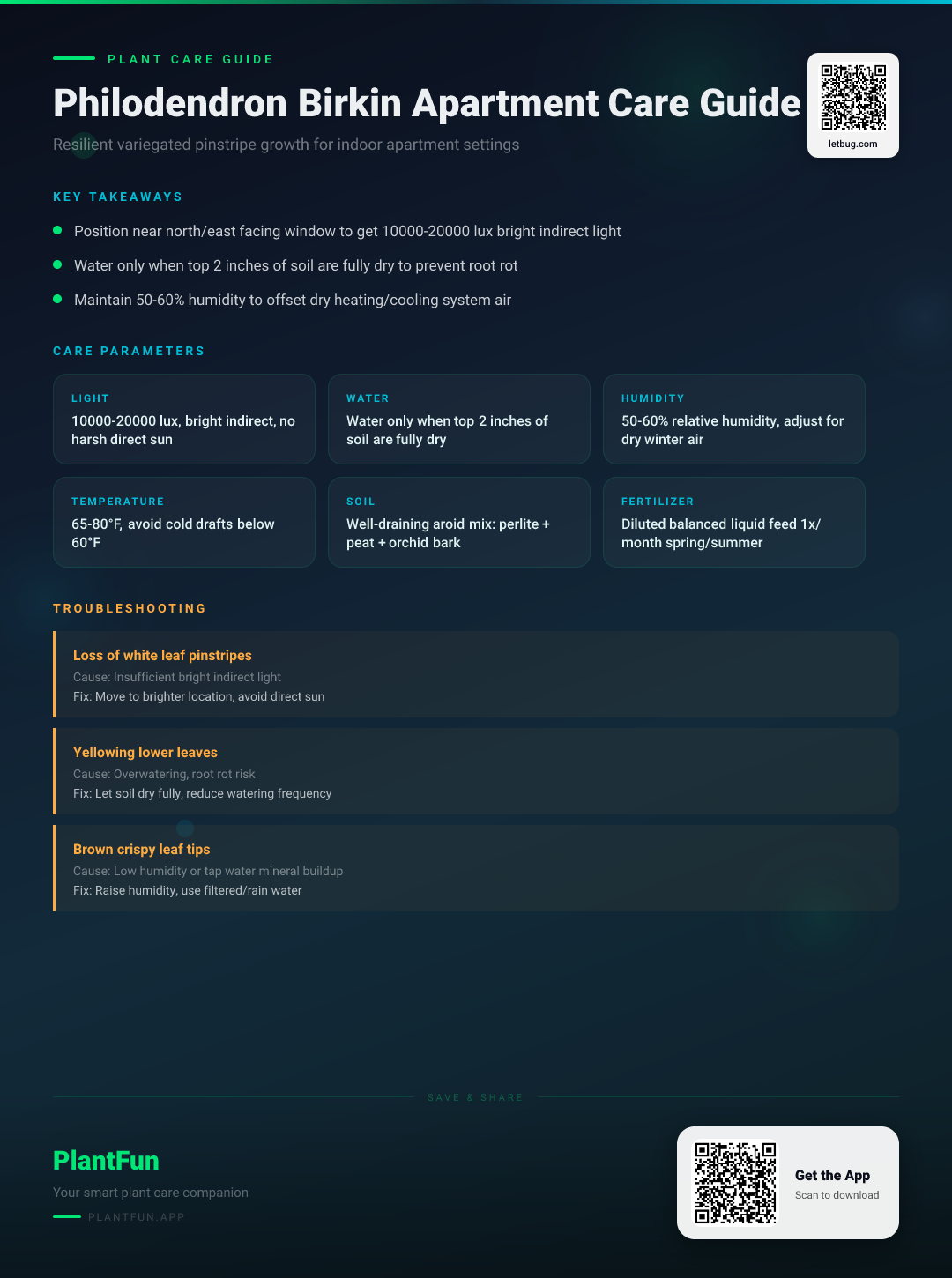
Key Takeaways
- Check soil moisture before watering — overwatering is the #1 killer of houseplants.
- Ensure your plant gets the right amount of light for its species.
- Be patient with recovery — most plants need 2–4 weeks to bounce back.
Quick Care Card: The Birkin Cheat Sheet
| Feature | Requirement |
|---|---|
| Light | 10,000–20,000 Lux (Bright, indirect) |
| Water | Allow top 2 inches of soil to dry out |
| Humidity | 50–60% (Use a pebble tray or humidifier) |
| Temperature | 65–80°F (18–27°C) |
| Soil | Well-draining aroid mix (Perlite/Peat/Bark) |
| Fertilizer | Balanced liquid feed during growing season |
| Toxicity | Toxic to cats and dogs (ASPCA, 2026) |
TL;DR: Why Your Birkin Needs Specific Apartment Care
The Philodendron ‘Birkin’ is a unstable mutation, meaning it requires consistent, high-quality indirect light to maintain its iconic white pinstripes. In an apartment setting, this translates to placing your plant within 3 feet of an east-facing window. Overwatering and low humidity are the primary killers of this species in urban homes. Keep the substrate airy, avoid direct afternoon sun, and maintain moderate humidity to prevent browning tips and color reversion.
Understanding the Birkin: Why Pinstripes Demand More Light
When I first brought home my Philodendron Birkin, I tucked it into a shadowy bookshelf—a classic rookie mistake. Within weeks, the vibrant white variegation began to fade, and the new leaves emerged almost entirely dark green.
This plant is a cultivar of Philodendron erubescens. The pinstripes are essentially a loss of chlorophyll in specific cell layers. Because those white stripes cannot photosynthesize, the plant must work harder to survive (Akramian, Khaleghi, & Salehi Arjmand, 2024). If your plant isn’t getting enough light, it will naturally revert to green leaves to increase its efficiency, essentially “dropping” the expensive-to-maintain variegation.
Section 1: Managing Light in North or East-Facing Apartments (The Lux Threshold)
In my experience, apartments often suffer from “light-trap” windows where the glass blocks UV. To hit that 10,000–20,000 lux requirement, I recommend a simple app-based light meter on your phone. If you are in a north-facing unit, you will likely need to keep the plant directly on the windowsill. If you have an east-facing window, pull it back 12 inches to avoid scorching the thin, variegated cells (NC State Extension, 2026).
Section 2: The Watering Rule (Preventing Root Rot in Containers)
How often to water Philodendron Birkin? There is no calendar date; there is only the “finger test.”
- Stick your index finger 2 inches into the potting medium.
- If it feels cool or damp, wait.
- If it is dry and loose, water thoroughly until the liquid drains out the bottom.
Avoid letting the pot sit in a saucer of water, as this creates the anaerobic conditions that trigger root rot—a common culprit when asking why is my Philodendron Birkin turning yellow (NC State Extension, 2026).
Section 3: Humidity and Your Heating/Cooling Cycle
Apartments are notorious for bone-dry air during winter due to HVAC systems. Because the Birkin has a relatively dense leaf structure, it is prone to curling if humidity drops below 40%. I keep mine next to a small humidifier set to 55%. If you don’t have space, a grouping of plants can create a microclimate that mimics their native tropical environment (Tasnim, Rahman, & Sarker, 2025).
Section 4: Soil Composition and Nutrient Timing
The best soil for Philodendron Birkin is a blend that mimics the forest floor. I mix 50% high-quality potting soil with 25% chunky perlite and 25% orchid bark. This ensures that when you do water, excess moisture escapes quickly, preventing the root suffocation that often leads to stunted growth (Akramian, Khaleghi, & Salehi Arjmand, 2024).
Troubleshooting Guide: Why are my Birkin leaves losing their white stripes?
[Leaf Reversion]
Symptom: New leaves are emerging solid green with no stripes.
Likely cause: Chronic light deprivation forcing the plant to prioritize chlorophyll production.
Fix:
- Move the plant to a brighter location (closer to an east or south window with a sheer curtain).
- Prune back the solid green stems to encourage the plant to push out new growth from a variegated node.
[Brown, Crispy Tips]
Symptom: The edges of the leaves are dry, brittle, and brown.
Likely cause: Low humidity or inconsistent watering schedules.
Fix:
- Increase ambient humidity to 50%+ using a humidifier.
- Implement a consistent watering cycle rather than waiting for the plant to wilt.
Voice Search FAQ: How do I know if my Philodendron Birkin is getting enough light?
If your plant is stretching (internodes getting longer) or the variegation is fading, it is starving for light. Healthy Birkins have tight, compact growth with clear, crisp pinstripes.
Voice Search FAQ: Can I use tap water for my Philodendron Birkin?
Yes, but be cautious. If your local water is high in chlorine or fluoride, let it sit out for 24 hours to dissipate. If your tips consistently brown despite good humidity, switch to filtered or distilled water.
Seasonal Care Calendar: Adjusting for Winter Air Dryness
- Spring/Summer: Increase feeding to every 4–6 weeks; the plant is in its active growth phase (Tasnim, Rahman, & Sarker, 2025).
- Autumn/Winter: Reduce water by 30% and stop fertilizing. Monitor for dry air from radiators; move the plant away from heat vents.
References
- Akramian, M.; Khaleghi, A.; Salehi Arjmand, H. (2024). Optimization of plant growth regulators for in vitro mass propagation of Philodendron cv. Birkin through shoot tip culture. Greenhouse Plant Production Journal. https://doi.org/10.61186/gppj.1.1.55. Accessed 2026-03-13.
- Tasnim, N.; Rahman, K.; Sarker, S. (2025). In vitro Mass Propagation of Philodendron cv. ‘Birkin’ through Direct and Indirect Organogenesis. Plant Tissue Culture and Biotechnology. https://doi.org/10.3329/ptcb.v35i1.82285. Accessed 2026-03-13.
- ASPCA. (2026). Toxic and Non-Toxic Plants List — ASPCA. https://www.aspca.org/pet-care/animal-poison-control/toxic-and-non-toxic-plants. Accessed 2026-03-13.
- NC State Extension. (2026). Philodendron Birkin Care — NC State Extension Gardener Plant Toolbox. https://plants.ces.ncsu.edu/plants/birkin-care/. Accessed 2026-03-13.
Optional Helper: Plantfun.App
Plantfun.App identifies your plants by photo, diagnoses pests and diseases with clear fixes, and creates personalised watering and light schedules that adapt to your home conditions — a handy companion for putting this guide into daily practice.
Found an error or have suggestions? We'd love your feedback.
Need help identifying this problem?
Get instant identification, personalized care schedules, and effective pest treatment plans directly on your phone.
Sponsored • We may earn a commission from app downloads
Related Guides
Philodendron Birkin in a Low-Light Apartment: The Only Care Guide You’ll Ever Need
Boost your Philodendron Birkin's variegation with 4 simple environmental adjustments. Learn the exact light, water, and humidity levels for thriving in apartments.
Care GuidePhilodendron Birkin in a Low-Space Apartment: The Complete Care Guide for Resilient Growth
Master Philodendron Birkin care in tight spaces. Get exact light levels, watering schedules, and 3 expert tips to keep your pinstripes vibrant all year long.
Care GuidePhilodendron Birkin in a Low-Humidity Apartment: The Ultimate Care Guide to Preventing Leaf Browning
Revive your Philodendron Birkin with expert care steps. Learn to balance 40-50% humidity and specific light levels to stop leaf browning and encourage growth.
Pest ControlAnts on Plants: What They Mean and What to Do
Ants usually aren't eating your plant. They are farming other pests.