
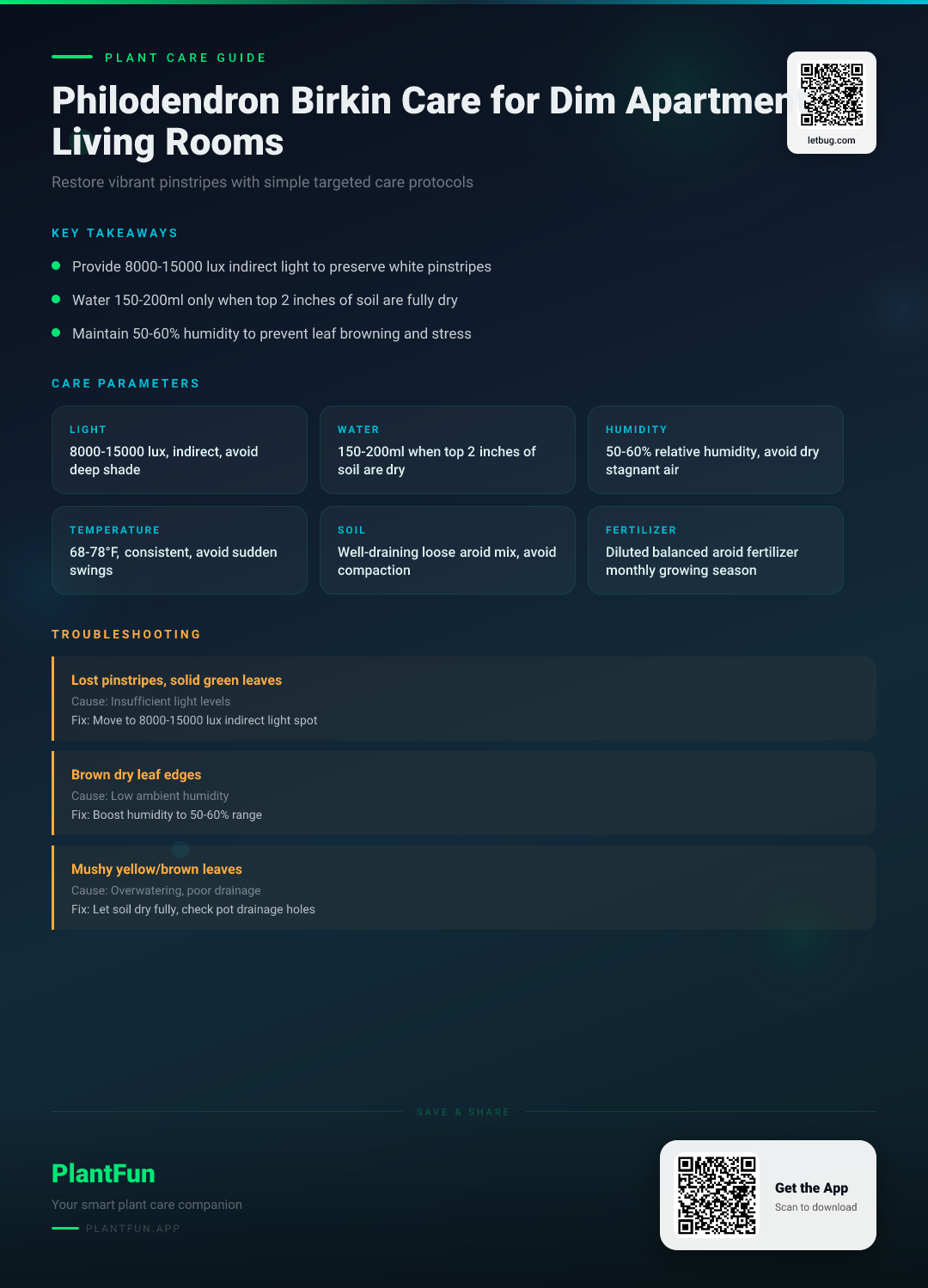
Key Takeaways
- Check soil moisture before watering — overwatering is the #1 killer of houseplants.
- Ensure your plant gets the right amount of light for its species.
- Be patient with recovery — most plants need 2–4 weeks to bounce back.
Quick Care Card: Essential Data
| Feature | Requirement |
|---|---|
| Light | 8,000–15,000 Lux (Bright, indirect) |
| Water | 150–200ml when top 2 inches dry |
| Humidity | 50–60% |
| Temperature | 68–78°F (20–25°C) |
| Soil | Well-draining aroid mix |
| Fertilizer | Balanced liquid feed, monthly (Spring/Summer) |
| Toxicity | Toxic to cats and dogs (ASPCA, 2026) |
TL;DR: The Birkin’s Apartment Reality Check
Your Philodendron Birkin isn’t a low-light plant; it is a variegation-dependent hybrid. If it loses its iconic white pinstripes, it is likely starving for light. To recover, move it within 3 feet of an east-facing window, standardize your watering to the “top 2 inches” rule, and maintain humidity above 50% to prevent edge browning. Consistency is the only cure.
My Experience: The “Deep Shade” Trap
When I first brought home my Birkin, I placed it on a bookshelf six feet away from a window. Within three months, the beautiful white stripes vanished, replaced by solid, uninspired dark green leaves. I realized I had fallen for the myth that all Philodendrons thrive in dim corners. The Birkin is a sport mutation, and its lack of chlorophyll in the pinstripes makes it less efficient at photosynthesis (Akramian et al., 2024). It needs more light than a standard Heartleaf Philodendron to keep that energy-demanding variegation alive.
Identifying Why Your Birkin is Losing Its Pinstripes
Variegation is unstable. When the plant senses it cannot produce enough energy, it “reverts” to solid green to maximize its photosynthetic capacity. If your plant is turning green, it is telling you, “I don’t have enough light to support this colorful display.” For advanced propagation techniques, researchers have noted that shoot tip health is the primary factor in maintaining these traits (Tasnim et al., 2025).
Step 1: Calibrating Your Living Room Light
Place your Birkin in the brightest spot of your apartment that avoids direct midday sun. Direct rays will scorch the leaves, but anything less than 8,000 lux will trigger reversion.
- The Hand Test: If you cannot cast a soft shadow on the wall behind your plant during the day, it is not getting enough light.
- Distance: Keep the plant within 3 feet of a window.
- Lux Monitoring: If you use a light meter app, aim for the 10,000-lux sweet spot.
Step 2: Precision Watering: Why ‘When Dry’ Beats a Weekly Calendar
Stop watering on a schedule. Apartment humidity and temperatures fluctuate.
- The Test: Stick your index finger 2 inches into the soil. If it feels moist, wait. If it feels dry, apply 150–200ml of room-temperature water.
- Drainage: Ensure your pot has drainage holes. A soggy root zone is the fastest route to rot (NC State Extension, 2026).
Step 3: Humidity Hacks for Stagnant Apartment Air
Most apartments hover around 30% humidity, which is too dry for the Birkin.
- Use a pebble tray or a humidifier to keep levels between 50-60%.
- Avoid placing the plant directly in front of heating vents.
Step 4: The Role of Fertilizer in Variegation Maintenance
Use a balanced 20-20-20 fertilizer at half-strength once a month during the growing season. Nitrogen drives growth, but excess can actually push the plant to produce more green chlorophyll, potentially masking your stripes. Stick to the scheduled amount to support cellular development without forcing unwanted foliage types (Akramian et al., 2024).
Troubleshooting: What to Do When Leaves Turn Brown or Mushy
[Root Rot]
Symptom: Yellowing leaves and soft, brown stems.
Likely cause: Overwatering or heavy, dense potting soil.
Fix:
- Remove the plant from its pot and trim away mushy, black roots.
- Repot into fresh, chunky aroid mix (bark, perlite, coco coir).
[Leaf Burn]
Symptom: Crispy, brown edges or bleached patches.
Likely cause: Direct afternoon sunlight.
Fix:
- Move the plant two feet away from the window.
- Use a sheer curtain to diffuse the light.
FAQ: Why is my Philodendron Birkin turning solid green?
It is a survival response. The plant is compensating for low light by producing more chlorophyll. Move it to a brighter location immediately.
FAQ: Can I keep my Philodendron Birkin in a room with no windows?
No. This plant requires natural or supplemental artificial light to photosynthesize. It will eventually decline in a windowless room.
FAQ: How do I know if I’m overwatering my Birkin?
Check the soil. If you notice a musty odor or the soil remains wet for more than 7 days, you are likely overwatering. Refer to the NC State Extension guidelines on proper drainage.
Seasonal Care Calendar
- Spring: Repot if rootbound; begin monthly feeding.
- Summer: Monitor for heat stress; increase water frequency as needed.
- Autumn: Reduce water; stop fertilizing as growth slows.
- Winter: Ensure the plant is away from cold drafts; keep away from heaters (NC State Extension, 2026).
Common Mistakes to Avoid
- Mistake: Using dense garden soil. What happens: Roots suffocate and rot. Instead: Use a mix of bark, perlite, and peat/coco coir.
- Mistake: Assuming all Philodendrons like low light. What happens: The Birkin reverts to green. Instead: Prioritize bright, indirect light.
References
- Akramian, M.; Khaleghi, A.; Salehi Arjmand, H. (2024). Optimization of plant growth regulators for in vitro mass propagation of Philodendron cv. Birkin through shoot tip culture. Greenhouse Plant Production Journal. https://doi.org/10.61186/gppj.1.1.55. Accessed 2026-03-16.
- Tasnim, N.; Rahman, K.; Sarker, S. (2025). In vitro Mass Propagation of Philodendron cv. ‘Birkin’ through Direct and Indirect Organogenesis. Plant Tissue Culture and Biotechnology. https://doi.org/10.3329/ptcb.v35i1.82285. Accessed 2026-03-16.
- ASPCA. (2026). Toxic and Non-Toxic Plants List — ASPCA. https://www.aspca.org/pet-care/animal-poison-control/toxic-and-non-toxic-plants. Accessed 2026-03-16.
- NC State Extension. (2026). Philodendron Birkin — NC State Extension Gardener Plant Toolbox. https://plants.ces.ncsu.edu/plants/birkin-care/. Accessed 2026-03-16.
Optional Helper: Plantfun.App
Plantfun.App identifies your plants by photo, diagnoses pests and diseases with clear fixes, and creates personalised watering and light schedules that adapt to your home conditions — a handy companion for putting this guide into daily practice.
Found an error or have suggestions? We'd love your feedback.
Need help identifying this problem?
Get instant identification, personalized care schedules, and effective pest treatment plans directly on your phone.
Sponsored • We may earn a commission from app downloads
Related Guides
Philodendron Birkin in a Low-Light Apartment: The Only Care Guide You’ll Ever Need
Boost your Philodendron Birkin's variegation with 4 simple environmental adjustments. Learn the exact light, water, and humidity levels for thriving in apartments.
Care GuidePhilodendron Birkin Care in Your Apartment: The Ultimate Guide to Resilient, Variegated Growth
Transform your Philodendron Birkin into a lush, vibrant showpiece. Follow our 4-point care checklist to master the perfect light, water, and humidity balance.
Care GuidePhilodendron Birkin Care in Low-Light Apartments: A Budget-Friendly Guide to Resilient Growth
Boost your Philodendron Birkin's growth without spending on expensive gear. Discover 4 expert-tested hacks for maintaining vibrant pinstripe leaves in any apartment.
Pest ControlAnts on Plants: What They Mean and What to Do
Ants usually aren't eating your plant. They are farming other pests.