
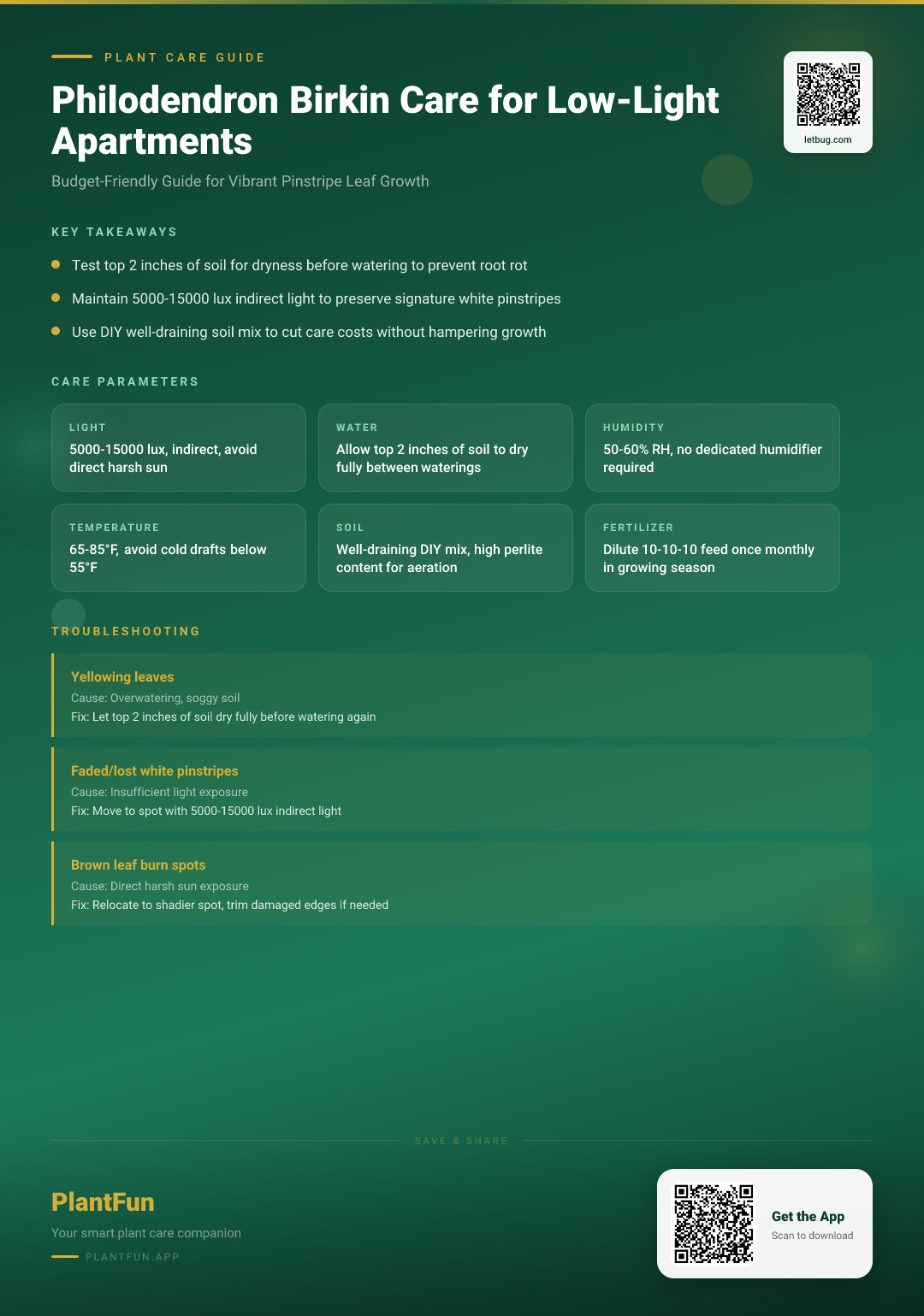
Key Takeaways
- Check soil moisture before watering — overwatering is the #1 killer of houseplants.
- Ensure your plant gets the right amount of light for its species.
- Be patient with recovery — most plants need 2–4 weeks to bounce back.
Quick Care Card: Essential Thresholds for the Apartment-Bound Birkin
| Feature | Requirement |
|---|---|
| Light | 5,000–15,000 Lux (Bright, indirect) |
| Water | 2-inch topsoil dry-down method |
| Humidity | 50–60% (Moderate) |
| Temperature | 65°F–80°F (18°C–27°C) |
| Soil | Well-draining chunky aroid mix |
| Fertilizer | Balanced liquid feed, monthly in summer |
| Toxicity | Toxic to cats and dogs (ASPCA, 2026) |
Understanding the Birkin: Why Your Apartment Needs a Strategic Setup
When I first brought my Philodendron ‘Birkin’ home to a dimly lit studio apartment, I made the mistake of placing it in a dark corner, thinking it would “adapt.” Within weeks, the vibrant white pinstripes began to disappear, replaced by dull, solid green foliage. I learned the hard way that this plant is a specific mutation, and it requires consistent environmental cues to maintain its aesthetic (NC State Extension, 2026). In my experience, success in an apartment isn’t about expensive grow lights—it’s about managing the energy flow through strategic placement and disciplined moisture control.
Format A: The Complete Scenario Guide - TL;DR
For apartment dwellers, the secret to a thriving Philodendron Birkin is balancing light intensity with consistent hydration. To keep the signature variegation, place your plant near an east-facing window to capture morning sun without heat stress. Water only when the top 2 inches of soil feel dry. Avoid constant soil saturation to prevent root rot, and keep temperatures stable. With these simple adjustments, your plant will maintain its striking pinstripes year-round without requiring high-tech equipment or complex fertilizer routines.
Measuring Your Light: Finding the 5,000–15,000 Lux Sweet Spot
In my experience, the most common error is underestimating how much light a Birkin truly needs. While many guides claim they are “low light” plants, they are actually “low-light tolerant,” meaning they survive but don’t thrive. To maintain that beautiful variegation, aim for 5,000–15,000 lux. You don’t need a professional meter; you can download a free light-meter app on your phone to check your window sill. If the lux is below 2,000, your Birkin will likely revert to green.
Watering Wisely: The 2-Inch Moisture Test for Busy Owners
Don’t water on a calendar schedule. I suggest the “Finger Test”: push your finger into the soil up to the second knuckle (about 2 inches). If it feels damp, wait. If it’s dry, it’s time to water. This prevents the primary cause of root degradation in indoor environments (NC State Extension, 2026).
Humidity & Temperature: Maintaining the 50-60% Range Without a Humidifier
Apartments are notorious for dry air, especially in winter. You don’t need a bulky humidifier. I keep my plants in a group to create a “micro-climate,” which naturally traps humidity. Keeping the ambient temperature between 65°F and 80°F ensures the metabolic processes in the plant remain steady (Akramian et al., 2024).
Soil Mix Hacks: Budget-Friendly DIY Media for Drainage
Stop buying expensive specialty bags. Create your own mix by combining 50% high-quality potting soil with 50% coarse perlite or orchid bark. This ensures that when you do water, excess moisture moves away from the roots quickly, preventing the dreaded root rot.
Seasonal Calendar: Adjusting Care from Winter Dormancy to Summer Growth
- Summer: Growth is active. Maintain soil moisture and apply a diluted balanced fertilizer once a month.
- Winter: Growth slows down. Reduce watering frequency; allow the soil to dry out an extra inch deeper than you would in summer.
Voice FAQ: Why is my Philodendron Birkin losing its white pinstripes?
This is usually a signal that the plant isn’t receiving enough light. Without sufficient photosynthesis, the plant prioritizes chlorophyll (green) over variegation (white) to survive. Move it to a brighter location gradually.
Voice FAQ: Can I really grow a Birkin in a windowless bathroom?
No. While they appreciate the humidity of a bathroom, they cannot survive without a natural light source. If you have no windows, you would need a dedicated horticultural lamp, which contradicts our budget-friendly focus.
Can I put my plant near a radiator?
Avoid direct heat sources at all costs. Radiators dry out the foliage, leading to brown, crispy leaf margins.
Common Mistakes: Avoiding Overwatering and Leaf Burn
- Mistake: Letting the plant sit in a saucer of water. What happens: Root rot. Instead: Always dump the drainage water 15 minutes after watering.
- Mistake: Putting it in harsh afternoon sun. What happens: Leaf burn. Instead: Use a sheer curtain to filter the light.
Troubleshooting: What to do when leaves turn yellow
Overwatering
Symptom: Lower leaves turn yellow and mushy.
Likely cause: The roots are suffocating due to stagnant moisture.
Fix:
- Check the drainage holes to ensure they aren’t blocked.
- Repot into a fresh, airy mix with high perlite content.
Nutrient Deficiency
Symptom: Older leaves turn yellow, but the plant remains firm.
Likely cause: The plant has depleted the soil nutrients.
Fix:
- Apply a balanced, water-soluble fertilizer at half-strength during the growing season.
References
- Akramian, M.; Khaleghi, A.; Salehi Arjmand, H. (2024). Optimization of plant growth regulators for in vitro mass propagation of Philodendron cv. Birkin through shoot tip culture. Greenhouse Plant Production Journal. https://doi.org/10.61186/gppj.1.1.55. Accessed 2026-03-15.
- Tasnim, N.; Rahman, K.; Sarker, S. (2025). In vitro Mass Propagation of Philodendron cv. ‘Birkin’ through Direct and Indirect Organogenesis. Plant Tissue Culture and Biotechnology. https://doi.org/10.3329/ptcb.v35i1.82285. Accessed 2026-03-15.
- ASPCA. (2026). Toxic and Non-Toxic Plants List — ASPCA. https://www.aspca.org/pet-care/animal-poison-control/toxic-and-non-toxic-plants. Accessed 2026-03-15.
- NC State Extension. (2026). Philodendron Birkin Care — NC State Extension Gardener Plant Toolbox. https://plants.ces.ncsu.edu/plants/birkin-care/. Accessed 2026-03-15.
Optional Helper: Plantfun.App
Plantfun.App identifies your plants by photo, diagnoses pests and diseases with clear fixes, and creates personalised watering and light schedules that adapt to your home conditions — a handy companion for putting this guide into daily practice.
Found an error or have suggestions? We'd love your feedback.
Need help identifying this problem?
Get instant identification, personalized care schedules, and effective pest treatment plans directly on your phone.
Sponsored • We may earn a commission from app downloads
Related Guides
Philodendron Birkin in a Low-Light Apartment: The Only Care Guide You’ll Ever Need
Boost your Philodendron Birkin's variegation with 4 simple environmental adjustments. Learn the exact light, water, and humidity levels for thriving in apartments.
Care GuidePhilodendron Birkin in a Low-Space Apartment: The Complete Care Guide for Resilient Growth
Master Philodendron Birkin care in tight spaces. Get exact light levels, watering schedules, and 3 expert tips to keep your pinstripes vibrant all year long.
Care GuidePhilodendron Birkin Care in a Low-Light Apartment: The Ultimate Budget-Friendly Resilient Growth Plan
Transform your Philodendron Birkin into a thriving apartment staple. Follow our budget-friendly 4-step care plan to optimize growth and maintain vibrant stripes.
Pest ControlAnts on Plants: What They Mean and What to Do
Ants usually aren't eating your plant. They are farming other pests.