
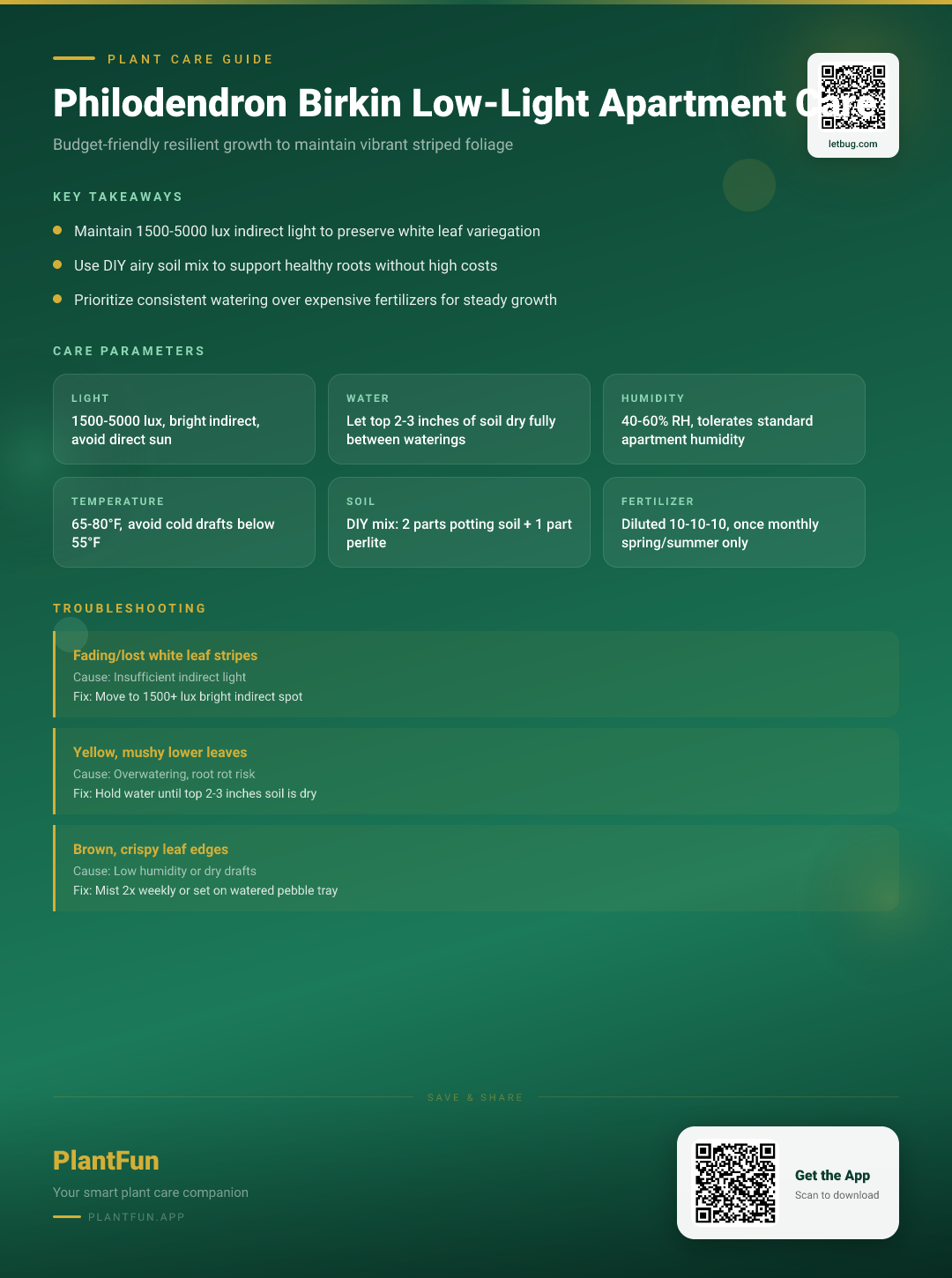
Key Takeaways
- Check soil moisture before watering — overwatering is the #1 killer of houseplants.
- Ensure your plant gets the right amount of light for its species.
- Be patient with recovery — most plants need 2–4 weeks to bounce back.
TL;DR: The Birkin Quick-Start
To keep your Philodendron Birkin thriving in a low-light apartment, prioritize bright, indirect light (1,500–5,000 lux) and let the top 2 inches of soil dry out completely between waterings. Use a chunky, aerated soil mix to prevent root rot—the number one killer of indoor Philodendrons. Keep temperatures steady between 65°F and 80°F. Avoid excessive fertilizer; simple, balanced plant food once a month in summer is plenty. Remember, this plant is toxic to pets, so keep it out of reach (ASPCA, 2026).
Quick Care Card: Essential Thresholds for Apartment Success
| Feature | Requirement |
|---|---|
| Light | Bright, indirect (1,500–5,000 lux) |
| Water | Allow top 2” of soil to dry out |
| Humidity | 40–60% (average apartment levels) |
| Temperature | 65°F–80°F (18°C–27°C) |
| Soil | Chunky, well-draining aroid mix |
| Fertilizer | Balanced liquid feed, monthly (summer) |
| Toxicity | Toxic to cats and dogs (ASPCA, 2026) |
Why the Philodendron Birkin is the Perfect Apartment Plant
When I first brought my Philodendron ‘Birkin’ home, I was captivated by its pinstriped variegation. Unlike many high-maintenance tropicals, the Birkin is a relatively slow-growing, compact cultivar that doesn’t need a sprawling greenhouse to be happy. It is an incredibly resilient houseplant that handles the fluctuating environments of urban living better than most. For those interested in the genetics behind these plants, scientists are working on advanced propagation methods to ensure consistency in these unique traits (Akramian et al., 2024).
Decoding Your Light: Managing 1,500–5,000 Lux in Typical Apartment Windows
In my experience, the ‘low light’ label is often misinterpreted. While these plants survive in dim corners, they thrive with 1,500–5,000 lux. If you don’t have a light meter, a simple test is to hold your hand 12 inches above the plant; if your hand casts a soft but visible shadow, the light is sufficient. Avoid direct sun, which burns the leaves. If your apartment faces north, keep the plant on the windowsill to maximize exposure.
The Budget Watering Strategy: Why Consistency Beats High-End Fertilizer
New gardeners often think expensive fertilizer is the secret to growth, but water management is the real key. I never stick to a rigid schedule; instead, I check the soil. Stick your finger 2 inches into the pot—if it feels damp, wait. If it’s dry, water thoroughly until the excess drains out. Consistent moisture prevents stress, which is vital for maintaining the plant’s health (NC State Extension, 2026).
Soil Science on a Shoestring: DIY Airy Mixes for Healthy Roots
You don’t need fancy, overpriced bagged mixes. I make my own budget-friendly blend: 50% indoor potting soil, 25% perlite (for drainage), and 25% orchid bark. This mimics the airy, epiphytic environment these plants prefer and prevents the root suffocation that often occurs in dense, peat-heavy soils.
Seasonal Care Calendar: Navigating Apartment Climate Changes
- Spring/Summer: Growth accelerates. This is the only time I apply a standard, affordable 10-10-10 liquid fertilizer at half strength.
- Autumn/Winter: Growth slows as light decreases. I stop fertilizing entirely and reduce watering frequency by roughly 30% to account for cooler, less evaporative conditions.
Common Mistakes: Stop These 3 Habits That Sabotage Variegation
- Mistake: Putting it in a dark corner. What happens: It loses its stripes and reverts to solid green to maximize chlorophyll production. Instead: Move it at least 3 feet closer to a window.
- Mistake: Using a pot without drainage. What happens: Root rot leading to yellow leaves. Instead: Always use a pot with drainage holes.
- Mistake: Over-fertilizing. What happens: Salt buildup, which burns delicate roots. Instead: Feed only during the growing season (NC State Extension, 2026).
FAQ: Why is my Philodendron Birkin losing its white stripes?
This is typically a light issue. If the plant isn’t getting enough light, it reverts to solid dark green to capture more energy. Move it to a brighter spot.
FAQ: Can I keep my Philodendron Birkin in a windowless bedroom?
No. While it is a resilient houseplant, it cannot survive without a natural light source. It will eventually yellow and decline without photosynthesis.
FAQ: How often should I actually water my plant?
There is no one-size-fits-all answer. Use the “two-inch finger test” every 7–10 days. If the soil is dry at that depth, it’s time to water.
Step-by-Step Recovery: What to do if your leaves turn yellow
- Check the soil moisture immediately. If it’s soggy, you have overwatered.
- Gently remove the plant from its pot to inspect the root system.
- If you find brown, mushy roots, trim them off with sterilized shears.
- Repot in fresh, dry, well-draining soil mix.
- Adjust your watering schedule to wait longer between cycles (Tasnim et al., 2025).
References
- Akramian, M., Khaleghi, A., & Salehi Arjmand, H. (2024). Optimization of plant growth regulators for in vitro mass propagation of Philodendron cv. Birkin through shoot tip culture. Greenhouse Plant Production Journal. https://doi.org/10.61186/gppj.1.1.55. Accessed 2026-03-15.
- Tasnim, N., Rahman, K., & Sarker, S. (2025). In vitro Mass Propagation of Philodendron cv. ‘Birkin’ through Direct and Indirect Organogenesis. Plant Tissue Culture and Biotechnology. https://doi.org/10.3329/ptcb.v35i1.82285. Accessed 2026-03-15.
- ASPCA. (2026). Toxic and Non-Toxic Plants List — ASPCA. https://www.aspca.org/pet-care/animal-poison-control/toxic-and-non-toxic-plants. Accessed 2026-03-15.
- NC State Extension. (2026). Philodendron Birkin Care — NC State Extension Gardener Plant Toolbox. https://plants.ces.ncsu.edu/plants/birkin-care/. Accessed 2026-03-15.
Optional Helper: Plantfun.App
Plantfun.App identifies your plants by photo, diagnoses pests and diseases with clear fixes, and creates personalised watering and light schedules that adapt to your home conditions — a handy companion for putting this guide into daily practice.
Found an error or have suggestions? We'd love your feedback.
Need help identifying this problem?
Get instant identification, personalized care schedules, and effective pest treatment plans directly on your phone.
Sponsored • We may earn a commission from app downloads
Related Guides
Philodendron Birkin in Low-Light Apartments: A Resilient Growth and Seasonal Care Guide
Transform your Philodendron Birkin into a thriving centerpiece. Follow our expert seasonal checklist, precise watering logs, and light-tuning tips for apartments.
Care GuidePhilodendron Birkin Care in Low-Light Apartments: A Budget-Friendly Guide to Resilient Growth
Boost your Philodendron Birkin's growth without spending on expensive gear. Discover 4 expert-tested hacks for maintaining vibrant pinstripe leaves in any apartment.
Care GuidePhilodendron Birkin in a Dim Apartment: The Complete Care Guide for Resilient Growth
Master Philodendron Birkin care in your apartment with this 5-step growth strategy. Get precise light lux, watering cycles, and humidity tips for lush leaves.
Pest ControlAnts on Plants: What They Mean and What to Do
Ants usually aren't eating your plant. They are farming other pests.