
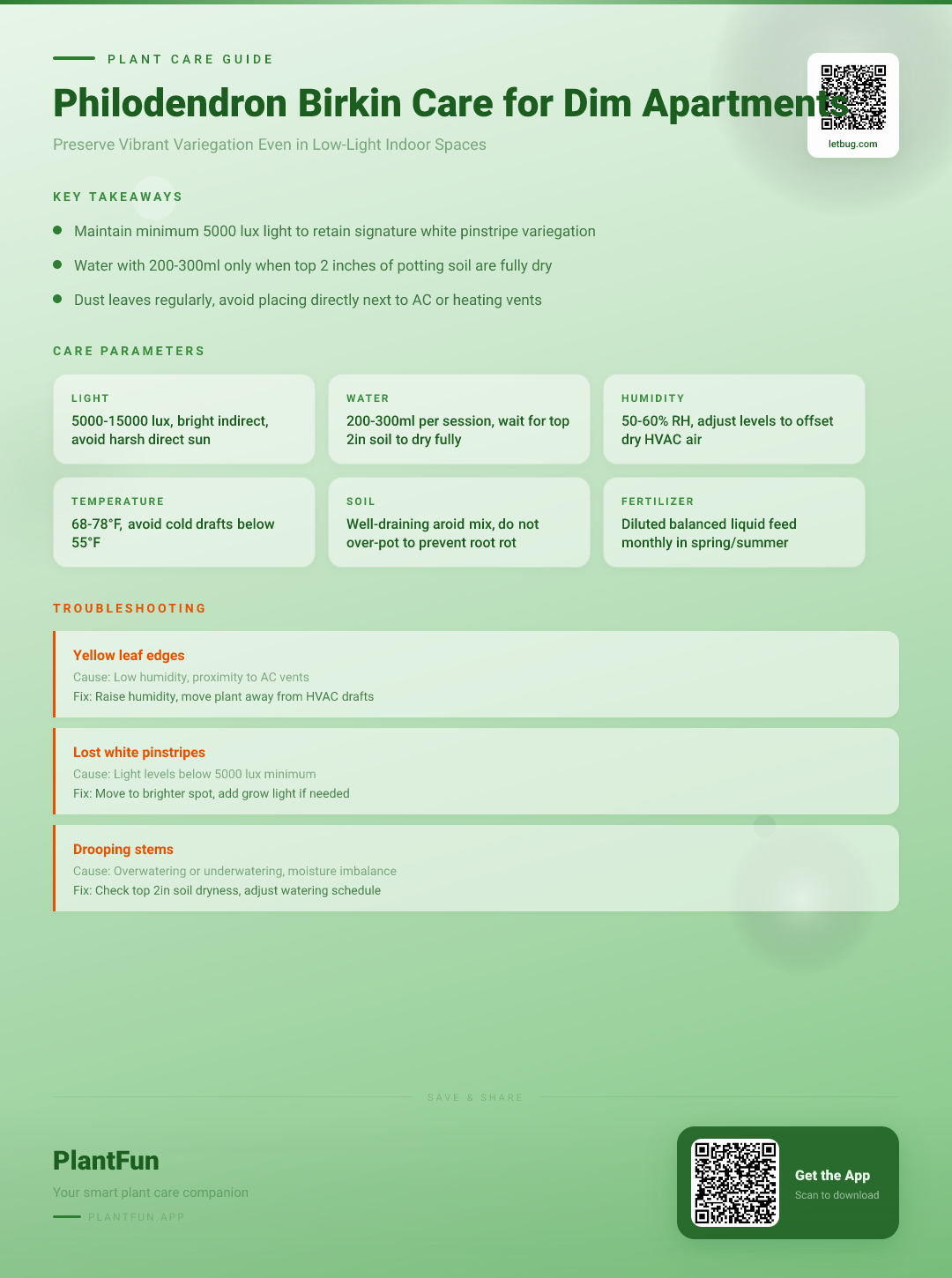
Key Takeaways
- Check soil moisture before watering — overwatering is the #1 killer of houseplants.
- Ensure your plant gets the right amount of light for its species.
- Be patient with recovery — most plants need 2–4 weeks to bounce back.
Quick Care Card: The Birkin Baseline
| Feature | Requirement |
|---|---|
| Light | 10,000–15,000 lux (bright, indirect) |
| Water | 2-inch top-soil dry down |
| Humidity | 50–60% relative humidity |
| Temperature | 68–78°F (20–25°C) |
| Soil | Chunky, well-draining aroid mix |
| Fertilizer | Balanced liquid feed, monthly (spring/summer) |
| Toxicity | Toxic to cats and dogs (ASPCA, 2026) |
TL;DR: The Apartment Reality
To keep your Philodendron Birkin thriving in an apartment, prioritize stable, bright indirect light near an east-facing window. Avoid over-watering by checking the soil depth before adding 200-300ml of water, and keep the plant away from drafty HVAC vents. When I first brought my Birkin into a small city apartment, I ignored the importance of leaf cleaning; dust accumulation on those beautiful pinstripes inhibits photosynthesis, leading to stunted growth. Keep it clean, keep it bright, and keep it consistent.
Why This Matters
The Philodendron ‘Birkin’ is a stable mutation of Philodendron ‘Rojo Congo’. Its signature white pinstriping is an unstable trait that relies on adequate light intensity to maintain its characteristic pattern (NC State Extension, 2026). In low-light apartment settings, the plant often reverts to a solid dark green to maximize chlorophyll production, sacrificing its ornamental appeal.
Section 1: Light & Lux Thresholds
Optimal growth requires at least 5,000 lux (approx. 500 foot-candles), though 10,000–15,000 lux produces the most vibrant pinstripes. I use a simple light meter app to confirm that my plant is receiving sufficient intensity. If you don’t have a meter, look for a spot where the plant would be able to “see” a wide expanse of the sky without direct sun hitting the leaves, which causes scorch.
Section 2: The Watering Dial
How often to water Philodendron Birkin depends on your apartment’s specific microclimate. Avoid a strict calendar. Instead, use the “finger test”: insert your index finger two inches into the soil. If it feels dry, apply 200–300ml of room-temperature water. A moisture meter can also act as a secondary check, but manual tactile testing remains the gold standard for avoiding root rot in enclosed pots.
Section 3: Temperature and Humidity Calibration
Indoor plants often suffer in dry, climate-controlled apartments. A consistent 68–78°F range is ideal (NC State Extension, 2026). During winter, when HVAC systems drop humidity below 30%, place your Birkin on a pebble tray or near a humidifier to keep ambient levels around 50%.
Section 4: Symptom-to-Action Troubleshooting
[Loss of Variegation]
Symptom: Leaves are becoming solid dark green with fading white stripes.
Likely cause: Insufficient light intensity (Akramian et al., 2024).
Fix:
- Move the plant two feet closer to your brightest window.
- Ensure no heavy curtains are obstructing light.
[Yellowing Edges]
Symptom: The margins of the leaves are turning yellow or brown.
Likely cause: Inconsistent watering or salt buildup in the soil.
Fix:
- Flush the soil with distilled water to remove mineral excess.
- Normalize your watering routine by checking soil moisture every 5 days.
[Drooping Stems]
Symptom: The entire plant looks tired and stems have lost their turgidity.
Likely cause: Dehydration or, paradoxically, root rot from over-watering.
Fix:
- Check the root ball for mushy, black roots; prune if necessary.
- If roots are healthy, provide a thorough soak and allow excess water to drain completely.
Section 5: Seasonal Care Calendar
- Spring/Summer: This is the fast-growth phase. Increase liquid fertilizer frequency and monitor for rapid soil drying.
- Fall/Winter: Growth slows as day length decreases. Reduce watering frequency by 30% and stop fertilizing entirely to prevent salt accumulation, as established in tissue culture research protocols (Tasnim et al., 2025).
FAQ
- Why is my Philodendron Birkin turning solid green? It is likely reaching for more light. As it struggles in dim conditions, it produces more chlorophyll to survive, overriding the pinstripe mutation.
- How do I know if my apartment is too dark for a Birkin? If you cannot read a book comfortably at the plant’s position during the day, it is likely too dark.
- Can I place my Birkin right next to an AC vent? No; dry, cold air currents will cause severe leaf tip browning and rapid dehydration.
Common Mistakes to Avoid
-
Mistake: Over-potting the plant.
What happens: The extra soil retains too much moisture, leading to root suffocation.
Instead: Keep your Birkin in a tight-fitting pot; it prefers to be slightly root-bound. -
Mistake: Neglecting leaf dust.
What happens: Dust blocks stomata, reducing the plant’s ability to breathe.
Instead: Gently wipe leaves with a damp cloth every two weeks.
References
- Akramian, M.; Khaleghi, A.; Salehi Arjmand, H. (2024). Optimization of plant growth regulators for in vitro mass propagation of Philodendron cv. Birkin through shoot tip culture. Greenhouse Plant Production Journal. https://doi.org/10.61186/gppj.1.1.55. Accessed 2026-03-19.
- Tasnim, N.; Rahman, K.; Sarker, S. (2025). In vitro Mass Propagation of Philodendron cv. ‘Birkin’ through Direct and Indirect Organogenesis. Plant Tissue Culture and Biotechnology. https://doi.org/10.3329/ptcb.v35i1.82285. Accessed 2026-03-19.
- ASPCA. (2026). Toxic and Non-Toxic Plants List — ASPCA. https://www.aspca.org/pet-care/animal-poison-control/toxic-and-non-toxic-plants. Accessed 2026-03-19.
- NC State Extension. (2026). Philodendron Birkin Care — NC State Extension Gardener Plant Toolbox. https://plants.ces.ncsu.edu/plants/birkin-care/. Accessed 2026-03-19.
Optional Helper: Plantfun.App
Plantfun.App identifies your plants by photo, diagnoses pests and diseases with clear fixes, and creates personalised watering and light schedules that adapt to your home conditions — a handy companion for putting this guide into daily practice.
Found an error or have suggestions? We'd love your feedback.
Need help identifying this problem?
Get instant identification, personalized care schedules, and effective pest treatment plans directly on your phone.
Sponsored • We may earn a commission from app downloads
Related Guides
Philodendron Birkin in a Low-Light Apartment: The Only Care Guide You’ll Ever Need
Boost your Philodendron Birkin's variegation with 4 simple environmental adjustments. Learn the exact light, water, and humidity levels for thriving in apartments.
Care GuidePhilodendron Birkin in Low-Light Apartments: A Resilient Growth and Seasonal Care Guide
Transform your Philodendron Birkin into a thriving centerpiece. Follow our expert seasonal checklist, precise watering logs, and light-tuning tips for apartments.
Care GuidePhilodendron Birkin in a Low-Light Apartment: The Complete Care Guide for Resilient Growth
Revive your Philodendron Birkin in a dark apartment. Use our precise lux thresholds and watering schedule to maintain white variegation and prevent yellowing.
Pest ControlAnts on Plants: What They Mean and What to Do
Ants usually aren't eating your plant. They are farming other pests.