
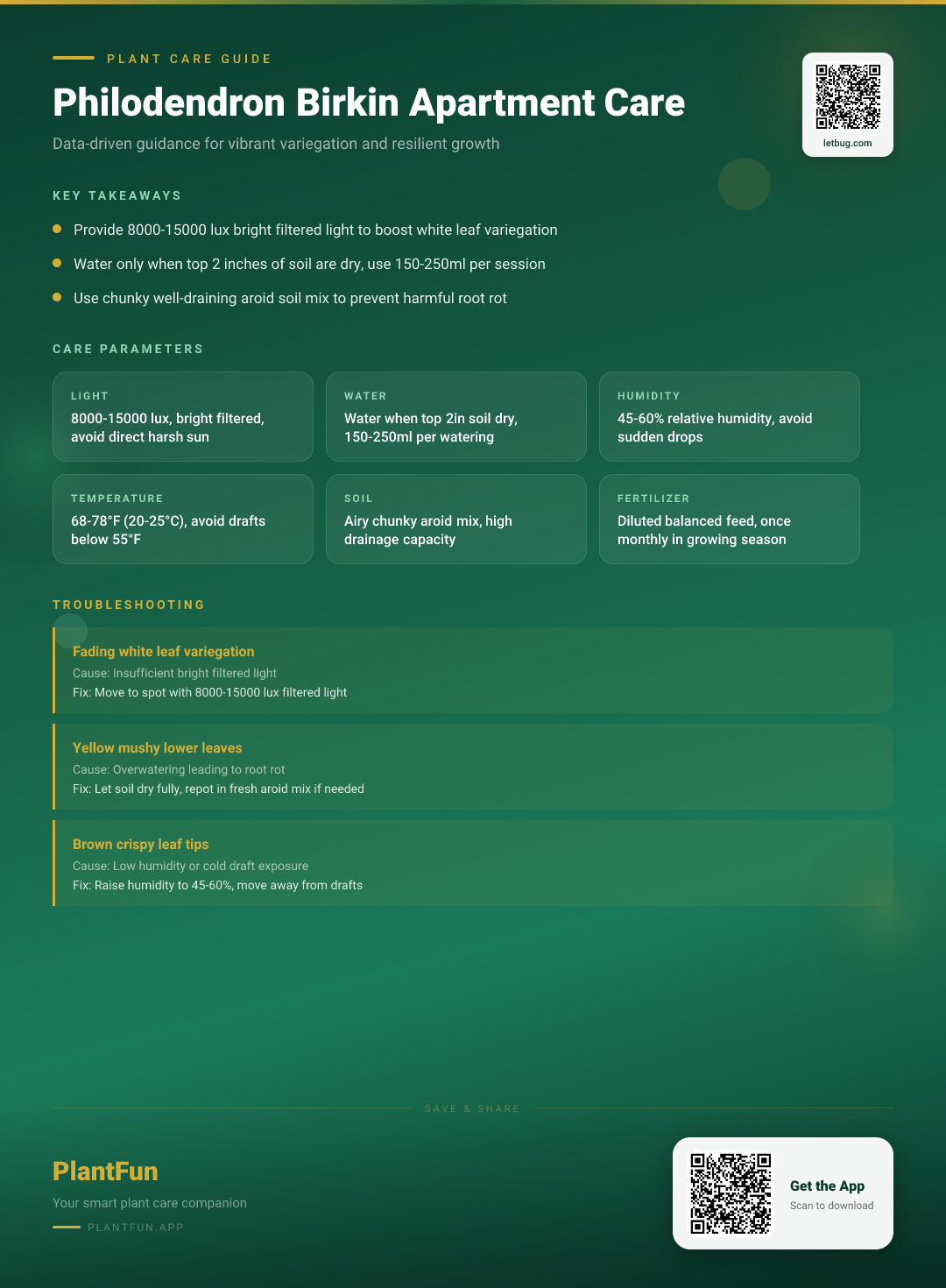
Key Takeaways
- Check soil moisture before watering — overwatering is the #1 killer of houseplants.
- Ensure your plant gets the right amount of light for its species.
- Be patient with recovery — most plants need 2–4 weeks to bounce back.
TL;DR: Essential Care for Your Birkin
To keep your Philodendron Birkin healthy, provide bright, indirect light (8,000–15,000 lux) and water only when the top 2 inches of soil are dry. Maintain humidity between 45–60% and room temperatures between 68–78°F. Use a chunky, well-draining aroid mix to prevent root suffocation. Always keep this plant out of reach of pets, as it is toxic (ASPCA, 2026).
Quick Care Card: Essential Metrics for the Birkin
| Feature | Requirement |
|---|---|
| Light | 8,000–15,000 lux (Bright, filtered) |
| Water | Top 2 inches dry; 150–250ml per watering |
| Humidity | 45–60% constant |
| Temperature | 68–78°F (20–25°C) |
| Soil | Airy, chunky aroid mix |
| Fertilizer | Balanced liquid feed, monthly in summer |
| Toxicity | Toxic to cats and dogs (ASPCA, 2026) |
Understanding Your Philodendron Birkin’s Apartment Reality
When I first bought my Philodendron Birkin, I treated it like a standard Pothos. I placed it in a dim corner and watered it whenever I remembered. Within a month, the beautiful pinstripe variegation faded, and the leaves began drooping. I learned the hard way that this cultivar—a spontaneous mutation of Philodendron ‘Rojo Congo’—requires specific environmental stability to maintain its aesthetic (NC State Extension, 2026). In an apartment, your biggest enemy isn’t lack of a green thumb; it’s the lack of consistency.
Format A: The Complete Scenario Guide - Why Consistency Matters
1. Lighting: 8,000–15,000 lux (bright, filtered light)
Philodendron Birkin light levels are the primary driver of variegation. If you notice your Philodendron Birkin losing variegation, it is almost certainly a reaction to insufficient light. While they can survive in lower light, they will revert to solid green to maximize chlorophyll production. Aim for a spot near an east-facing window where the plant receives soft, morning sun.
2. Hydration: Water when top 2 inches of soil dry (typically 150-250ml per watering)
Overwatering is the fastest path to root rot. My rule of thumb: insert your index finger two inches into the soil. If it feels moist, wait. When you do water, use roughly 150–250ml of room-temperature water. Ensure the pot has drainage holes—no plant survives in a cachepot without an outlet for excess moisture.
3. Climate Control: Maintain 45-60% humidity and 68-78°F (20-25°C) temperature
Apartments are notorious for fluctuating humidity, especially in winter. Using a hygrometer to track your local environment is a game-changer. If your levels drop below 40%, group your plants together or use a pebble tray to create a localized microclimate (NC State Extension, 2026).
4. Soil & Drainage: Utilizing an airy, chunky aroid mix for root health
Standard potting soil is often too dense. For my Birkins, I mix equal parts high-quality potting soil, orchid bark, and perlite. This creates the aeration necessary for oxygen to reach the roots, which is crucial for healthy shoot development (Akramian et al., 2024).
Seasonal Care Calendar: Adapting to Apartment Temperature Swings
- Spring/Summer: This is the growing season. If you want to know how to make your Philodendron Birkin grow faster, apply a balanced, water-soluble fertilizer once a month.
- Autumn/Winter: Growth slows significantly. Reduce watering frequency by 30-50% and cease fertilization. Monitor for drafts near windows or heating vents, as the Birkin is sensitive to extreme temperature shifts (Tasnim et al., 2025).
Common Mistakes: Avoiding Over-fertilization and Root Rot
- Mistake: Pouring water directly into the center of the crown. What happens: Water trapped in the crown leads to bacterial rot. Instead: Water directly onto the soil surface, avoiding the leaves.
- Mistake: Fertilizing during dormancy. What happens: Salt buildup occurs in the soil, potentially burning roots. Instead: Only fertilize when the plant shows new, active growth.
FAQ: Why is my Philodendron Birkin losing its white stripes?
This is typically a sign of light deficiency. The plant is essentially saying, “I need more energy, so I’m stopping the ‘fancy’ white stripes and focusing on green photosynthetic surfaces.” Move it closer to a bright window.
FAQ: Can I place my Philodendron Birkin near an apartment window?
Yes, but avoid direct midday sun, which can scorch the leaves. An east or north-facing window is ideal for filtering the light to the required 8,000–15,000 lux range (NC State Extension, 2026).
FAQ: How do I know if my Birkin needs more humidity?
If the leaf edges turn crispy or brown, and the newest leaf fails to unfurl correctly (stuck leaf), your environment is likely too dry. Aim for 45-60% humidity to keep the foliage supple (NC State Extension, 2026).
References
- Akramian, M.; Khaleghi, A.; Salehi Arjmand, H. (2024). Optimization of plant growth regulators for in vitro mass propagation of Philodendron cv. Birkin through shoot tip culture. Greenhouse Plant Production Journal. https://doi.org/10.61186/gppj.1.1.55. Accessed 2026-03-11.
- Tasnim, N.; Rahman, K.; Sarker, S. (2025). In vitro Mass Propagation of Philodendron cv. ‘Birkin’ through Direct and Indirect Organogenesis. Plant Tissue Culture and Biotechnology. https://doi.org/10.3329/ptcb.v35i1.82285. Accessed 2026-03-11.
- ASPCA. (2026). Toxic and Non-Toxic Plants List — ASPCA. https://www.aspca.org/pet-care/animal-poison-control/toxic-and-non-toxic-plants. Accessed 2026-03-11.
- NC State Extension. (2026). Philodendron Birkin Care — NC State Extension Gardener Plant Toolbox. https://plants.ces.ncsu.edu/plants/birkin-care/. Accessed 2026-03-11.
Optional Helper: Plantfun.App
Plantfun.App identifies your plants by photo, diagnoses pests and diseases with clear fixes, and creates personalised watering and light schedules that adapt to your home conditions — a handy companion for putting this guide into daily practice.
Found an error or have suggestions? We'd love your feedback.
Need help identifying this problem?
Get instant identification, personalized care schedules, and effective pest treatment plans directly on your phone.
Sponsored • We may earn a commission from app downloads
Related Guides
Philodendron Birkin in a Dim Apartment: The Complete Care Guide for Resilient Growth
Master Philodendron Birkin care in your apartment with this 5-step growth strategy. Get precise light lux, watering cycles, and humidity tips for lush leaves.
Care GuidePhilodendron Birkin in a Low-Light Apartment: The Only Care Guide You’ll Ever Need
Boost your Philodendron Birkin's variegation with 4 simple environmental adjustments. Learn the exact light, water, and humidity levels for thriving in apartments.
Care GuideThe Complete Philodendron Birkin Care Checklist for Resilient Growth in Average Apartments
Grow a lush, striped Philodendron Birkin even in a standard apartment. Get exact light levels, watering amounts, and a seasonal care checklist to avoid yellow leaves and stunted growth.
Pest ControlAnts on Plants: What They Mean and What to Do
Ants usually aren't eating your plant. They are farming other pests.