
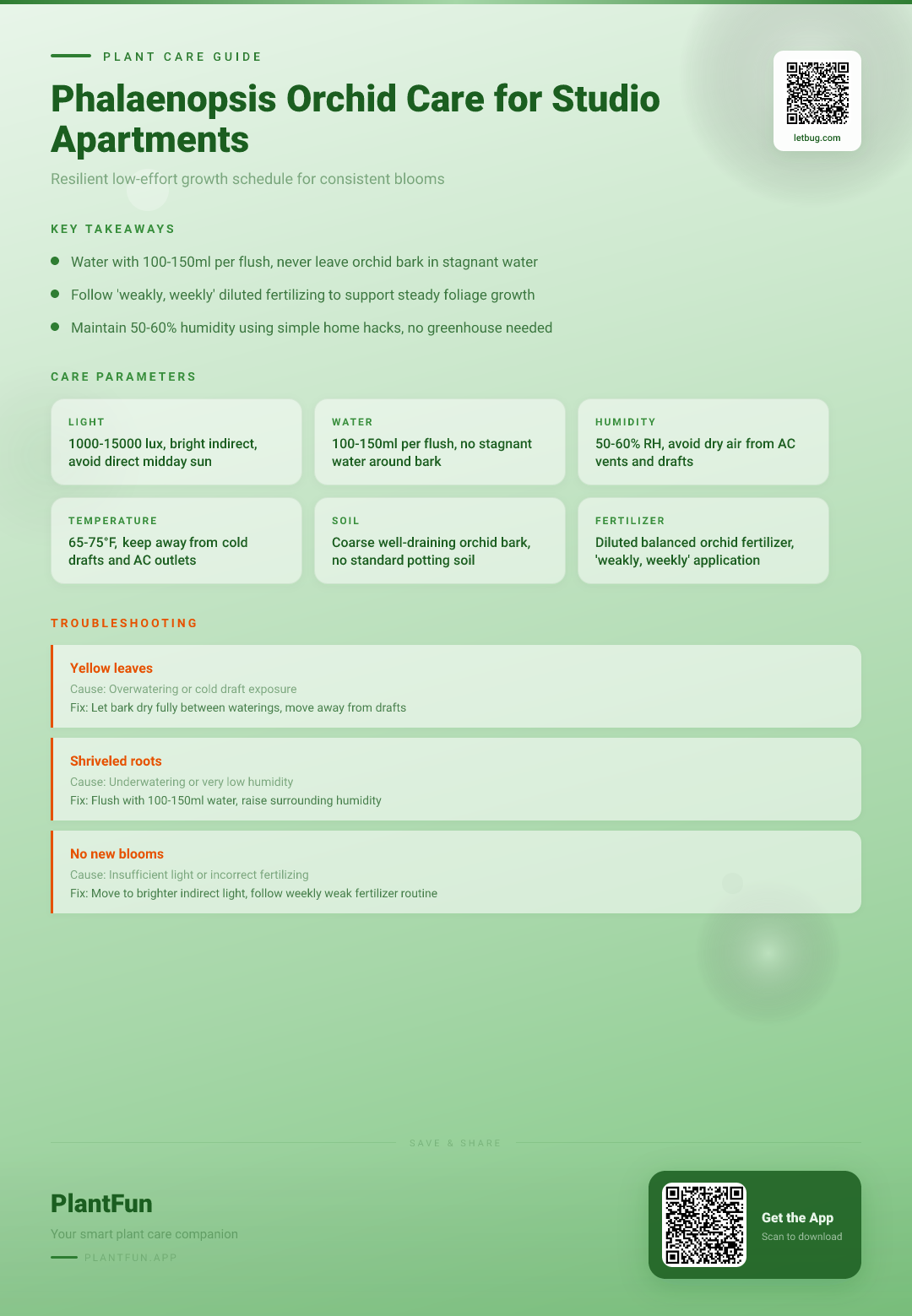
Key Takeaways
- Check soil moisture before watering — overwatering is the #1 killer of houseplants.
- Ensure your plant gets the right amount of light for its species.
- Be patient with recovery — most plants need 2–4 weeks to bounce back.
TL;DR: Keep your Phalaenopsis orchid in bright, indirect light (15,000 lux) and water only when roots turn silver-gray. In studio apartments, focus on airflow to mimic their natural epiphytic habitat. Avoid stagnant water in the pot to prevent root rot, and maintain 50-60% humidity for year-round vitality. According to the ASPCA, these orchids are non-toxic to cats and dogs (ASPCA, 2026).
Quick Care Card: The Essential Metrics
| Feature | Requirement |
|---|---|
| Light | 15,000 lux (Bright, indirect) |
| Water | 100-150ml per flush (When roots turn silver) |
| Humidity | 50-60% |
| Temperature | 65-75°F (18-24°C) |
| Soil | Orchid bark (Epiphytic mix) |
| Fertilizer | Weakly, Weekly (1/4 strength) |
| Toxicity | Non-toxic to pets (ASPCA, 2026) |
Why Orchids Thrive (or Fail) in Studio Apartments: Understanding the Airflow Factor
When I first brought a Phalaenopsis into my own studio, I treated it like my Pothos—kept it in a corner and watered it on a schedule. It didn’t last three months. I learned the hard way that Phalaenopsis are epiphytes, meaning they grow on trees, not in soil (NC State Extension, 2026). In small apartments, air stagnation is the silent killer. Without proper airflow around the root system, bark stays soggy, leading to hypoxia in the roots and eventual decline. Your goal is to replicate the breeze they experience in the wild.
Seasonal Routine: Spring & Summer Growth Cycles vs. Winter Dormancy
During spring and summer, orchids prioritize leaf and root development. I increase my watering slightly during these months, as the warmer apartment temperatures cause faster transpiration. As autumn transitions to winter, the cooling temperatures (ideally dropping to 60-65°F at night) act as a chemical signal for the plant to produce a new flower spike (Babůrek, 2009). If your apartment stays a constant 75°F year-round, you might struggle to trigger a new bloom cycle; try moving the plant to a cooler windowsill in November.
Light Requirements: Decoding ‘Bright Indirect’ in North vs. West-Facing Windows
Light is the engine of your orchid. A North-facing window is often too dim for consistent blooming, while a West-facing window can scorch leaves if not filtered by a sheer curtain. Aim for 15,000 lux. A simple test: hold your hand between the orchid and the window. If your hand casts a crisp, dark shadow, the light is too intense. If it casts a fuzzy, faint shadow, you have found the sweet spot (NC State Extension, 2026).
The Watering Science: Why You Must Never Let Orchid Bark Sit in Stagnant Water
I never water on a calendar. Instead, I observe the root color. Healthy, hydrated roots are bright green. When the roots turn a silvery-gray, the orchid is signaling for water. When I water, I run 100-150ml of lukewarm water through the bark, ensuring I never let the pot sit in the excess runoff in the saucer. This prevents root rot, a common issue in indoor plant care for studio apartments where evaporation is low.
Humidity Hacks: Practical Ways to Maintain 50% Levels Without a Greenhouse
Apartment air is notoriously dry, especially in winter. I use a humidity tray—a shallow dish filled with pebbles and water—placed beneath the orchid. Crucially, the bottom of the pot must sit on the pebbles, never touching the water. This provides a micro-climate of higher localized humidity without soaking the root ball.
Fertilizing Strategy: The ‘Weakly, Weekly’ Method for Consistent Foliage
Orchids do not need heavy doses of nutrients. I use a balanced, water-soluble orchid fertilizer at 1/4 of the recommended strength every time I water. This constant, mild nutrition mimics the nutrient runoff they collect from tree bark in the wild (Ko, 2018).
Common Apartment Pitfalls: Addressing Drafts, AC Vents, and Low Air Circulation
- Mistake: Placing the orchid directly under an AC vent. What happens: Rapid moisture loss leads to shriveled leaves. Instead: Place your plant at least three feet away from all vents.
- Mistake: Using standard potting soil. What happens: Suffocation of the roots. Instead: Always use a specialized chunky orchid potting mix to allow airflow.
FAQ: Why is my orchid leaf turning yellow in my apartment?
Yellowing leaves are often a sign of crown rot from water sitting in the center of the leaves, or simply the natural senescence of an old leaf. Check the crown; if it’s mushy or dark brown, you have a common orchid disease caused by overwatering.
FAQ: Can I keep my Phalaenopsis in a bathroom with no windows?
No. While they love the humidity of a bathroom, they must have access to natural light to photosynthesize. Unless you use a high-output LED grow light, a windowless bathroom is not suitable for long-term survival.
Step-by-Step Recovery: What to do if your orchid roots are shriveled
- Remove the orchid from the pot and gently wash away old, decaying bark.
- Use sterilized shears to clip off any mushy, black, or hollow roots.
- Repot in fresh, high-quality bark media.
- Increase humidity using a pebble tray.
- Keep the plant in a shaded, warm location (70°F) until you see new root growth (usually 3-4 weeks).
References
- Babůrek, I. (2009). Frowine, S.A.: Moth orchid. The complete guide to Phalaenopsis. Biologia plantarum. https://doi.org/10.1007/s10535-009-0040-0. Accessed 2026-03-19.
- Ko, R. (2018). Phalaenopsis aphrodite (moth orchid): Functional genomics and biotechnology. Journal of Plant Pathology & Microbiology. https://doi.org/10.4172/2157-7471-c2-010. Accessed 2026-03-19.
- ASPCA. (2026). Toxic and Non-Toxic Plants List — ASPCA. https://www.aspca.org/pet-care/animal-poison-control/toxic-and-non-toxic-plants. Accessed 2026-03-19.
- NC State Extension. (2026). Phalaenopsis Orchid Care — NC State Extension Gardener Plant Toolbox. https://plants.ces.ncsu.edu/plants/phalaenopsis-orchid/. Accessed 2026-03-19.
Optional Helper: Plantfun.App
Plantfun.App identifies your plants by photo, diagnoses pests and diseases with clear fixes, and creates personalised watering and light schedules that adapt to your home conditions — a handy companion for putting this guide into daily practice.
Found an error or have suggestions? We'd love your feedback.
Need help identifying this problem?
Get instant identification, personalized care schedules, and effective pest treatment plans directly on your phone.
Sponsored • We may earn a commission from app downloads
Related Guides
Phalaenopsis Orchid Care in Low-Humidity Apartments: A 5-Step Resilient Growth Guide
Revive your wilting Phalaenopsis orchid with our apartment-proof care guide. Master precise humidity, light, and watering thresholds for year-round blooms.
Care GuidePhalaenopsis Orchid Care in Low-Humidity Apartments: A Budget-Friendly Blueprint for Resilient Blooms
Revive your Phalaenopsis orchid with our 3-step budget care plan. Get exact lux levels and watering cycles to ensure vibrant, lasting blooms in any apartment.
Care GuidePhalaenopsis Orchid Care in Apartment Living: The 5-Step Path to Reliable Annual Reblooming
Stop discarding your Phalaenopsis orchid after the flowers fade. Master 5 essential care steps for consistent reblooming in your apartment all year round today.
Pest ControlAnts on Plants: What They Mean and What to Do
Ants usually aren't eating your plant. They are farming other pests.