
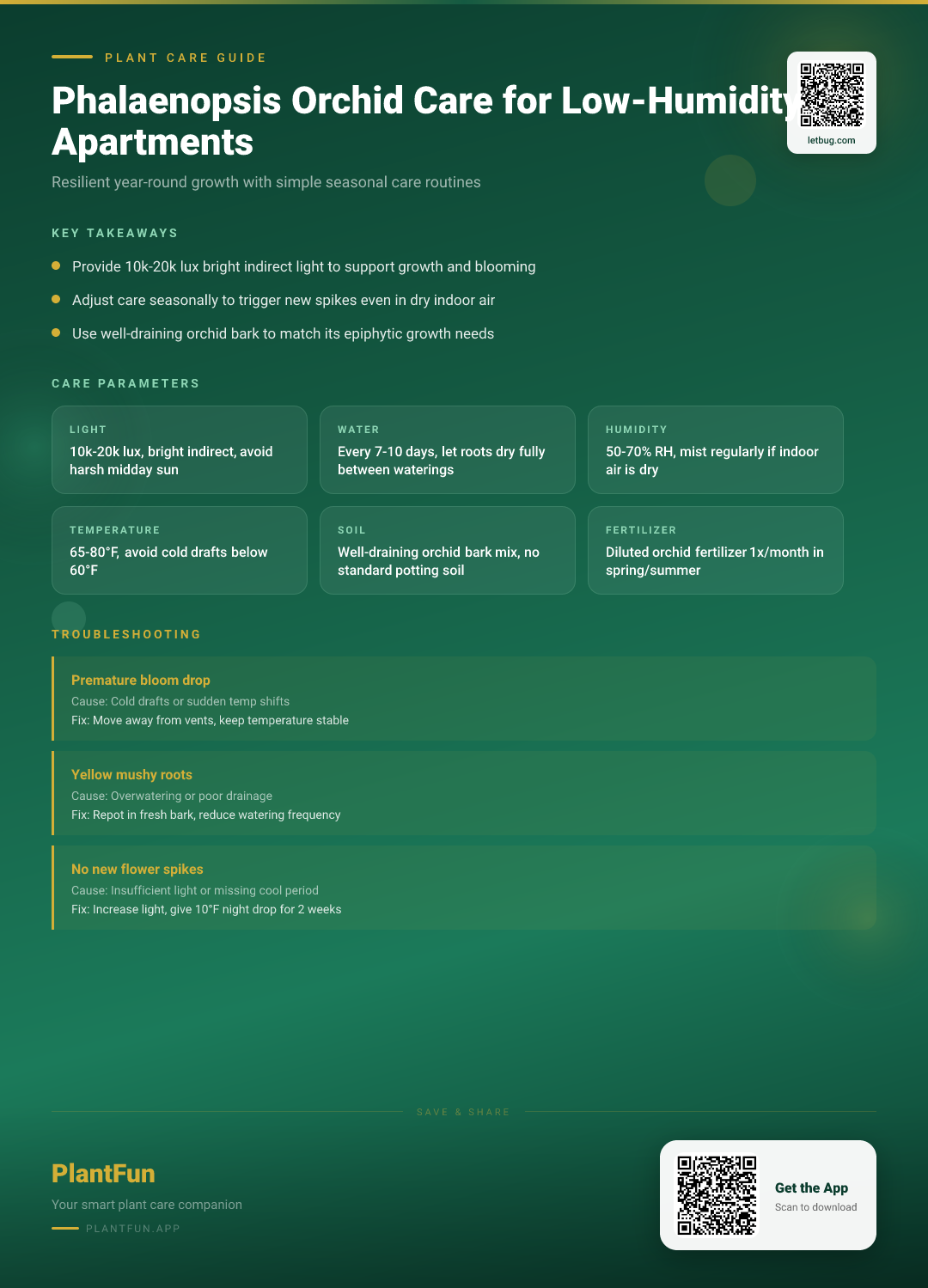
Key Takeaways
- Check soil moisture before watering — overwatering is the #1 killer of houseplants.
- Ensure your plant gets the right amount of light for its species.
- Be patient with recovery — most plants need 2–4 weeks to bounce back.
TL;DR: Keep your Phalaenopsis in bright, indirect light (10k-20k lux), water only when the roots turn silvery-grey, and maintain humidity above 50% using pebble trays. To trigger reblooming, expose the plant to a 15-degree night-time temperature drop for 2-4 weeks during autumn. Avoid letting water sit in the crown to prevent rot.
Quick Care Card: The Phalaenopsis Cheat Sheet
| Feature | Requirement |
|---|---|
| Light | 10k-20k Lux (Bright, indirect) |
| Water | Every 7-10 days (When roots turn silver) |
| Humidity | 50-70% |
| Temperature | 65-80°F (18-27°C) |
| Soil | Orchid bark mix (no potting soil) |
| Fertilizer | Balanced orchid fertilizer, monthly |
| Toxicity | Non-toxic to cats and dogs (ASPCA, 2026) |
My Experience: Learning the Hard Way
When I first started collecting orchids, I treated them like typical foliage plants, sitting them in a dark corner and watering them on a strict Sunday schedule. I lost three plants to root rot within the first year. My mistake was viewing the potting media as soil. Once I realized that Phalaenopsis are epiphytes—plants that grow on trees, not in dirt—everything changed. I stopped the weekly schedule and started reading the roots, which transformed my orchids from disposable decor into permanent residents of my apartment.
Why Your Orchid Hates Your Living Room: The Apartment Micro-climate Challenge
Most apartments are designed for human comfort, which often means dry air and fluctuating drafts from HVAC units. Phalaenopsis, native to tropical environments, prefer high ambient moisture (NC State Extension, 2026). When humidity drops below 40%, the plant struggles to transpire efficiently, leading to dehydrated leaves and stunted spikes.
Understanding the Epiphytic Shift: Mimicking Natural Bark Environments
In nature, these orchids cling to tree bark. Their roots are covered in velamen—a spongy, multi-layered epidermis that absorbs moisture and nutrients from the air (Babůrek, 2009). If you bury them in standard potting soil, you deprive them of oxygen, inevitably causing root death. Using a chunky, aerated bark mix is essential for mimicking their natural epiphytic environment.
Essential Care Thresholds: Measuring Success in Lux, Humidity, and Temperature
To move beyond survival, you need to manage your indoor climate. Phalaenopsis require 10k to 20k lux of light (NC State Extension, 2026). If you don’t have a light meter, a simple test is the “shadow test”: if the plant casts a sharp shadow under your chosen light source, it’s sufficient. Humidity should be maintained between 50-70%; a pebble tray filled with water beneath the pot provides a necessary localized boost in moisture.
Spring & Summer: Optimizing Active Growth and Fertilizer Cycles
During the warmer months, the plant focuses on leaf and root production. I keep my plants well-hydrated during this phase. I use a balanced liquid orchid fertilizer at half-strength once a month. According to Ko (2018), consistent nitrogen supply during this vegetative phase is linked to higher resilience against biotic stressors.
Autumn & Winter: Managing Dry Air and Temperature Drops to Trigger Spikes
Winter is the most critical time for reblooming. As heating systems dry out the air, monitor your humidity closely. To induce a new spike, the plant requires a temperature drop of about 10-15°F during the night for several weeks (NC State Extension, 2026). I move mine to a cooler window sill in October to signal that it is time for the reproductive phase.
The 7-Step Seasonal Maintenance Calendar for Busy Apartment Dwellers
- Spring: Flush the bark with distilled water to remove accumulated salts.
- Spring: Repot if the bark has decomposed into fine particles.
- Summer: Ensure bright, indirect light; avoid harsh midday sun.
- Summer: Increase watering frequency as evaporation increases.
- Autumn: Induce cool nights (60-65°F) to trigger flower spikes.
- Winter: Use a humidifier to counteract forced-air heating.
- Winter: Monitor for pests like mealybugs near the flower spikes.
Troubleshooting Guide
[Root Rot]
Symptom: Roots are mushy, dark brown, or black.
Likely cause: Overwatering or using non-draining media.
Fix:
- Remove the plant from the pot and trim dead, mushy roots with sterilized scissors.
- Repot into fresh, dry bark and wait 3 days before watering again.
[Yellowing Leaves]
Symptom: Older, bottom-most leaves turning yellow.
Likely cause: Natural aging or improper light levels.
Fix:
- If only the bottom leaf yellows, it is likely normal senescence.
- If multiple leaves yellow, check for high-light stress or nutrient deficiency.
[Dehydrated, Wrinkled Leaves]
Symptom: Leaves look limp and leather-like.
Likely cause: Root damage preventing water uptake.
Fix:
- Check the root health; if roots are firm but silver, water immediately.
- Increase ambient humidity to reduce transpirational stress.
Frequently Asked Questions
- Can I put my orchid in a bathroom with no window? No, Phalaenopsis require light for photosynthesis to sustain their growth cycle; move them to a brighter spot or use a small grow light.
- How do I know when my orchid needs to be repotted? When the potting media has broken down into fine dirt-like particles that hold too much water, or if roots are aggressively growing out of the pot.
- Is my orchid dying if it drops its flowers? No, this is the natural end of the bloom cycle; focus on leaf health to ensure it returns next year.
Common Mistakes: Avoiding Crown Rot and Bark Degradation
- Mistake: Letting water pool in the center (crown) of the leaves. What happens: The water sits in the tight space and invites bacterial rot. Instead: Direct water only to the bark; if water spills, blot it with a paper towel.
- Mistake: Using fine-grade potting soil. What happens: Roots suffocate and die due to lack of airflow. Instead: Always use a specifically labeled orchid bark mix.
The Science of Reblooming: How to Successfully Induce a New Spike
Reblooming is a metabolic response to seasonal changes. Research into the functional genomics of Phalaenopsis suggests that temperature-sensitive pathways act as a master switch for floral initiation (Ko, 2018). By consistently exposing the plant to cooler night temperatures, you effectively “switch” the plant from vegetative growth to reproductive development (Babůrek, 2009).
References
- Babůrek, I. (2009). Frowine, S.A.: Moth orchid. The complete guide to Phalaenopsis. Biologia plantarum. https://doi.org/10.1007/s10535-009-0040-0. Accessed 2026-03-19.
- Ko, R. (2018). Phalaenopsis aphrodite (moth orchid): Functional genomics and biotechnology. Journal of Plant Pathology & Microbiology. https://doi.org/10.4172/2157-7471-c2-010. Accessed 2026-03-19.
- ASPCA. (2026). Toxic and Non-Toxic Plants List — ASPCA. https://www.aspca.org/pet-care/animal-poison-control/toxic-and-non-toxic-plants. Accessed 2026-03-19.
- NC State Extension. (2026). Phalaenopsis Orchid Care — NC State Extension Gardener Plant Toolbox. https://plants.ces.ncsu.edu/plants/phalaenopsis-orchid/. Accessed 2026-03-19.
Optional Helper: Plantfun.App
Plantfun.App identifies your plants by photo, diagnoses pests and diseases with clear fixes, and creates personalised watering and light schedules that adapt to your home conditions — a handy companion for putting this guide into daily practice.
Found an error or have suggestions? We'd love your feedback.
Need help identifying this problem?
Get instant identification, personalized care schedules, and effective pest treatment plans directly on your phone.
Sponsored • We may earn a commission from app downloads
Related Guides
Phalaenopsis Orchid Care for Studio Apartments: A Resilient Growth Schedule for Low-Flow Living
Revive your orchid with this seasonal care plan for apartments. Learn exact watering frequencies, humidity secrets, and light thresholds for consistent blooms.
Care GuidePhalaenopsis Orchid Care in Low-Humidity Apartments: A 5-Step Resilient Growth Guide
Revive your wilting Phalaenopsis orchid with our apartment-proof care guide. Master precise humidity, light, and watering thresholds for year-round blooms.
Care GuidePhalaenopsis Orchid Care in Apartment Living: The 5-Step Path to Reliable Annual Reblooming
Stop discarding your Phalaenopsis orchid after the flowers fade. Master 5 essential care steps for consistent reblooming in your apartment all year round today.
Pest ControlAnts on Plants: What They Mean and What to Do
Ants usually aren't eating your plant. They are farming other pests.