
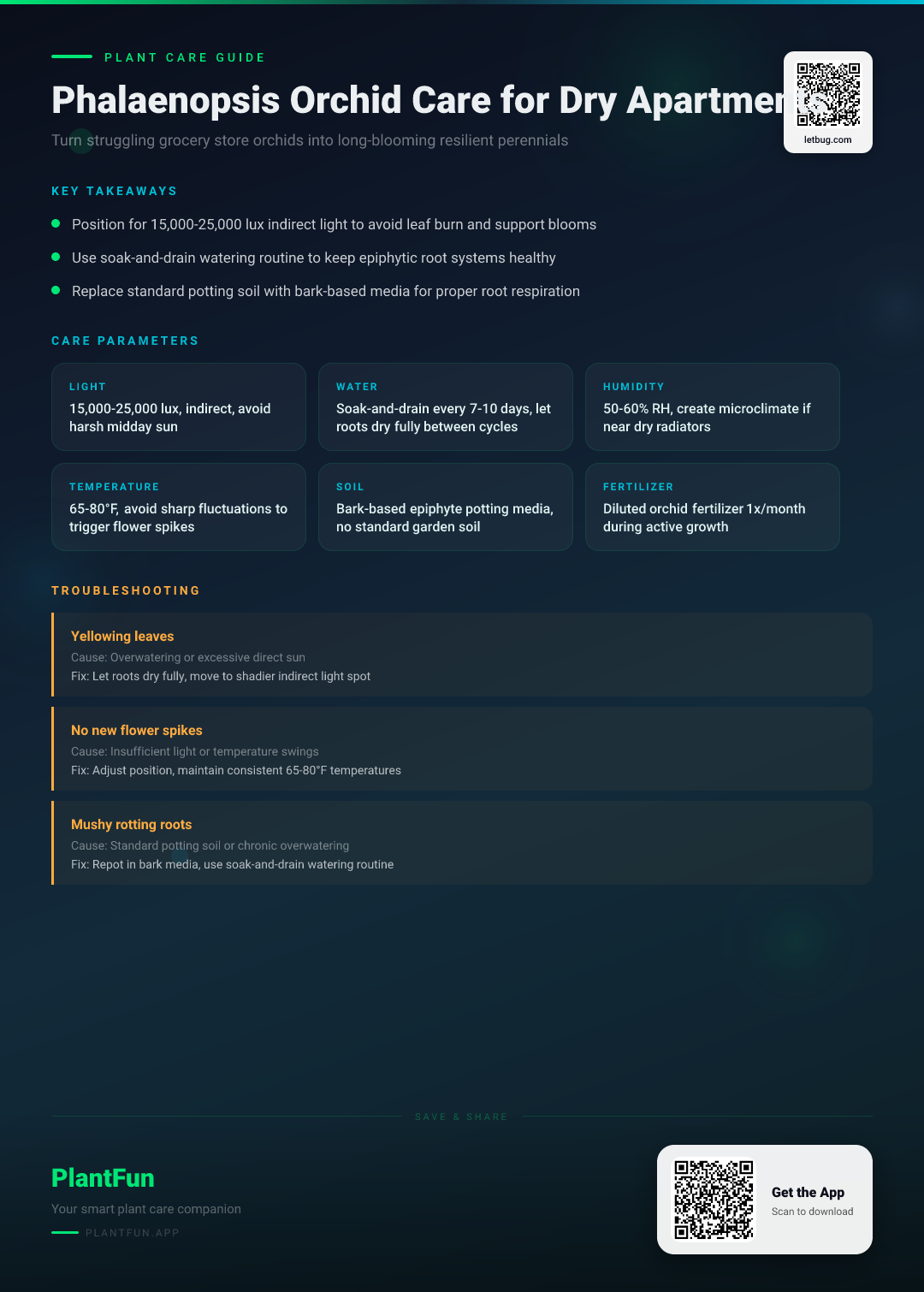
Key Takeaways
- Check soil moisture before watering — overwatering is the #1 killer of houseplants.
- Ensure your plant gets the right amount of light for its species.
- Be patient with recovery — most plants need 2–4 weeks to bounce back.
TL;DR: Phalaenopsis orchids are epiphytes, meaning they thrive on air and light rather than soil. To keep yours blooming, ditch the soil for a bark-based mix, provide 15,000–25,000 lux of indirect light, and water only when the roots turn silvery-grey. Avoid common rot by ensuring the roots never sit in stagnant water.
Quick Care Card: Snapshot of Essential Needs
| Feature | Requirement |
|---|---|
| Light | 15,000–25,000 lux (bright, indirect) |
| Watering | Soak when roots turn silvery-grey |
| Humidity | 50–60% |
| Temperature | 65–80°F (18–27°C) |
| Soil Media | Chunky bark or sphagnum moss blend |
| Fertilizer | Balanced orchid food, diluted (monthly) |
| Toxicity | Non-toxic to cats and dogs (ASPCA, 2026) |
Why Phalaenopsis Orchids Struggle in Standard Apartments
When I first got my grocery store orchid years ago, I made the mistake of leaving it in its dense, peat-heavy plug. Within weeks, the bottom leaves yellowed and the roots turned to mush. Most apartment dwellers view these plants as disposable, but they are actually incredibly hardy when you mimic their natural environment. According to NC State Extension, Phalaenopsis are tropical epiphytes that require high levels of gas exchange at the root level—something dense potting soil completely suffocates (NC State Extension, 2026).
Understanding the Epiphytic Root System: Why You Must Ditch the Soil
In the wild, these plants cling to tree bark, absorbing moisture from humid air and rain. Their roots are covered in velamen—a spongy, white tissue that acts like a hydration-detecting straw. When you use standard houseplant soil, this tissue cannot breathe, leading to rapid decay. You must use a specialized, airy best orchid potting mix to ensure oxygen reaches the root zone.
Step 1: Mastering Light: Positioning for 15,000-25,000 Lux Without Leaf Burn
Phalaenopsis are not low-light plants. They crave bright, indirect light to fuel their blooms. Using an indoor plant light meter is the most accurate way to check your placement. You are looking for a spot that mimics the dappled light under a forest canopy.
Step 2: The Soak-and-Drain Watering Ritual: Timing and Techniques for Healthy Roots
Never water on a schedule. Instead, observe the roots through a transparent plastic pot. If they are green, the plant is hydrated. When they fade to a silvery-grey, it is time for a deep soak. Submerge the pot in a bowl of tepid water for 10–15 minutes, then drain completely. Never leave the plant sitting in a saucer of water, as this is the primary cause of orchid root rot symptoms.
Step 3: Humidity Hacks: Creating a 50–60% Microclimate Near Your Radiator
Dry apartment air is the enemy of the Phalaenopsis. To boost humidity without creating mold, place your orchid on a tray filled with pebbles and water, ensuring the pot sits on the stones, not in the water. This creates a localized humid microclimate (Ko, 2018).
Step 4: Decoding Nutritional Needs: When and How to Fertilize for Resilient Blooms
Use a balanced, urea-free orchid fertilizer at 1/4 strength during the growing season (spring through early autumn). Over-fertilizing can burn delicate root tips. If you aren’t sure how often to fertilize orchids, keep it simple: fertilize lightly every third watering.
Step 5: Managing Temperature Fluctuations: The Secret to Triggering New Flower Spikes
To trigger a new spike, Phalaenopsis need a “cool-down” period. A drop in nighttime temperatures to about 60–65°F for 2–4 weeks in autumn often signals the plant to produce a new bloom spike (Babůrek, 2009).
Voice Search FAQ
Why is my orchid’s leaf turning yellow?
Usually, this indicates root suffocation or crown rot. Check the roots; if they are brown and mushy, repot in fresh bark immediately.
How often should I actually soak my orchid roots?
Ignore the calendar. Soak them only when the roots turn silvery-grey and the pot feels lightweight.
Can I leave my Phalaenopsis in the original plastic pot?
Yes, as long as it has adequate drainage holes. In fact, clear plastic is best for monitoring root health.
Common Mistakes: Avoiding Overwatering and Improper Substrate Choice
- Mistake: Using standard potting soil.
- What happens: The roots suffocate and rot within weeks.
- Instead: Use an orchid-specific bark or moss-based substrate.
- Mistake: Pouring water into the crown (the center where leaves meet).
- What happens: Water pools and causes crown rot, which is fatal.
- Instead: Water only the substrate at the base of the plant.
Seasonal Care Calendar: Navigating Winter Heat and Summer Humidity
- Winter: Watch for dry heat near radiators. Increase local humidity and keep the plant away from cold drafts.
- Summer: Increase light levels slightly and ensure good air circulation to prevent fungal issues.
References
- ASPCA. (2026). Toxic and Non-Toxic Plants List — ASPCA. https://www.aspca.org/pet-care/animal-poison-control/toxic-and-non-toxic-plants. Accessed 2026-03-18.
- Babůrek, I. (2009). Frowine, S.A.: Moth orchid. The complete guide to Phalaenopsis. Biologia plantarum. https://doi.org/10.1007/s10535-009-0040-0. Accessed 2026-03-18.
- Ko, R. (2018). Phalaenopsis aphrodite (moth orchid): Functional genomics and biotechnology. Journal of Plant Pathology & Microbiology. https://doi.org/10.4172/2157-7471-c2-010. Accessed 2026-03-18.
- NC State Extension. (2026). Phalaenopsis Orchid Care — NC State Extension Gardener Plant Toolbox. https://plants.ces.ncsu.edu/plants/phalaenopsis-orchid/. Accessed 2026-03-18.
Optional Helper: Plantfun.App
Plantfun.App identifies your plants by photo, diagnoses pests and diseases with clear fixes, and creates personalised watering and light schedules that adapt to your home conditions — a handy companion for putting this guide into daily practice.
Found an error or have suggestions? We'd love your feedback.
Need help identifying this problem?
Get instant identification, personalized care schedules, and effective pest treatment plans directly on your phone.
Sponsored • We may earn a commission from app downloads
Related Guides
Phalaenopsis Orchid Care in Apartment Living: The 5-Step Path to Reliable Annual Reblooming
Stop discarding your Phalaenopsis orchid after the flowers fade. Master 5 essential care steps for consistent reblooming in your apartment all year round today.
Care GuideThe Complete Phalaenopsis Orchid Care Checklist for Thriving in Typical Urban Apartments
Get a simple, actionable care checklist to grow resilient, repeat-blooming Phalaenopsis orchids even in low-light, dry typical apartments with no fancy equipment required. Follow our science-backed steps for consistent results.
Care GuidePhalaenopsis Orchid Care Checklist for 500 Sq Ft Studio Apartments: Resilient Growth Tips
Grow thriving phalaenopsis orchids even in your tiny studio apartment. Get our printable 10-step checklist, exact light, water, and humidity parameters for consistent resilient growth and regular reblooms.
Pest ControlAnts on Plants: What They Mean and What to Do
Ants usually aren't eating your plant. They are farming other pests.