
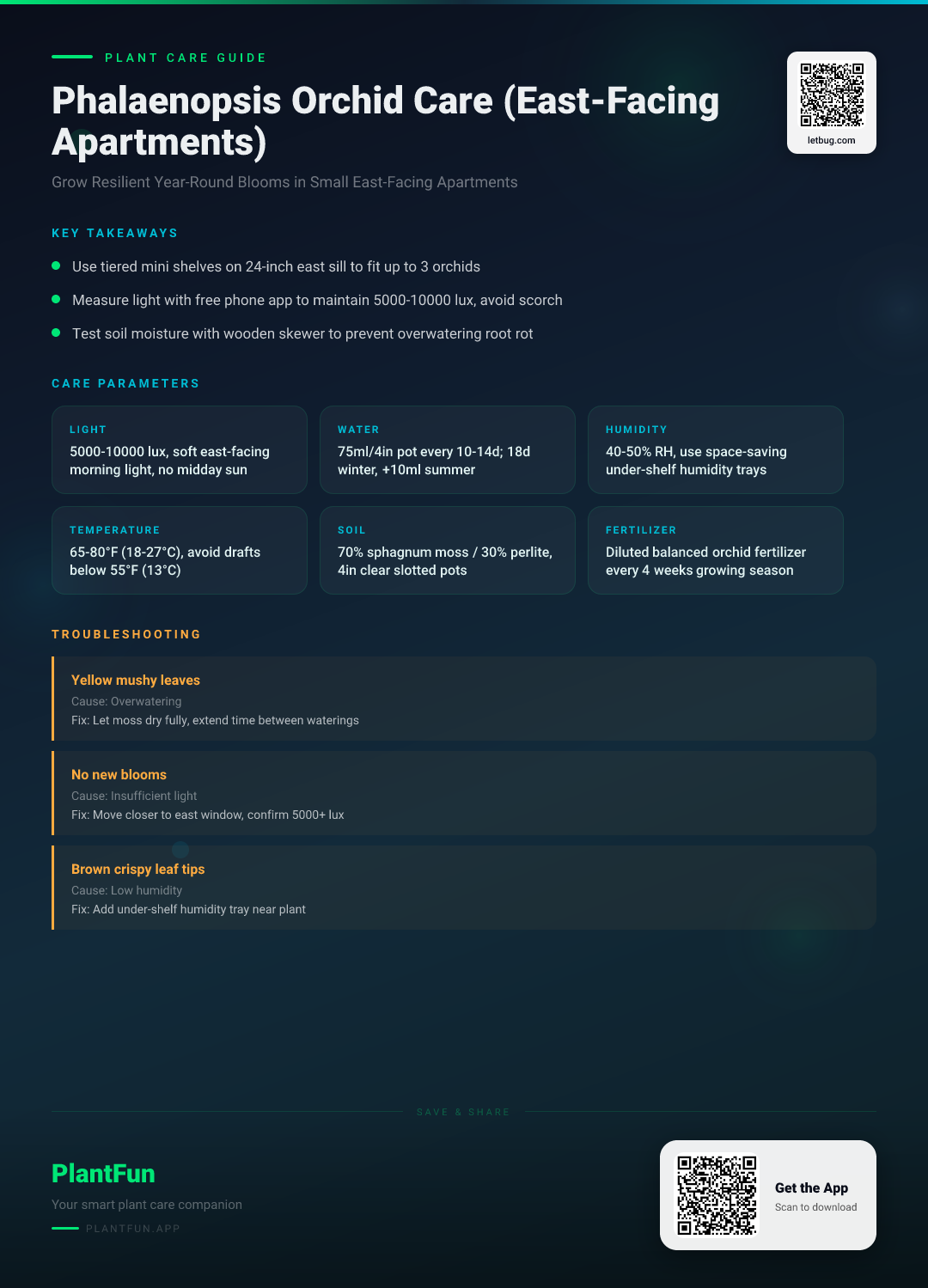
Key Takeaways
- Check soil moisture before watering — overwatering is the #1 killer of houseplants.
- Ensure your plant gets the right amount of light for its species.
- Be patient with recovery — most plants need 2–4 weeks to bounce back.
Quick Care Card (Printable Fridge Magnet Size)
| Care Factor | Exact Threshold For East-Facing Small Apartments |
|---|---|
| Light | 5,000–10,000 lux of soft morning east-facing light |
| Water | 75ml per 4-inch pot every 10–14 days (adjust for seasons) |
| Humidity | 40–50% relative humidity |
| Temperature | 65–80°F (18–27°C) year-round, no exposure below 55°F (13°C) |
| Soil Mix | 70% sphagnum moss / 30% perlite |
| Fertilizer | 1/4 strength balanced orchid fertilizer every 4 weeks (spring/summer only) |
| Toxicity | Non-toxic to cats, dogs, and humans (ASPCA, 2026) |
Why This Guide Works For Small Apartments
Most generic Phalaenopsis orchid care guides assume you have a large south-facing window, extra counter space for soaking pots, and room for a full-sized humidifier—luxuries most renters in 500–700 sqft urban apartments don’t have. This guide is built exclusively for homes with only east-facing window access, with zero-clutter solutions that don’t take over valuable living space, and exact, no-guess measurements so even first-time orchid owners can succeed.
Myth: Phalaenopsis need bright direct south light to bloom. Reality: The soft, filtered morning light from east-facing windows closely matches the dappled understory light these orchids evolved in (Babůrek, 2009), making it far better for preventing leaf scorch and supporting consistent bloom cycles. If you’re looking for more space-saving plant storage ideas, check out our guide to small space houseplant storage hacks.
Pre-Setup: Zero-Clutter Orchid Placement Hacks
This setup fits up to 3 full-sized Phalaenopsis orchids on a single 24-inch east-facing sill, with zero counter space used:
- Install a 22-inch wide, 2-tiered clear acrylic mini shelf on the back half of your window sill. This leaves the front 2 inches of the sill free for small decor or other tiny plants if desired.
- Add 2 damage-free adhesive wall-mounted pot clips to the window frame directly above the sill, to hold your two smallest orchid pots. Place your largest orchid on the bottom shelf of the tiered unit.
- Adjust all pots so no leaves are touching the cold window glass, which can cause leaf tissue damage in winter. This setup is one of our top small apartment orchid placement ideas for maximizing limited sill real estate.
Care Step 1: Light Requirements (Exact Lux Thresholds)
Phalaenopsis orchids need 5,000–10,000 lux of light daily to produce consistent blooms (NC State Extension, 2026), which falls perfectly within the range of unobstructed east-facing morning light. To measure your light levels accurately:
- Download a free light meter app to your phone, and hold it at the same height as your orchid’s leaves.
- Take measurements at 9AM, 12PM, and 3PM to capture daily light ranges.
- If midday light exceeds 12,000 lux (rare for east-facing windows, but possible in summer), hang a cheap sheer curtain to filter excess light and prevent leaf scorch.
For more tips on measuring light for your houseplants, read our guide to how to measure houseplant light with a phone. This section covers the exact Phalaenopsis orchid light requirements lux levels you need for east-facing window orchid care success.
Care Step 2: Exact Watering Schedule For Tight Spaces
Forget messy sink soaks that take up valuable space and leave puddles on your counters. For east-facing apartment Phalaenopsis in 4-inch pots, water 75ml (about 1/3 cup) per pot every 10–14 days (Ko, 2018). To avoid overwatering (the #1 killer of orchids):
- Stick a plain wooden skewer 2 inches deep into the sphagnum moss mix.
- If the skewer comes out completely dry, it’s time to water. If it has any damp moss stuck to it, wait 2 days and test again.
- Pour the 75ml of water directly over the moss, avoiding the center crown of the plant to prevent rot.
This answers the common question of how often to water Phalaenopsis orchid in small spaces, with zero mess required. For more tips, see our guide to how to prevent overwatering houseplants.
Care Step 3: Humidity Optimization Without Bulky Tools
Phalaenopsis orchid humidity level needs sit between 40–50% (NC State Extension, 2026), which is easy to achieve without a bulky countertop humidifier that takes up precious space. Use under-shelf disposable humidity trays:
- Pick up 2 small 4-inch plastic trays, fill them 1/3 full with pebbles, then top with water just below the top of the pebbles.
- Tuck the trays directly under the tiered sill shelf, so they are completely hidden and take up zero extra counter space.
- Refill the water once a week: the evaporation will raise local humidity around your orchids to the perfect range, no electricity required.
Care Step 4: Temperature Guidelines For Apartment Living
Sealed urban apartments almost always fall within the ideal Phalaenopsis temperature range of 65–80°F (18–27°C) year-round (Babůrek, 2009). The only exceptions to watch for:
- Never place orchids within 1 foot of drafty entryways, AC vents, or radiators, where temperatures can drop below 55°F (13°C) or spike above 85°F (29°C) quickly.
- If you run your AC constantly in summer, move your orchids 1 foot away from vents to avoid cold air damage.
Care Step 5: Soil & Potting For Small Footprints
Skip bulky decorative pots that take up extra sill space. Use 4-inch clear slotted plastic pots, which fit easily in tight sill gaps and let you monitor root health without repotting frequently. Use a soil mix of 70% long-fiber sphagnum moss and 30% perlite (Ko, 2018): this mix retains just the right amount of moisture for east-facing apartment conditions, and drains quickly to prevent root rot. Only repot your orchid every 2–3 years, when roots are growing out of the slotted holes of the pot.
Seasonal Care Calendar
Adjust your care routine slightly for sealed apartment seasonal conditions:
- Winter (Phalaenopsis orchid winter care apartment): Reduce watering to 75ml every 18 days, as lower light levels slow orchid growth and reduce moisture use. No other adjustments are needed.
- Summer (Phalaenopsis orchid summer watering): Add 10ml of extra water per watering session, as warmer, drier apartment air increases evaporation from the moss mix.
Common Small-Apartment Orchid Care Mistakes To Avoid
- Mistake: Overcrowding your sill with more than 3 orchids per 24-inch space. What happens: Poor air circulation leads to root rot and fungal leaf spots, which can spread quickly to all your plants. Instead: Stick to our tiered shelf + clip setup for 3 plants max, or add a hanging window planter if you want to grow more orchids without using sill space.
- Mistake: Using oversized pots larger than 4 inches. What happens: Extra unused soil holds excess moisture that leads to root rot, and takes up valuable sill space that could be used for other plants or decor. Instead: Only repot when roots are visibly growing out of the slotted pot holes, and only go up 1 pot size (max 1 inch larger) when you do repot.
- Mistake: Placing orchids near kitchen grease vents or bathroom exhaust fans. What happens: Grease clogs the tiny stomata on orchid leaves, preventing photosynthesis, while dry exhaust air drops humidity below 30% leading to leaf drop. Instead: Keep orchids at least 3 feet away from kitchen and bathroom vents to avoid damage.
- Mistake: Overfertilizing more than once every 4 weeks. What happens: Salt buildup burns orchid roots, prevents blooming, and requires frequent flushing that makes a mess in small apartment spaces. Instead: Use 1/4 strength balanced orchid fertilizer only during spring and summer growing seasons, and skip fertilizing entirely in fall and winter.
Voice Search FAQ
Can I keep a Phalaenopsis orchid on my small east-facing apartment window sill?
Yes! East-facing morning light is ideal for Phalaenopsis orchids, as it provides the 5,000–10,000 lux they need to produce consistent blooms without the risk of midday leaf scorch that comes with south-facing light (NC State Extension, 2026). Our tiered shelf setup lets you fit up to 3 orchids on a standard 24-inch sill without taking up any extra counter space, making it perfect for small apartments.
How often do I water my Phalaenopsis orchid in a small apartment?
For a standard 4-inch potted Phalaenopsis in an east-facing apartment, water 75ml every 10–14 days during spring and summer, and every 18 days during winter (Ko, 2018). Test moisture levels with a wooden skewer before watering to avoid overwatering, and skip messy sink soaks entirely by pouring the measured amount directly into the pot.
Why won’t my Phalaenopsis orchid rebloom?
The most common causes for east-facing apartment Phalaenopsis not reblooming are insufficient light (below 5,000 lux for 4+ hours a day) or not getting a 10°F nighttime temperature drop for 2–3 weeks in fall to trigger bloom spike growth (Babůrek, 2009). Move your orchid closer to the window if light levels are low, and place it near a slightly drafty (not cold) window for 3 weeks in fall to trigger blooming. For more troubleshooting tips, read our guide to why your houseplants aren’t blooming.
References
- NC State Extension. (2026). Phalaenopsis Orchid Care Checklist — NC State Extension Gardener Plant Toolbox. https://plants.ces.ncsu.edu/plants/phalaenopsis-orchid/. Accessed 2026-02-24.
- Babůrek, I. (2009). Frowine, S.A.: Moth orchid. The complete guide to Phalaenopsis. Biologia plantarum. https://doi.org/10.1007/s10535-009-0040-0. Accessed 2026-02-24.
- Ko, R. (2018). Phalaenopsis aphrodite (moth orchid): Functional genomics and biotechnology. Journal of Plant Pathology & Microbiology. https://doi.org/10.4172/2157-7471-c2-010. Accessed 2026-02-24.
- ASPCA. (2026). Toxic and Non-Toxic Plants List — ASPCA. https://www.aspca.org/pet-care/animal-poison-control/toxic-and-non-toxic-plants. Accessed 2026-02-24.
Optional Helper: Plantfun.App
Plantfun.App identifies your plants by photo, diagnoses pests and diseases with clear fixes, and creates personalised watering and light schedules that adapt to your home conditions — a handy companion for putting this guide into daily practice.
Found an error or have suggestions? We'd love your feedback.
Need help identifying this problem?
Get instant identification, personalized care schedules, and effective pest treatment plans directly on your phone.
Sponsored • We may earn a commission from app downloads
Related Guides
Phalaenopsis Orchid Care Checklist for East-Facing Apartments: Resilient Growth & Consistent Blooms
Stop struggling to keep your Phalaenopsis orchid alive. Grab our 12-point actionable checklist, exact light, water, and humidity thresholds for east-facing apartments, plus fixes for 7 common mistakes to get consistent yearly blooms.
Care GuideThe Complete Phalaenopsis Orchid Care Checklist for Resilient Growth in Small Urban Apartments
Stop losing your phalaenopsis orchid to tricky apartment conditions. Grab our 12-step checklist with exact light, water, and humidity thresholds to keep it blooming year-round.
Care GuidePhalaenopsis Orchid Care Checklist for 500 Sq Ft Studio Apartments: Resilient Growth Tips
Grow thriving phalaenopsis orchids even in your tiny studio apartment. Get our printable 10-step checklist, exact light, water, and humidity parameters for consistent resilient growth and regular reblooms.
Pest ControlAnts on Plants: What They Mean and What to Do
Ants usually aren't eating your plant. They are farming other pests.