
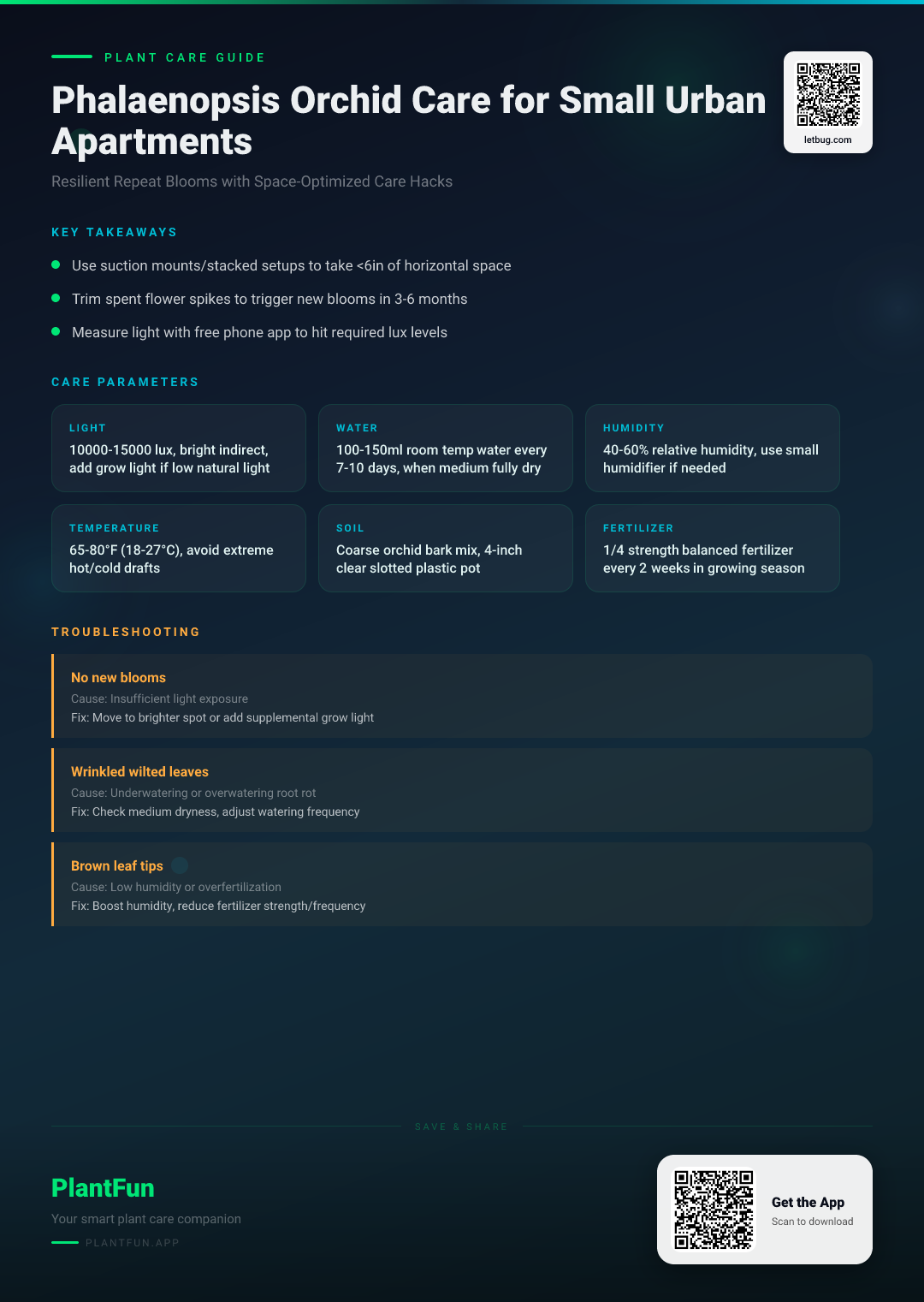
Key Takeaways
- Check soil moisture before watering — overwatering is the #1 killer of houseplants.
- Ensure your plant gets the right amount of light for its species.
- Be patient with recovery — most plants need 2–4 weeks to bounce back.
Quick Care Card
| Parameter | Small Apartment Optimized Rule |
|---|---|
| Light | 10,000-15,000 lux bright indirect light; use slim under-cabinet grow lights if natural light is insufficient |
| Water | 100-150ml room-temperature rain/distilled water every 7-10 days, only when potting medium is completely dry 1 inch deep |
| Humidity | 40-60% relative humidity; use mini desktop humidifiers or pebble trays for small space adjustment |
| Temperature | 65-80°F (18-27°C); keep away from drafty windows and forced air vents |
| Soil & Pot | Coarse orchid bark mix in 4-inch clear slotted pots (best orchid pots for small spaces) |
| Fertilizer | 1/4 strength balanced 20-20-20 fertilizer every 2 weeks during spring and summer growing season |
| Toxicity | Non-toxic to cats, dogs, and humans (ASPCA, 2026) |
Why This Guide Is Built For Small Apartment Orchid Owners
Generic Phalaenopsis orchid care advice rarely accounts for the unique stressors of small urban apartments: limited unobstructed bright light blocked by surrounding buildings, no extra shelf or counter space for large plant setups, low humidity from forced air heating and cooling, and drafty window seals that cause sudden temperature swings. This orchid care checklist for apartments is built exclusively for Phalaenopsis orchid in small apartment setups, with Phalaenopsis orchid care for beginners in mind, no guesswork or large gardening supplies required.
Step 1: Space-Optimized Placement for Your Phalaenopsis Orchid
You don’t need a dedicated plant shelf to grow healthy orchids. Try these small space orchid setup ideas that take less than 6 inches of horizontal space:
- Over-the-sill suction cup mounts: Stick clear plastic suction mounts directly to your window glass to hold 4-inch orchid pots. They take zero counter or sill space, and put the orchid directly in bright indirect light.
- Under-cabinet grow light setups: Mount slim LED grow strips under upper kitchen or bathroom cabinets, and place your orchid on the edge of the counter directly below. This uses less than 6 inches of counter space, and is perfect for low-light apartments with no unobstructed windows.
- Narrow windowsill risers: Use 5-inch wide acrylic tiered risers on your windowsill to stack 2-3 orchids vertically, without blocking light to lower plants or taking up extra sill space.
Step 2: Exact Light Requirements for Apartment Growth
Phalaenopsis orchid light levels need to stay between 10,000 and 15,000 lux of bright indirect light for healthy growth and repeated blooms (NC State Extension, 2026). To test your light levels:
- Download a free lux meter app on your smartphone.
- Hold your phone at the same height as the orchid’s leaves, at midday when the sun is brightest.
- Take a 10-second reading. If it’s below 10,000 lux, you’ll need to add grow lights for low light orchid care tips: set the grow light to 12 hours per day, positioned 6-12 inches above the orchid’s leaves.
Step 3: Watering Schedule & Exact Volume Guidelines
One of the most common questions from new owners is how often to water Phalaenopsis orchid. Follow these measurable rules to avoid overwatering, the top cause of orchid death in apartments:
- Water with 100-150ml of room-temperature rain or distilled water every 7-10 days (Babůrek, 2009).
- Always test the potting medium first: stick your finger 1 inch into the coarse bark mix. If there’s any moisture at all, wait 2-3 days and test again. Only water when the medium is completely dry.
- Pour water directly into the bark mix, avoiding the center crown of the orchid to prevent rot. You don’t need to soak the entire pot, which can create mess in small living spaces.
Step 4: Humidity & Temperature Thresholds for Resilient Blooms
Orchid humidity requirements for apartments are lower than you might think:
- Target 40-60% relative humidity, and a consistent temperature between 65-80°F (18-27°C) (NC State Extension, 2026).
- Myth vs reality: Contrary to popular belief, Phalaenopsis don’t need 70%+ tropical humidity to bloom. The 40-60% range is easily achievable in most apartments with small hacks: place a 100ml mini humidifier 1 foot away from the orchid, or set the pot on a tray of pebbles filled with water (make sure the pot bottom doesn’t touch the water to avoid root rot).
- Keep orchids at least 2 feet away from heating vents, AC units, and drafty window seals to avoid sudden temperature swings that cause bud drop.
Step 5: Potting & Fertilizing Rules for Small Space Setups
Best orchid pots for small spaces are 4-inch clear plastic slotted pots: they are compact enough for all the placement hacks above, and let you check root health without repotting, so you don’t waste space on unnecessarily large pots.
- Use only coarse orchid bark mix, not regular potting soil, which holds too much moisture and causes root rot.
- Fertilize with 1/4 strength balanced 20-20-20 fertilizer every 2 weeks during the spring and summer growing season (Ko, 2018). Skip fertilizing in winter when growth slows. A small 4oz bottle of fertilizer fits easily in a kitchen drawer and lasts 2+ years for a single orchid, so you don’t need to store large gardening supplies.
Step 6: Post-Bloom Pruning Hack for Continuous Growth
To encourage new blooms without taking up extra vertical space in your apartment, follow this pruning rule once all flowers have faded and the spike starts to turn brown:
- Locate the third node (small raised bump) from the bottom of the flower spike.
- Use clean, sharp scissors to trim the spike 1 inch above this node.
- A new side spike will grow from this node in 3-6 months, instead of the old spike growing tall and leggy and taking up extra vertical space (NC State Extension, 2026). This is one of the easiest tricks for how to get Phalaenopsis orchid to rebloom year after year.
Seasonal Care Calendar Adjustments for Apartment Conditions
Adjust your care routine to account for seasonal changes in apartment environments:
- Winter (orchid winter care for apartments): Reduce watering to every 14 days, as dry forced air heating slows down moisture evaporation. Keep orchids at least 1 foot away from drafty window seals where cold air seeps in, and increase humidity by 10% to counter dry heating air.
- Summer (orchid summer watering schedule): Stick to every 7 days if the bark mix dries out faster from hot weather. Move orchids 2 feet away from windows that get direct afternoon sun to avoid leaf burn, and increase humidity by 10% to counter dry air from AC units.
5 Common Small Apartment Orchid Care Mistakes to Avoid
- Mistake: Placing your orchid near heating or AC vents. What happens: Dry air blasts cause rapid bud drop and shriveled leaves. Instead: Keep orchids at least 2 feet away from all vents, and use a mini humidifier nearby if the air feels dry.
- Mistake: Sticking to a rigid watering schedule without testing the medium for dryness. What happens: Overwatering causes root rot, which kills the majority of apartment orchids. Instead: Test the bark 1 inch deep every week, and only water when it’s completely dry.
- Mistake: Using a pot larger than 4 inches to “give the orchid room to grow”. What happens: Extra potting mix holds excess moisture that rots roots, and takes up unnecessary limited shelf space. Instead: Only repot into a pot 1 inch larger every 2-3 years, when roots are growing heavily out of the slotted pot holes.
- Mistake: Tucking your orchid behind larger plants on a crowded windowsill. What happens: Light levels drop below 10,000 lux, so your orchid won’t produce new bloom spikes. Instead: Place orchids on the front edge of the sill or the top tier of a riser, so they get unobstructed light.
- Mistake: Skipping fertilizer to avoid storing extra gardening supplies. What happens: Orchids don’t get enough nutrients to produce new blooms, and will only grow leaves year after year. Instead: Buy a small 4oz bottle of orchid fertilizer, which fits in a kitchen drawer and lasts for years.
Frequently Asked Questions
FAQ 1: Can I keep my Phalaenopsis orchid on a crowded kitchen windowsill with other plants?
Yes! Kitchens often have higher natural humidity that is perfect for orchids, as long as you place the orchid on the front edge of the sill or on the top tier of a narrow riser, so it gets unobstructed light of 10,000-15,000 lux daily (NC State Extension, 2026). Just keep it at least 3 feet away from the stove to avoid damage from hot air blasts.
FAQ 2: Why is my apartment orchid dropping buds before they open?
The most common reasons for why is my orchid dropping buds are sudden temperature swings from drafty windows, dry air from forced air heating or cooling, or a sudden drop in light levels (Babůrek, 2009). Test the temperature within 1 foot of your orchid to make sure it stays between 65-80°F, and use a mini humidifier to keep humidity above 40% to stop bud drop.
FAQ 3: How do I get my Phalaenopsis orchid to rebloom in a low-light apartment?
First, test your light levels with a free lux meter app. If you get less than 10,000 lux of natural light, install a slim under-cabinet LED grow light set to 12 hours per day, positioned 8 inches above the orchid’s leaves. After the last bloom fades, prune the flower spike 1 inch above the third node from the bottom, and fertilize every 2 weeks with 1/4 strength balanced fertilizer. You should see a new bloom spike in 3-6 months (Ko, 2018).
References
- NC State Extension. (2026). Phalaenopsis Orchid Care Checklist — NC State Extension Gardener Plant Toolbox. https://plants.ces.ncsu.edu/plants/phalaenopsis-orchid/. Accessed 2026-03-05.
- Babůrek, I. (2009). Frowine, S.A.: Moth orchid. The complete guide to Phalaenopsis. Biologia plantarum. https://doi.org/10.1007/s10535-009-0040-0. Accessed 2026-03-05.
- Ko, R. (2018). Phalaenopsis aphrodite (moth orchid): Functional genomics and biotechnology. Journal of Plant Pathology & Microbiology. https://doi.org/10.4172/2157-7471-c2-010. Accessed 2026-03-05.
- ASPCA. (2026). Toxic and Non-Toxic Plants List — ASPCA. https://www.aspca.org/pet-care/animal-poison-control/toxic-and-non-toxic-plants. Accessed 2026-03-05.
Optional Helper: Plantfun.App
Plantfun.App identifies your plants by photo, diagnoses pests and diseases with clear fixes, and creates personalised watering and light schedules that adapt to your home conditions — a handy companion for putting this guide into daily practice.
Found an error or have suggestions? We'd love your feedback.
Need help identifying this problem?
Get instant identification, personalized care schedules, and effective pest treatment plans directly on your phone.
Sponsored • We may earn a commission from app downloads
Related Guides
Phalaenopsis Orchid Care Checklist for East-Facing Apartments: Resilient Growth & Consistent Blooms
Stop struggling to keep your Phalaenopsis orchid alive. Grab our 12-point actionable checklist, exact light, water, and humidity thresholds for east-facing apartments, plus fixes for 7 common mistakes to get consistent yearly blooms.
Care GuideThe Complete Phalaenopsis Orchid Care Checklist for Resilient Growth in East-Facing Apartments
Stop killing your Phalaenopsis orchid with generic greenhouse care advice. Get our 21-point apartment-specific checklist, exact light/water parameters, and easy fixes to trigger repeat blooms yearly.
Care GuideThe Complete Phalaenopsis Orchid Care Checklist for Resilient Growth in Small Urban Apartments
Stop losing your phalaenopsis orchid to tricky apartment conditions. Grab our 12-step checklist with exact light, water, and humidity thresholds to keep it blooming year-round.
Pest ControlAnts on Plants: What They Mean and What to Do
Ants usually aren't eating your plant. They are farming other pests.