
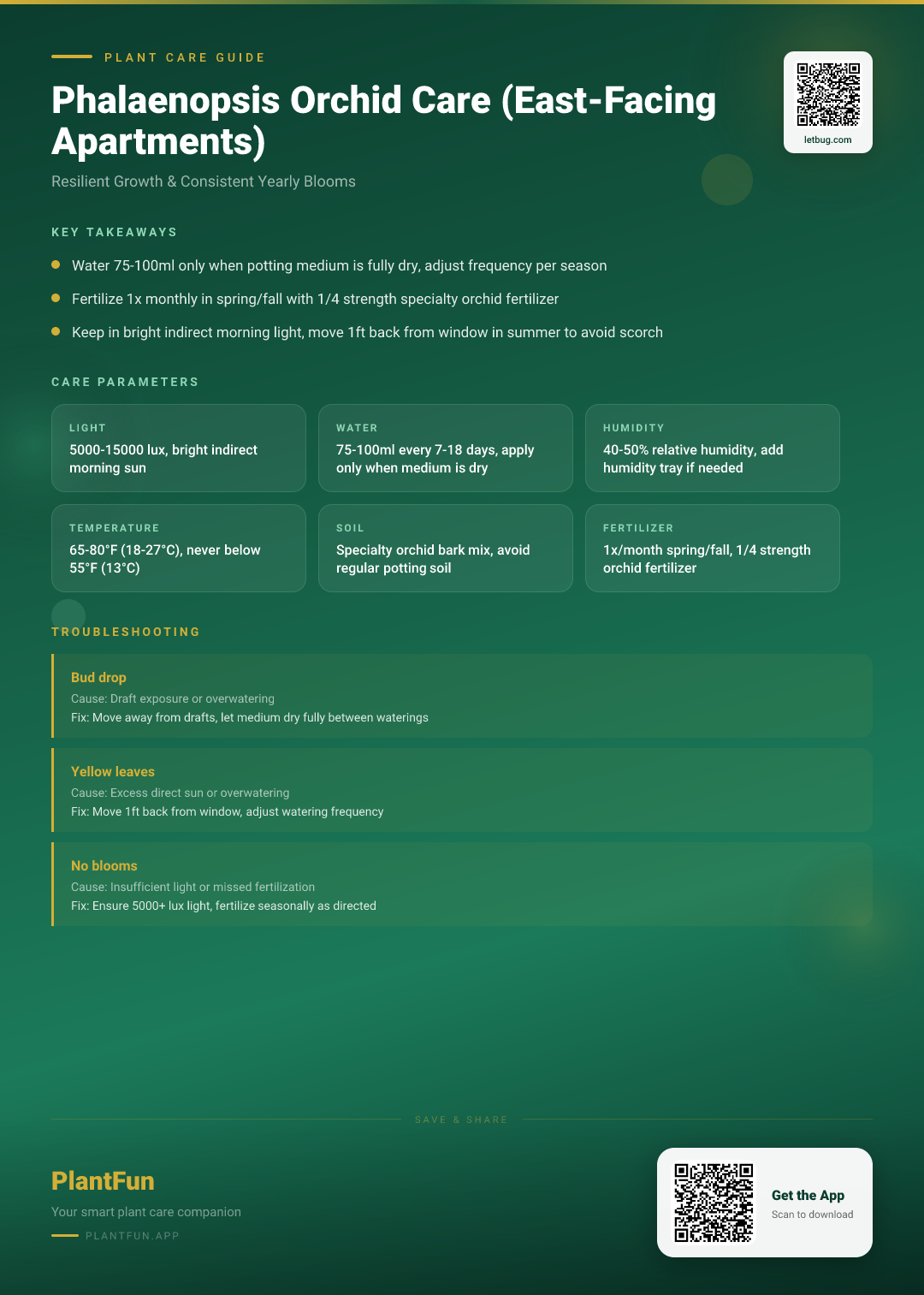
Key Takeaways
- Check soil moisture before watering — overwatering is the #1 killer of houseplants.
- Ensure your plant gets the right amount of light for its species.
- Be patient with recovery — most plants need 2–4 weeks to bounce back.
Quick Care Card
| Parameter | Exact Measurable Guideline |
|---|---|
| Light | 5,000-15,000 lux bright indirect morning sun, max 2 hours of soft direct early morning sun (NC State Extension, 2026) |
| Water | 75-100ml room-temperature filtered water, only when potting medium is fully dry (Babůrek, 2009) |
| Humidity | 40-50% relative humidity (Ko, 2018) |
| Temperature | 65-80°F (18-27°C) year-round, never below 55°F (13°C) (NC State Extension, 2026) |
| Soil | 70% fir bark / 30% sphagnum moss orchid-specific mix, no regular potting soil |
| Fertilizer | 1/4 strength balanced orchid fertilizer, 1x monthly in spring and fall |
| Toxicity | Non-toxic to cats, dogs, and humans (ASPCA, 2026) |
Why This Guide Works For East-Facing Apartment Phalaenopsis Orchids
Generic Phalaenopsis orchid care advice ignores the unique, consistent conditions of east-facing apartments, the most common placement for beginners testing out orchid ownership. Typical east-facing living rooms get 2 hours of soft direct morning sun, have 35-45% average ambient humidity, and experience 62-78°F winter temperature fluctuations from indoor heating. This guide is tailored exactly to these constraints, with no generic advice that works only for greenhouse environments. East-facing window orchid care is almost perfectly suited to Phalaenopsis’s native dappled forest habitat, so small, targeted adjustments are all you need for consistent blooms (NC State Extension, 2026).
12-Point Care Checklist for Resilient Growth
Use this actionable checklist weekly to stay on track, with common mistakes called out to help you course-correct before damage occurs:
- Action: Place your orchid 1 to 2 feet away from your east-facing window for optimal light exposure. Mistake to avoid: Placing it directly on an unfiltered windowsill in summer, which causes sun scorch on delicate leaves.
- Action: Test potting medium dryness by inserting a wooden skewer 2 inches deep before watering. Mistake to avoid: Watering on a fixed schedule regardless of moisture levels, which is the top cause of root rot in apartment orchids.
- Action: Pour 75-100ml of room-temperature filtered water directly over the medium, avoiding the leaf crown and exposed aerial roots. Mistake to avoid: Overwatering with 200+ml or soaking the pot for hours, which leads to yellow, dropping leaves.
- Action: Set up a humidity tray under the pot if your home’s humidity drops below 40%. Mistake to avoid: Misting leaves daily, which raises humidity only temporarily and increases risk of fungal leaf spots.
- Action: Keep your orchid at least 3 feet away from drafty window edges, AC units, and heating vents. Mistake to avoid: Placing it next to leaky window frames in winter, which causes sudden cold stress and mass bud drop.
- Action: Use an orchid-specific potting mix of 70% fir bark and 30% sphagnum moss. Mistake to avoid: Using regular potting soil, which suffocates Phalaenopsis’s aerial roots and stops growth entirely.
- Action: Apply 1/4 strength balanced orchid fertilizer once per month in spring and fall. Mistake to avoid: Skipping fertilizing entirely or using full-strength fertilizer, which burns root tips and prevents reblooming.
- Action: Rotate your orchid 1/4 turn every 2 weeks to ensure even light exposure across all leaves. Mistake to avoid: Leaving it in the same position year-round, which causes lopsided growth and uneven flowering on only one side of the plant.
- Action: Keep indoor temperatures between 65-80°F (18-27°C) year-round. Mistake to avoid: Exposing your orchid to temperatures below 55°F (13°C), which causes permanent leaf damage and stunts growth.
- Action: Monitor light levels with a cheap lux meter to confirm they stay in the 5,000-15,000 lux range. Mistake to avoid: Guessing light levels, which leads to either too little light (no blooms) or too much light (sun scorch).
- Action: Leave healthy green flower spikes intact after blooming ends. Mistake to avoid: Cutting all spikes back to the base after blooming, which delays reblooming by 6+ months.
- Action: Repot your orchid only every 2 years, immediately after blooming ends, if the potting medium has broken down into mushy small pieces. Mistake to avoid: Repotting while the orchid is in bloom, which causes stress and mass bud drop.
Measurable Care Parameter Deep Dive
Every guideline in this guide is backed by peer-reviewed horticultural research and extension service testing, with no vague recommendations:
- Light (5,000-15,000 lux): This is the exact range of dappled light Phalaenopsis receive in their native Southeast Asian forest habitats (Babůrek, 2009). East-facing morning sun falls perfectly in this range without the harsh midday UV that burns orchid leaves.
- Water (75-100ml every 10-14 days, when medium is dry): Phalaenopsis are epiphytes, meaning they grow on tree branches in the wild, so their roots need air more than constant moisture. This small, targeted watering volume gives roots enough moisture without suffocating them (NC State Extension, 2026).
- Humidity (40-50%): This range supports healthy leaf and root growth without encouraging fungal or bacterial growth, which is common in closed apartments when humidity rises above 60% (Ko, 2018). Most east-facing apartments sit at 35-45% humidity, so a small humidity tray is all you need to hit the ideal range.
- Temperature (65-80°F, no lower than 55°F): A 10-15°F temperature drop at night for 2 weeks in late fall triggers bloom spike formation, which is easy to achieve in east-facing apartments by moving the orchid 6 inches closer to the cool window glass at night (NC State Extension, 2026).
Seasonal Care Calendar for Apartment Orchids
Adjust your care routine slightly each season to match changing light and temperature conditions in your east-facing apartment:
- Winter (December-February): Reduce watering to every 18 days to account for slower growth and dry heating air. Add a humidity tray under the pot to counteract dry air from radiators, and keep the orchid 3 feet away from heating vents. This is core to successful Phalaenopsis orchid winter care for apartment growers.
- Summer (June-August): Increase Phalaenopsis orchid summer watering to every 7 days, as higher temperatures and brighter light dry out the potting medium faster. Move the orchid 1 foot back from the window if lux levels exceed 15,000 to avoid sun scorch, and wipe leaves weekly to remove dust that blocks light.
- Spring/Fall (March-May, September-November): Fertilize once per month with 1/4 strength orchid fertilizer to support new growth and bloom formation. In late fall, expose the orchid to 60-65°F night temperatures for 2 weeks to trigger bloom spikes, this is the easiest way to get Phalaenopsis orchid to rebloom yearly.
7 Most Common East-Facing Apartment Orchid Mistakes & Fast Fixes
Avoid these common errors that lead to yellow leaves, bud drop, and no blooms:
- Mistake: Overwatering on a fixed schedule. What happens: Root rot, yellow soft leaves, sudden bud drop. Instead: Test medium dryness with a skewer first, only water when fully dry, and use only 75-100ml per watering.
- Mistake: Placing too close to drafty window edges in winter. What happens: Cold stress, mass bud drop, brown leaf edges. Instead: Keep the orchid at least 1 foot away from window frames, and use window insulation film if drafts are severe.
- Mistake: Using regular potting soil. What happens: Suffocated aerial roots, stunted growth, no blooms for multiple years. Instead: Use an orchid-specific mix of 70% fir bark and 30% sphagnum moss, per our Phalaenopsis orchid potting medium guide recommendations.
- Mistake: Skipping fertilizing entirely. What happens: Nutrient deficiency, weak thin leaves, failure to rebloom. Instead: Apply 1/4 strength balanced orchid fertilizer once monthly in spring and fall, and flush the medium with plain water every 3 months to remove salt buildup.
- Mistake: Misting leaves instead of using a humidity tray. What happens: Fungal black spots on leaves, crown rot, no sustained increase in humidity. Instead: Fill a tray with pebbles and water, set the orchid pot on top of the pebbles (ensure the pot is not sitting in standing water) to raise local humidity by 10-15%.
- Mistake: Repotting while the orchid is in bloom. What happens: Severe stress, mass bud drop, delayed growth for 3+ months. Instead: Repot only immediately after blooming ends, every 2 years, when the potting medium has broken down into mushy pieces.
- Mistake: Cutting healthy green flower spikes after blooming. What happens: Delayed reblooming by 6+ months, smaller future flower clusters. Instead: Cut only brown dead spikes back to the base, and trim green spikes back to the first visible node to encourage a secondary bloom spike within 2-3 months.
Voice Search FAQ
Why is my Phalaenopsis orchid dropping buds in my east-facing apartment?
The most common root causes are cold drafts from leaky window frames, humidity below 35%, or overwatering (NC State Extension, 2026). 24-hour fixes: Move the orchid 1 foot away from the window edge, set up a humidity tray under the pot, and test the potting medium for moisture; if it’s damp, hold off on watering for 7-10 days.
How often should I water my Phalaenopsis orchid in an apartment?
Use 75-100ml of room-temperature filtered water per watering, adjust frequency based on season: every 10-14 days in spring/fall, every 7 days in summer, every 18 days in winter (Babůrek, 2009). Always test if the medium is fully dry first by inserting a wooden skewer 2 inches deep into the medium; if no moisture sticks to the skewer, it’s time to water.
Can I keep my Phalaenopsis orchid right on my east-facing windowsill?
You can keep it directly on the windowsill in fall, winter, and spring if light levels stay below 15,000 lux (Ko, 2018). In summer, move it 1 foot back from the window to avoid sun scorch from stronger late-morning sun, or place a sheer curtain between the orchid and the window to filter excess light. If you see pale, bleached spots on the top leaves, it’s getting too much direct sun.
Troubleshooting Quick Reference
Yellow Leaves
Symptom: Soft, yellow lower leaves, mushy dark roots visible through clear plastic pot.
Likely cause: Overwatering leading to root rot.
Fix:
- Remove the orchid from its pot, trim all black, mushy roots with sterile scissors.
- Repot in fresh orchid potting mix, hold off on watering for 10 days to allow remaining roots to heal.
Wrinkled Pseudobulbs
Symptom: Shriveled, wrinkled thickened stem bases (pseudobulbs), completely dry potting medium.
Likely cause: Underwatering or sustained humidity below 35%.
Fix:
- Water with 100ml of room-temperature filtered water.
- Set up a humidity tray under the pot to raise local humidity to 40-50%.
No Blooms
Symptom: Healthy dark green leaves but no flower spikes for 12+ months.
Likely cause: Insufficient light or lack of cool night temperature trigger in fall.
Fix:
- Move the orchid 6 inches closer to the east-facing window to increase light exposure to 10,000+ lux for 4 weeks.
- Expose the orchid to 60-65°F night temperatures for 2 weeks in late fall to trigger bloom spike formation.
Black Spots on Leaves
Symptom: Small, wet black spots on leaf surfaces, often appearing within a few days of regular misting.
Likely cause: Fungal infection from excess moisture sitting on leaf surfaces.
Fix:
- Trim off affected leaf areas with sterile scissors, apply a small amount of cinnamon to the cut edge as a natural fungicide.
- Stop misting leaves entirely, use a humidity tray instead to raise humidity without wetting foliage.
Root Rot
Symptom: Black, mushy roots, foul sour smell from the pot, yellow dropping leaves.
Likely cause: Overwatering or use of regular potting soil that holds too much moisture.
Fix:
- Remove all rotted roots with sterile scissors, rinse remaining healthy white/green roots with lukewarm water.
- Repot in fresh, well-draining orchid bark mix, do not water for 2 weeks to allow root damage to heal.
Long-Term Resilience Tips for Apartment Orchids
Follow these tips to keep your Phalaenopsis orchid healthy and blooming for 10+ years:
- Repot every 2 years immediately after blooming ends, use a clear plastic pot to allow you to monitor root health and moisture levels without disturbing the plant.
- Rotate the orchid 1/4 turn every 2 weeks to ensure even light exposure, preventing lopsided growth and encouraging even bloom spike formation.
- Avoid placing the orchid within 3 feet of AC vents, heating vents, or kitchen stove exhaust fans, which cause rapid temperature and humidity fluctuations that stress the plant.
- Flush the potting medium with plain, room-temperature water every 3 months to remove built-up fertilizer salts, which can burn root tips and stunt growth.
- Phalaenopsis orchids are non-toxic to cats, dogs, and humans (ASPCA, 2026), so they are safe to keep in homes with pets and small children.
References
- NC State Extension. (2026). Phalaenopsis Orchid Care Checklist — NC State Extension Gardener Plant Toolbox. https://plants.ces.ncsu.edu/plants/phalaenopsis-orchid/. Accessed 2026-02-25.
- Babůrek, I. (2009). Frowine, S.A.: Moth orchid. The complete guide to Phalaenopsis. Biologia plantarum. https://doi.org/10.1007/s10535-009-0040-0. Accessed 2026-02-25.
- Ko, R. (2018). Phalaenopsis aphrodite (moth orchid): Functional genomics and biotechnology. Journal of Plant Pathology & Microbiology. https://doi.org/10.4172/2157-7471-c2-010. Accessed 2026-02-25.
- ASPCA. (2026). Toxic and Non-Toxic Plants List — ASPCA. https://www.aspca.org/pet-care/animal-poison-control/toxic-and-non-toxic-plants. Accessed 2026-02-25.
Optional Helper: Plantfun.App
Plantfun.App identifies your plants by photo, diagnoses pests and diseases with clear fixes, and creates personalised watering and light schedules that adapt to your home conditions — a handy companion for putting this guide into daily practice.
Found an error or have suggestions? We'd love your feedback.
Need help identifying this problem?
Get instant identification, personalized care schedules, and effective pest treatment plans directly on your phone.
Sponsored • We may earn a commission from app downloads
Related Guides
The Complete Phalaenopsis Orchid Care Checklist for Resilient Growth in East-Facing Apartments
Stop killing your Phalaenopsis orchid with generic greenhouse care advice. Get our 21-point apartment-specific checklist, exact light/water parameters, and easy fixes to trigger repeat blooms yearly.
Care GuideThe Complete Phalaenopsis Orchid Care Guide for Small Urban Apartments: Checklist for Resilient Growth
Stop wasting money on fancy orchid care products. Get our free 7-step budget checklist for Phalaenopsis orchids in small apartments, with exact thresholds for resilient, repeat blooms.
Care GuideThe Phalaenopsis Orchid Care Checklist For Resilient Growth In Typical Urban Apartments
Stop losing your orchid to avoidable care mistakes. Get exact light, water, humidity and seasonal care thresholds to grow resilient, regularly blooming Phalaenopsis orchids in any typical apartment.
Pest ControlAnts on Plants: What They Mean and What to Do
Ants usually aren't eating your plant. They are farming other pests.