
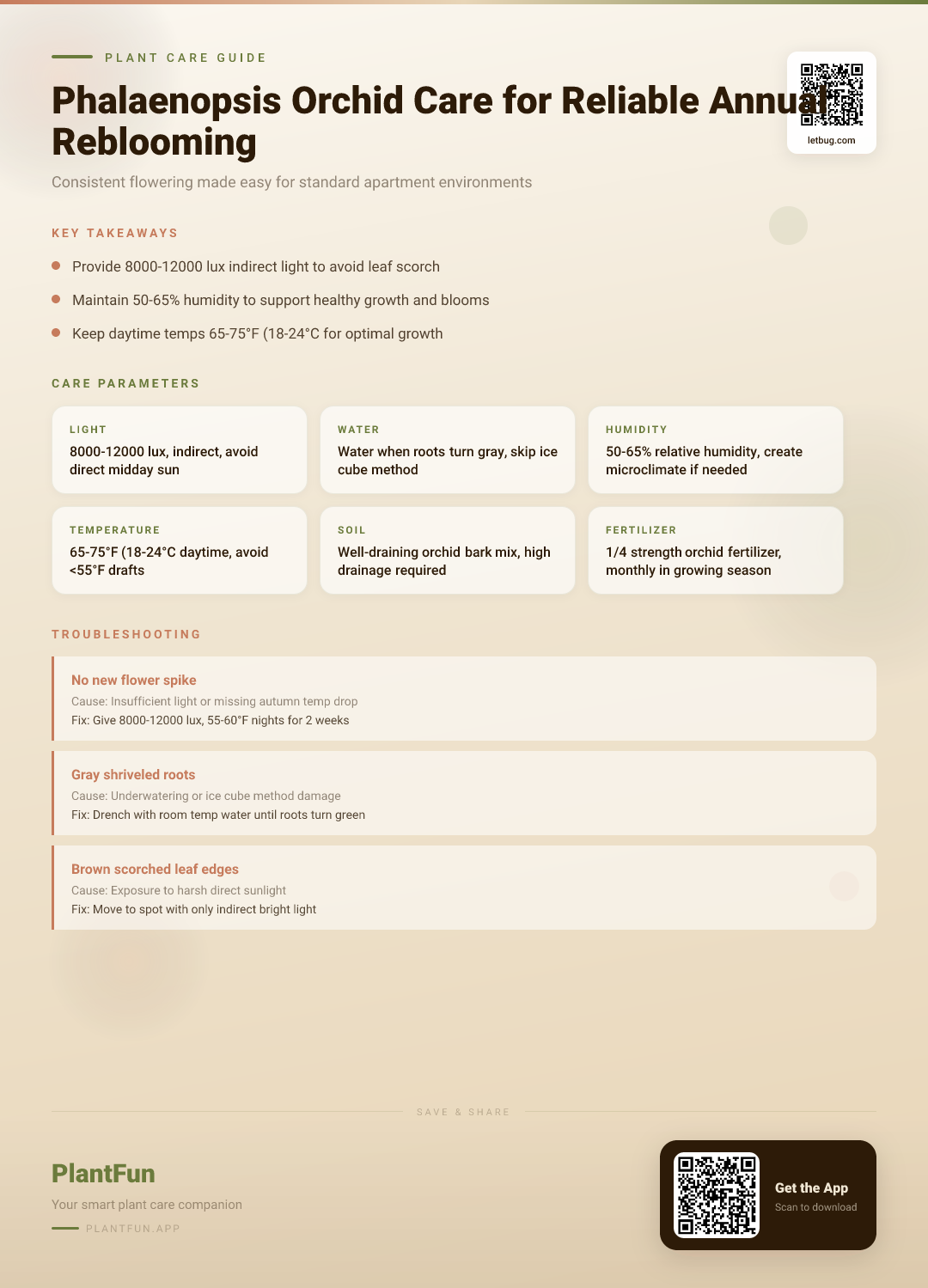
Key Takeaways
- Check soil moisture before watering — overwatering is the #1 killer of houseplants.
- Ensure your plant gets the right amount of light for its species.
- Be patient with recovery — most plants need 2–4 weeks to bounce back.
Quick Care Card: Essential Parameters for Phalaenopsis Success
| Parameter | Requirement |
|---|---|
| Light | 8,000–12,000 Lux (Bright, indirect) |
| Watering | Only when roots turn gray (typically every 7-10 days) |
| Humidity | 50–65% (Maintain via pebble tray or humidifier) |
| Temperature | 65–75°F (18–24°C) daytime |
| Substrate | High-quality orchid bark or specialized epiphytic mix |
| Fertilizer | Balanced orchid fertilizer at 1/4 strength during growth |
| Toxicity | Non-toxic to cats and dogs (ASPCA, 2026) |
TL;DR: The Truth About Apartment Orchid Longevity
Many people view the Phalaenopsis orchid as a disposable floral arrangement, but these plants are naturally long-lived epiphytes. In my experience, the secret to longevity is mimicking their native habitat: high humidity, consistent airflow, and sharp drainage. You don’t need a greenhouse to make them bloom again; you just need to stop overwatering, provide bright indirect light, and trigger the blooming cycle with a drop in nighttime temperatures. They are not designed to sit in soggy moss, and with the right adjustments, they can bloom annually for years (NC State Extension, 2026).
Why Your Orchid Stopped Blooming: Analyzing Apartment Stressors
When I first started collecting orchids, I kept mine in a dark corner, wondering why they never re-spiked. My mistake was assuming they enjoyed low light. In reality, Phalaenopsis orchids are highly responsive to their environment. Stressors like erratic temperatures from drafty apartment windows, poor airflow, and improper light are the primary culprits for non-blooming (Ko, 2018).
The Light Paradox: Providing 8,000–12,000 Lux Without Scorching Leaves
Orchids require high-quality light to store enough energy for a new flower spike. If your orchid has dark, hunter-green leaves, it is starving for light. I aim for an olive-green leaf color, which indicates a healthy, productive plant. You can achieve the required 8,000–12,000 lux by placing the plant in an east-facing window or shielding it with a sheer curtain in a southern exposure. Avoid direct midday sun, which can cause leaf burn (Babůrek, 2009).
Watering Mastery: Why the ‘Ice Cube Method’ is Failing Your Plant
The “ice cube method” is perhaps the most dangerous myth in indoor orchid care for beginners. These are tropical plants; subjecting their sensitive roots to freezing temperatures can cause cellular damage. Instead, use the “drench and drain” method. Carry your orchid to the sink, flush the substrate thoroughly with room-temperature water, and let it drain completely before returning it to its decorative pot. Never allow the plant to sit in standing water.
The 50–65% Humidity Threshold: Creating a Micro-Climate on a Budget
Apartments often have notoriously dry air, especially during winter heating months. Phalaenopsis thrive in 50–65% humidity (NC State Extension, 2026). If you notice crinkled or shriveled leaves, your ambient humidity is likely too low. I use a simple humidity tray—a shallow dish filled with pebbles and water—to increase the micro-climate around the pot without letting the roots touch the water.
Temperature Regulation: Why 65–75°F (18–24°C) Daytime Temps are Non-Negotiable
Steady temperatures are crucial for vegetative growth. However, to trigger a new flower spike in autumn, your orchid needs a consistent temperature drop of about 10–15°F at night for several weeks. Placing the orchid in a slightly cooler room (around 60–65°F at night) is often all it takes to shift the plant from “resting mode” to “blooming mode.”
Step-by-Step: Correcting Substrate Drainage and Preventing Root Rot
- Check the roots: Gently slide the plant out of its pot. If the roots are mushy or brown, you have orchid root rot signs, which requires immediate intervention.
- Trim damage: Using sterilized shears, remove all necrotic (dead) roots.
- Repot: Move the plant into a fresh best orchid potting mix for beginners, focusing on chunky bark that promotes airflow.
- Drainage: Ensure the inner nursery pot has ample drainage holes.
Seasonal Care: How to Trigger a New Flower Spike in Autumn
To encourage a rebloom, I stop using nitrogen-heavy fertilizers in early autumn. I allow the nights to cool down naturally. This signals to the orchid that the season is changing. By providing a sharp contrast between day and night temperatures, I consistently trigger the emergence of new flower spikes (Babůrek, 2009).
Voice Search FAQ: How do I get my Phalaenopsis to grow a new flower spike?
Encourage a spike by reducing nighttime temperatures to roughly 60°F (15°C) for 3–4 weeks during the fall. Ensure the plant receives consistent, bright indirect light during the day.
Voice Search FAQ: Why are the roots of my orchid turning gray instead of green?
Gray roots are a healthy indicator that the orchid is thirsty and ready for a drink. They should turn bright green shortly after watering. If they remain gray or white even after watering, you may need to check for root health issues.
Voice Search FAQ: Can I leave my orchid on a north-facing windowsill all winter?
While a north-facing window provides low, consistent light, it is often insufficient for Phalaenopsis to store the energy needed for reblooming. A southern or eastern window is preferred, provided the plant is protected from harsh, direct sun.
Common Mistakes to Avoid: From Over-Fertilizing to Poor Ventilation
- Mistake: Using standard potting soil.
- What happens: The roots suffocate and rot within weeks.
- Instead: Use an airy, bark-based mix specifically designed for epiphytes.
- Mistake: Leaving the plant in a decorative ceramic pot without drainage.
- What happens: Water pools at the bottom, leading to silent root death.
- Instead: Keep the plant in a clear plastic nursery pot and set that inside your decorative pot.
- Mistake: Heavy fertilization year-round.
- What happens: High nitrogen salts build up in the bark, burning the roots.
- Instead: Fertilize at 1/4 strength only during the active growing season (NC State Extension, 2026).
References
- Babůrek, I. (2009). Frowine, S.A.: Moth orchid. The complete guide to Phalaenopsis. Biologia plantarum. https://doi.org/10.1007/s10535-009-0040-0. Accessed 2026-03-15.
- Ko, R. (2018). Phalaenopsis aphrodite (moth orchid): Functional genomics and biotechnology. Journal of Plant Pathology & Microbiology. https://doi.org/10.4172/2157-7471-c2-010. Accessed 2026-03-15.
- American Society for the Prevention of Cruelty to Animals (ASPCA). (2026). Toxic and Non-Toxic Plants List — ASPCA. https://www.aspca.org/pet-care/animal-poison-control/toxic-and-non-toxic-plants. Accessed 2026-03-15.
- North Carolina State University Extension. (2026). Phalaenopsis Orchid Care — NC State Extension Gardener Plant Toolbox. https://plants.ces.ncsu.edu/plants/phalaenopsis-orchid/. Accessed 2026-03-15.
Optional Helper: Plantfun.App
Plantfun.App identifies your plants by photo, diagnoses pests and diseases with clear fixes, and creates personalised watering and light schedules that adapt to your home conditions — a handy companion for putting this guide into daily practice.
Found an error or have suggestions? We'd love your feedback.
Need help identifying this problem?
Get instant identification, personalized care schedules, and effective pest treatment plans directly on your phone.
Sponsored • We may earn a commission from app downloads
Related Guides
Phalaenopsis Orchid Care in Apartment Living: A Budget-Friendly Guide to Resilient Year-Round Blooms
Master Phalaenopsis orchid care in your apartment with this 5-step resilient growth plan. Get exact light levels, budget watering hacks, and bloom-boosting tips.
Care GuideThe Complete Phalaenopsis Orchid Care Checklist for Thriving in Typical Urban Apartments
Get a simple, actionable care checklist to grow resilient, repeat-blooming Phalaenopsis orchids even in low-light, dry typical apartments with no fancy equipment required. Follow our science-backed steps for consistent results.
Care GuidePhalaenopsis Orchid Care in Low-Humidity Apartments: A 5-Step Resilient Growth Guide
Revive your wilting Phalaenopsis orchid with our apartment-proof care guide. Master precise humidity, light, and watering thresholds for year-round blooms.
Pest ControlAnts on Plants: What They Mean and What to Do
Ants usually aren't eating your plant. They are farming other pests.