
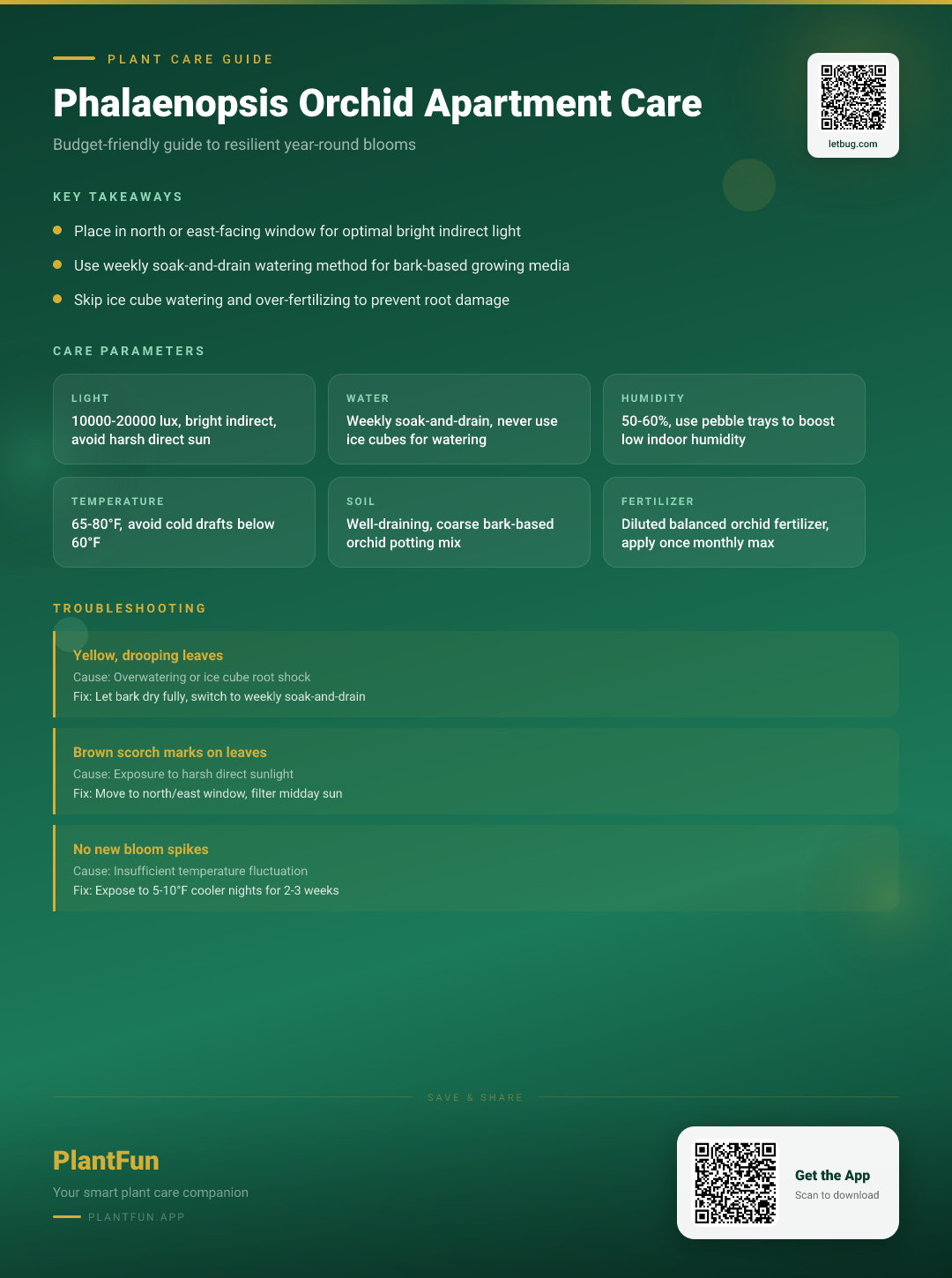
Key Takeaways
- Check soil moisture before watering — overwatering is the #1 killer of houseplants.
- Ensure your plant gets the right amount of light for its species.
- Be patient with recovery — most plants need 2–4 weeks to bounce back.
TL;DR: Keep your Phalaenopsis resilient by mimicking its natural, airy habitat. Provide bright, indirect light (10,000–20,000 lux), water only when the roots turn silvery-grey, and ensure a temperature drop in autumn to trigger spikes. Avoid ice cubes and direct sunlight at all costs. These orchids are non-toxic to pets (ASPCA, 2026).
Quick Care Card: Essential Data
| Feature | Requirement |
|---|---|
| Light | 10,000–20,000 lux (bright, indirect) |
| Watering | Weekly or when roots turn silvery-grey |
| Humidity | 50–60% |
| Temperature | 65–80°F (18–27°C) |
| Soil | Chunky bark-based orchid mix |
| Fertilizer | Balanced orchid food (half-strength) |
| Toxicity | Non-toxic to cats/dogs (ASPCA, 2026) |
Why Phalaenopsis Orchids Struggle in Typical Apartments
When I first brought home my first grocery-store Phalaenopsis, I treated it like a standard houseplant—potting it in dense soil and placing it on a dark bookshelf. Within two weeks, the roots rotted. The reality is that most apartment dwellers struggle because they treat these as terrestrial plants, ignoring their epiphytic nature (NC State Extension, 2026). They don’t want to live in wet dirt; they want to live in humid air.
Decoding the Habitat: Why Your Living Room is Actually a Rainforest
In the wild, Phalaenopsis orchids grow on tree trunks, not in the ground (Frowine, 2009). Their roots are adapted to breathe and capture moisture from humid air rather than being buried in dense, water-logged peat. Understanding this evolutionary biology—specifically the functional genomics of how they absorb nutrients—is key to keeping them alive (Ko, 2018).
Step 1: Achieving the Perfect Light Balance in North or East-Facing Windows
Light is the primary driver of blooming. You need between 10,000 and 20,000 lux (NC State Extension, 2026).
- North-Facing: Rarely enough light alone; keep the plant right against the glass.
- East-Facing: Ideal. Soft morning sun provides the necessary energy without scorching leaves.
- Test: Hold your hand 6 inches above the leaves at midday. If it casts a sharp, crisp shadow, the light is sufficient.
Step 2: The ‘Soak and Drain’ Watering Method for Bark-Based Media
Forget the watering can. The ‘soak and drain’ method is the only way to ensure the bark is hydrated without inviting rot.
- Place the plastic nursery pot in a bowl of lukewarm, de-chlorinated water.
- Let it sit for 10–15 minutes until the roots turn from silver/grey to a healthy, vibrant green.
- Remove and let every drop of excess water drain. Never let the pot sit in standing water.
Step 3: Humidity Management on a Budget: Pebble Trays vs. Daily Misting
Orchids thrive in 50–60% humidity (NC State Extension, 2026). In a dry apartment, a pebble tray is more effective than misting, as misting provides only fleeting moisture and can lead to fungal issues if water pools in the leaf crown.
- Pebble Tray Hack: Fill a shallow tray with pebbles and water. Place the pot on top of the pebbles, ensuring the bottom of the pot never touches the standing water.
Step 4: Seasonal Temperature Triggers to Force New Spikes
If your orchid hasn’t bloomed in a year, it likely needs a temperature differential. In the fall, move the orchid to a location where nighttime temperatures drop to around 60–65°F (15–18°C) for about two weeks. This “cool down” acts as a biological signal to start developing a new flower spike (Frowine, 2009).
FAQ 1: Why is my orchid leaf yellowing and drooping?
Symptom: Leaves look limp, shriveled, or yellowed at the base.
Likely cause: Root rot from overwatering or compaction of the bark media.
Fix:
- Unpot the orchid to inspect roots.
- Trim dead, mushy roots with sterilized scissors.
- Repot in fresh, airy bark media.
FAQ 2: How can I tell if my orchid is getting too much direct sun?
Symptom: Leaves have dark brown or black sunken patches.
Likely cause: Sunburn from intense, direct solar radiation.
Fix:
- Move the orchid at least 2–3 feet away from the window.
- Use a sheer curtain to diffuse the light.
FAQ 3: Can I put my orchid in a bathroom for humidity?
Yes, as long as it receives enough light. If your bathroom lacks a window, try the pebble tray method in your living area instead.
FAQ 4: How often to water Phalaenopsis in winter?
Reduce frequency to every 10–14 days, as lower light levels slow down the plant’s metabolism.
Common Mistakes: Stop Using Ice Cubes and Over-Fertilizing
- Mistake: Using ice cubes.
- What happens: The cold damages the tropical root tissue.
- Instead: Use room-temperature water.
- Mistake: Over-fertilizing.
- What happens: Fertilizer salts build up in the bark, burning roots.
- Instead: Use a balanced, water-soluble fertilizer at 1/4 strength once a month.
The Resilience Checklist: A Month-by-Month Maintenance Tracker
- Monthly: Check root color; flush the bark with plain water to remove salt buildup.
- Quarterly: Inspect for pests like mealybugs; wipe leaves with a damp cloth.
- Annually: Refresh bark media, as bark naturally decomposes over time (NC State Extension, 2026).
References and Botanical Resources
- Babůrek, I. (2009). Frowine, S.A.: Moth orchid. The complete guide to Phalaenopsis. Biologia plantarum. https://doi.org/10.1007/s10535-009-0040-0. Accessed 2026-03-10.
- Ko, R. (2018). Phalaenopsis aphrodite (moth orchid): Functional genomics and biotechnology. Journal of Plant Pathology & Microbiology. https://doi.org/10.4172/2157-7471-c2-010. Accessed 2026-03-10.
- ASPCA. (2026). Toxic and Non-Toxic Plants List — ASPCA. https://www.aspca.org/pet-care/animal-poison-control/toxic-and-non-toxic-plants. Accessed 2026-03-10.
- NC State Extension. (2026). Phalaenopsis Orchid Care — NC State Extension Gardener Plant Toolbox. https://plants.ces.ncsu.edu/plants/phalaenopsis-orchid/. Accessed 2026-03-10.
Optional Helper: Plantfun.App
Plantfun.App identifies your plants by photo, diagnoses pests and diseases with clear fixes, and creates personalised watering and light schedules that adapt to your home conditions — a handy companion for putting this guide into daily practice.
Found an error or have suggestions? We'd love your feedback.
Need help identifying this problem?
Get instant identification, personalized care schedules, and effective pest treatment plans directly on your phone.
Sponsored • We may earn a commission from app downloads
Related Guides
Phalaenopsis Orchid Care in Apartment Living: The 5-Step Path to Reliable Annual Reblooming
Stop discarding your Phalaenopsis orchid after the flowers fade. Master 5 essential care steps for consistent reblooming in your apartment all year round today.
Care GuidePhalaenopsis Orchid Care in Low-Humidity Apartments: A Budget-Friendly Blueprint for Resilient Blooms
Revive your Phalaenopsis orchid with our 3-step budget care plan. Get exact lux levels and watering cycles to ensure vibrant, lasting blooms in any apartment.
Care GuidePhalaenopsis Orchid Care Checklist For Small East-Facing Apartments: Grow Resilient Blooms Year-Round
Grow thriving, blooming Phalaenopsis orchids even in tiny east-facing apartments. Get our 8-step printable checklist, exact lux levels, and space-saving care hacks for beginners.
Pest ControlAnts on Plants: What They Mean and What to Do
Ants usually aren't eating your plant. They are farming other pests.