
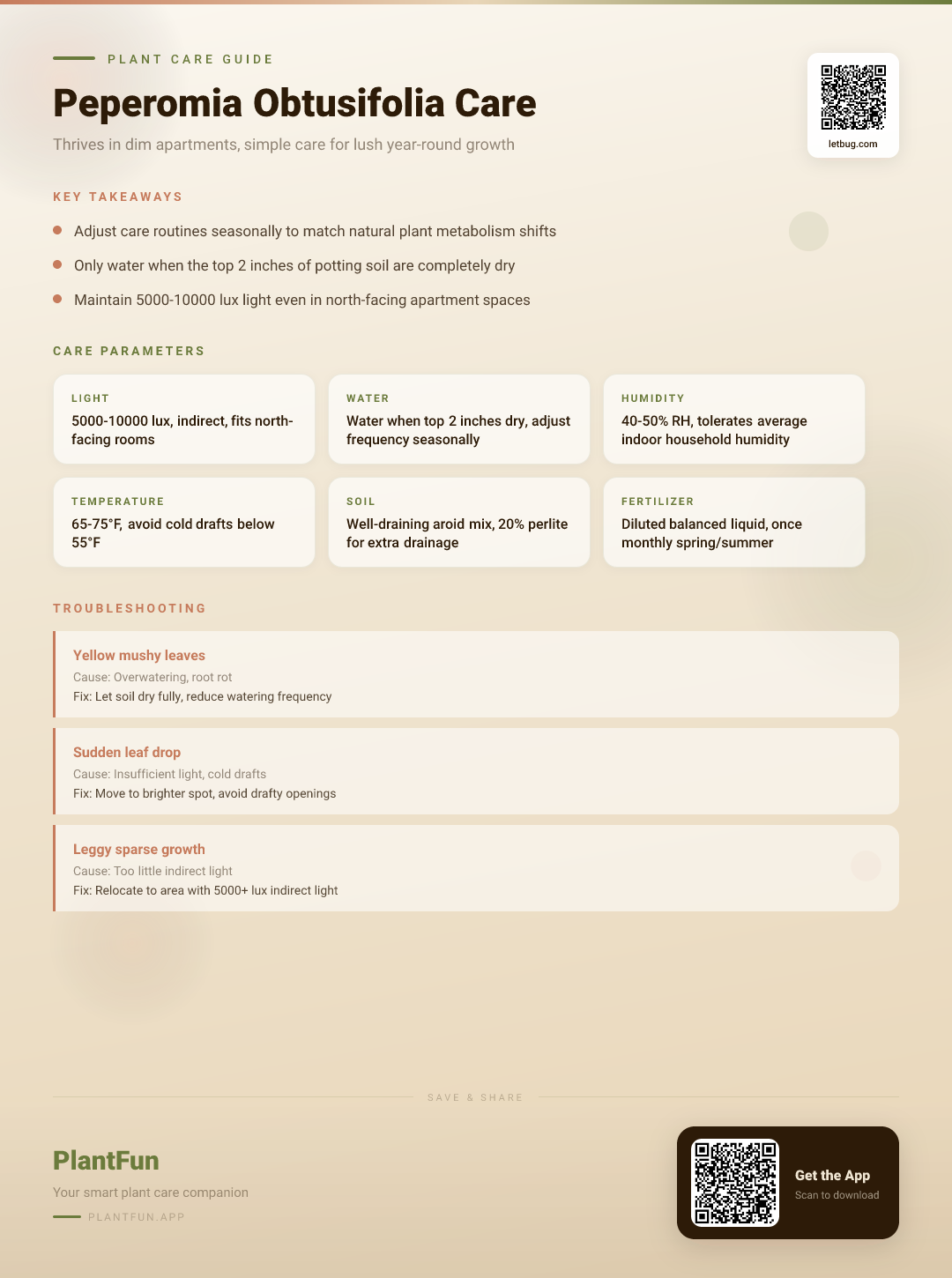
Key Takeaways
- Check soil moisture before watering — overwatering is the #1 killer of houseplants.
- Ensure your plant gets the right amount of light for its species.
- Be patient with recovery — most plants need 2–4 weeks to bounce back.
Quick Care Card: Essential Data for Peperomia obtusifolia
| Feature | Requirement |
|---|---|
| Light | 5,000–10,000 Lux (Bright, indirect) |
| Water | Allow top 2 inches of soil to dry out |
| Humidity | 40–50% (Standard home levels) |
| Temperature | 65–75°F (18–24°C) |
| Soil | Well-draining, peat-based mix |
| Fertilizer | Balanced liquid feed, monthly in summer |
| Toxicity | Non-toxic to cats and dogs (ASPCA, 2026) |
TL;DR: The 30-Second Apartment Care Summary
To keep your Peperomia obtusifolia thriving in an apartment, prioritize bright, indirect light (a few feet from a window). Water only when the top two inches of soil are dry to the touch, as overwatering is the primary cause of decline. Fertilize sparingly during the growing season and keep temperatures consistent between 65–75°F. It is a forgiving, non-toxic companion perfect for small-space living (NC State Extension, 2026).
Why Your Peperomia Needs a Seasonal Shift Strategy
When I first started collecting plants, I treated my Baby Rubber Plant like a cactus in winter and a tropical fern in summer. My mistake was consistency; I ignored that my apartment’s light levels and humidity plummeted during the heating months. Peperomia obtusifolia care requires acknowledging that your home’s microclimate changes. According to the NC State Extension (2026), these plants are native to the tropics, but in our city apartments, they react strongly to reduced daylight. If you don’t adjust your watering frequency as growth slows in autumn, you risk root rot.
Light Requirements: Maintaining 5,000-10,000 Lux in North-Facing Spaces
In a low-light apartment, light is the limiting factor. I measure light using a simple smartphone sensor to ensure my plant receives at least 5,000 lux. North-facing windows are often sufficient if the plant is placed within 12 inches of the glass. If your plant is growing tall and sparse, it is likely searching for more light (NC State Extension, 2026). Avoid direct afternoon sun, which can scorch the thick, succulent-like leaves.
Watering Protocols: Precise ml and Moisture Thresholds (Water when top 2 inches dry)
Watering is a science of touch. Never follow a calendar—always check the soil. For a standard 6-inch pot, I generally use 150ml to 200ml of room-temperature water.
- The Finger Test: Stick your index finger 2 inches into the soil. If it feels damp, wait.
- The Weight Test: Lift the pot. If it feels suspiciously light, it is time to hydrate.
Temperature & Humidity: Keeping 65-75°F and 40-50% Humidity During Winter Heating
City apartments get incredibly dry in winter due to radiator heat. I use a hygrometer to keep levels between 40-50%. If the air drops below 30%, you may notice the edges of the leaves crisping. Keep the plant away from direct drafts or vents, as sudden temperature fluctuations are detrimental to healthy foliage (Gilman, 2007).
The 4-Season Care Calendar: Adjusting for Seasonal Metabolism
- Spring: Increase water as new growth appears. Begin a mild, balanced liquid fertilizer.
- Summer: Peak growth time. Ensure 5,000–10,000 lux of light and monitor soil moisture weekly.
- Autumn: Reduce watering frequency. Cease fertilization as growth slows.
- Winter: Keep in a stable, warm spot. Allow soil to dry slightly more than in summer.
Step-by-Step Guide: Avoiding Root Rot in Plastic vs. Terra Cotta Pots
- Choose the Pot: Terra cotta is porous and dries out faster, which I prefer for beginners. Plastic retains moisture longer.
- Drainage: Ensure the pot has at least 3 drainage holes.
- The Mix: Use a mix of 60% potting soil and 40% perlite to ensure fast drainage.
- Watering: Pour water until it runs through the base. Discard excess water from the saucer within 15 minutes to prevent fungal issues.
Common Mistakes: Why Leaves Drop in Low Light
Overwatering
Symptom: Yellowing lower leaves that feel mushy or drop suddenly.
Likely cause: Excess moisture trapped in the soil.
Fix:
- Stop watering immediately.
- Check roots for brown, slimy rot and prune if necessary.
Inadequate Light
Symptom: Long, “leggy” stems with significant gaps between leaves.
Likely cause: The plant is etiolating, or stretching to find a light source.
Fix:
- Move the plant closer to a window.
- Consider a small, focused LED grow light if natural light is insufficient.
Cold Drafts
Symptom: Leaves wilting or browning despite moist soil.
Likely cause: Proximity to an air conditioner or a drafty window.
Fix:
- Relocate the plant to a warmer interior space.
- Ensure it stays above 60°F at all times.
FAQ: Why is my Peperomia growing tall and sparse?
This is typically caused by insufficient light. Research by Henny (1985) suggests that managing light and utilizing growth regulators (in commercial settings) can influence branching. At home, you can encourage bushiness by pruning the tips to force lateral growth (Henny, 1985).
FAQ: How do I know if my Peperomia needs more water?
If the leaves lose their signature turgidity—the firm, plump feel—and start to droop slightly, the plant is dehydrated. Use the finger test mentioned above to confirm.
FAQ: Can I use tap water for my Peperomia?
Yes, but if your water is heavily chlorinated, let it sit in an open container for 24 hours. This allows the chlorine to dissipate before watering.
Expert Tips for Resilient, Compact Growth
To maintain a compact shape, I rotate my plant 90 degrees every time I water. This ensures even growth on all sides. Furthermore, according to the ASPCA (2026), this plant is non-toxic, making it a safe choice for households with curious pets.
References and Botanical Notes
- Gilman, E. (2007). Peperomia obtusifolia Peperomia, Baby Rubber Plant. https://doi.org/10.32473/edis-fp466-1999. Accessed 2026-03-10.
- Henny, R. (1985). BA Induces Lateral Branching of Peperomia obtusifolia. HortScience. https://doi.org/10.21273/hortsci.20.1.115. Accessed 2026-03-10.
- ASPCA. (2026). Toxic and Non-Toxic Plants List — ASPCA. https://www.aspca.org/pet-care/animal-poison-control/toxic-and-non-toxic-plants. Accessed 2026-03-10.
- NC State Extension. (2026). Peperomia obtusifolia — NC State Extension Gardener Plant Toolbox. https://plants.ces.ncsu.edu/plants/peperomia-obtusifolia/. Accessed 2026-03-10.
Optional Helper: Plantfun.App
Plantfun.App identifies your plants by photo, diagnoses pests and diseases with clear fixes, and creates personalised watering and light schedules that adapt to your home conditions — a handy companion for putting this guide into daily practice.
Found an error or have suggestions? We'd love your feedback.
Need help identifying this problem?
Get instant identification, personalized care schedules, and effective pest treatment plans directly on your phone.
Sponsored • We may earn a commission from app downloads
Related Guides
Peperomia obtusifolia in Apartment Settings: The Only Care Guide You’ll Ever Need
Master your Peperomia obtusifolia care with 4 specific light and water thresholds. Learn how to prevent yellowing leaves and ensure resilient indoor growth.
Care GuideThe Complete Peperomia Obtusifolia Care Guide for Urban Apartments: Resilient Growth Made Easy
Get a step-by-step peperomia care checklist tailored for small urban apartments, with exact light, water, and humidity thresholds to grow lush, resilient plants with zero guesswork.
Care GuidePeperomia obtusifolia in a Low-Light Apartment: The Complete Care Guide for Resilient Growth
Revive your leggy Peperomia obtusifolia with our budget-friendly care plan. Master exact light levels, watering schedules, and soil mixes for resilient growth.
Safety GuidePeperomia Obtusifolia Placement Guide for Family Living Rooms: Pet & Child Safe Substitutions Included
Keep your family and pets safe while growing beautiful indoor greenery. Get exact Peperomia obtusifolia placement tips, care thresholds, and 3 non-toxic substitutions for common toxic living room plants.