
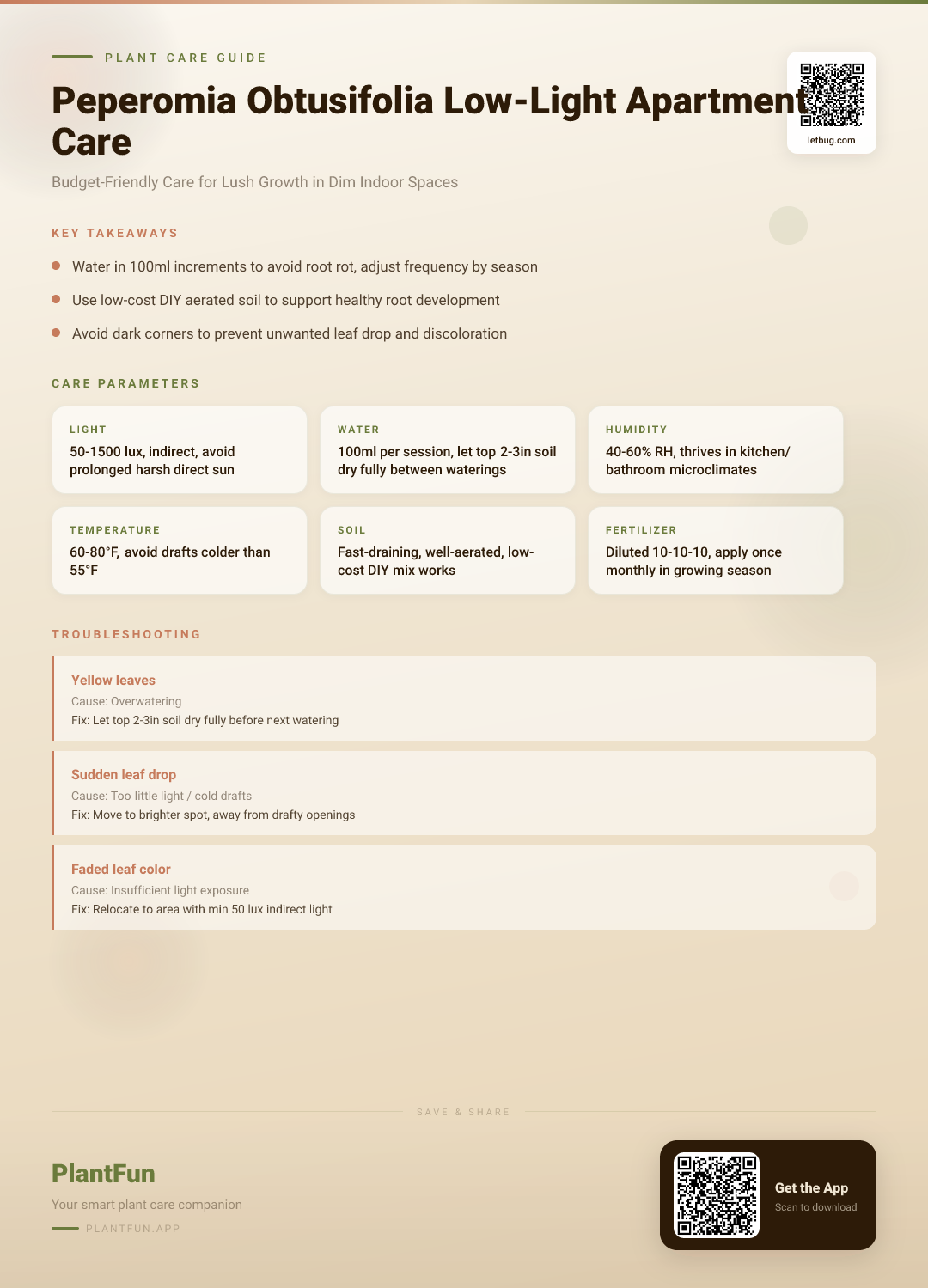
Key Takeaways
- Check soil moisture before watering — overwatering is the #1 killer of houseplants.
- Ensure your plant gets the right amount of light for its species.
- Be patient with recovery — most plants need 2–4 weeks to bounce back.
Quick Care Card: Essential Thresholds for Your Peperomia
| Feature | Requirement |
|---|---|
| Light | Bright indirect (5,000–10,000 lux) |
| Water | When top 50% of soil is dry |
| Humidity | 40–50% (Average household) |
| Temperature | 65–75°F (18–24°C) |
| Soil | Well-draining, peat-based mix |
| Fertilizer | Balanced liquid (diluted), monthly in spring/summer |
| Toxicity | Non-toxic to cats and dogs |
TL;DR: Why Peperomia obtusifolia is the Ultimate Apartment Survivor
If you live in a dim apartment, you don’t need a massive budget to keep plants alive. Peperomia obtusifolia, or the Baby Rubber Plant, is an ideal candidate for urban dwellers. It thrives in moderate light and stores water in its succulent-like leaves, making it forgiving of occasional neglect (NC State Extension, 2026). By mastering simple watering and soil aeration techniques, you can foster lush growth without expensive gear.
Understanding Your Apartment Light: How to Maximize Limited Lux
When I first got my Peperomia, I made the mistake of hiding it in a corner too far from my window. I soon learned that while they tolerate lower light, they perform best at 5,000–10,000 lux (Gilman, 2007). In my apartment, that means placing the pot on a bookshelf no more than 3 feet from a north-facing window.
- The Light Test: Hold your hand 12 inches above the plant during the day. If your shadow is soft and fuzzy rather than sharp, your light level is likely appropriate for sustained, slow growth.
Step 1: The Budget Watering Strategy (How to avoid root rot with 100ml increments)
Overwatering is the fastest way to kill a Peperomia. I recommend the “finger-depth” check: reach into the soil to the second knuckle. If you feel moisture, wait. When you do water, avoid heavy soaking that leads to waterlogged roots. I typically use a 100ml measure to ensure I am providing just enough hydration to reach the roots without saturation. If you are struggling with a schedule, check out our indoor plant maintenance checklist for more consistency.
Step 2: Soil Science for Beginners: DIY Aeration for Just Pennies
Commercial potting mixes are often too dense. To mimic the ideal, airy environment, I mix my standard potting soil with cheap perlite or coarse sand at a 3:1 ratio. This simple amendment ensures oxygen reaches the roots, preventing the anaerobic conditions that cause root rot (NC State Extension, 2026).
Step 3: Humidity Hacks: Why Your Kitchen is the Perfect Microclimate
Peperomia species prefer 40-50% relative humidity. You don’t need an expensive humidifier. Placing your plant in the kitchen or bathroom creates a natural microclimate where daily household activity keeps the air moist. Just ensure the plant isn’t sitting directly in a cold draft.
Step 4: Seasonal Adjustments: Managing Growth Cycles from Winter to Summer
During winter, the plant’s metabolism slows down. I reduce my watering by about 30% and stop fertilizing entirely between November and February. As light levels return in spring, Peperomia responds well to subtle hormonal triggers for lateral branching (Henny, 1985). This is the best time to consider Peperomia obtusifolia propagation if you want to expand your collection for free.
Common Mistakes to Avoid: Why Leaf Drop Happens in Dark Corners
- Mistake: Watering on a calendar schedule. What happens: Root rot and eventual leaf yellowing. Instead: Only water when the top 50% of the soil is dry.
- Mistake: Using a pot without drainage holes. What happens: Water pools at the bottom, suffocating the plant. Instead: Always use pots with drainage or a nursery liner.
- Mistake: Ignoring pest signs. What happens: Infestations spread rapidly in stagnant air. Instead: Wipe leaves monthly with a damp cloth; this keeps them clean and dust-free.
FAQ: Why is my Peperomia losing its green color?
If the foliage is fading to a pale lime or yellow, it is likely receiving too much direct light, which can cause chlorophyll degradation. Conversely, if it loses its variegation, it might be starving for more light. Adjust your placement by a few inches and monitor.
FAQ: Can I keep my Peperomia in a bathroom without windows?
Strictly speaking, no. While the humidity is beneficial, all plants require light to photosynthesize. If your bathroom has no windows, you will eventually see the plant decline. It is better to move it to a brighter room and use budget houseplant care tips to manage humidity elsewhere.
FAQ: How do I know if I’m overwatering my plant?
Look for soft, mushy stems or leaves that drop suddenly despite being plump. This is a classic symptom of overwatering and potential root rot (NC State Extension, 2026). If you suspect this, check your drainage immediately.
Expert Tips for Resilient Growth: Managing Pests on a Budget
If you spot small, web-like structures or white, cottony masses, you have pests. Don’t buy expensive systemic chemicals. A simple mix of water and a drop of dish soap (not detergent) wiped onto the leaves every three days for two weeks will handle most common indoor pests effectively. Also, remember that the ASPCA classifies Peperomia as non-toxic to both cats and dogs, making it a safe choice for pet owners (ASPCA, 2026).
References
- Gilman, E. (2007). Peperomia obtusifolia Peperomia, Baby Rubber Plant. https://doi.org/10.32473/edis-fp466-1999. Accessed 2026-03-19.
- Henny, R. (1985). BA Induces Lateral Branching of Peperomia obtusifolia. HortScience. https://doi.org/10.21273/hortsci.20.1.115. Accessed 2026-03-19.
- ASPCA. (2026). Toxic and Non-Toxic Plants List — ASPCA. https://www.aspca.org/pet-care/animal-poison-control/toxic-and-non-toxic-plants. Accessed 2026-03-19.
- NC State Extension. (2026). Peperomia obtusifolia — NC State Extension Gardener Plant Toolbox. https://plants.ces.ncsu.edu/plants/peperomia-obtusifolia/. Accessed 2026-03-19.
Optional Helper: Plantfun.App
Plantfun.App identifies your plants by photo, diagnoses pests and diseases with clear fixes, and creates personalised watering and light schedules that adapt to your home conditions — a handy companion for putting this guide into daily practice.
Found an error or have suggestions? We'd love your feedback.
Need help identifying this problem?
Get instant identification, personalized care schedules, and effective pest treatment plans directly on your phone.
Sponsored • We may earn a commission from app downloads
Related Guides
Peperomia obtusifolia in Apartment Settings: The Only Care Guide You’ll Ever Need
Master your Peperomia obtusifolia care with 4 specific light and water thresholds. Learn how to prevent yellowing leaves and ensure resilient indoor growth.
Care GuidePeperomia Obtusifolia in Dim Apartments: The Complete Budget-Friendly Care Guide for Resilient Growth
Transform your Peperomia into a lush apartment statement piece. Master precise 200ml watering cycles and low-light management for stress-free, resilient growth.
Care GuidePeperomia obtusifolia in Dim Apartments: The 5-Step Rescue Plan for Resilient Growth
Revive your struggling Peperomia obtusifolia with our expert-backed recovery plan. Discover exact lux levels, watering volumes, and fixes for drooping leaves.
Safety GuidePeperomia Obtusifolia Placement Guide for Family Living Rooms: Pet & Child Safe Substitutions Included
Keep your family and pets safe while growing beautiful indoor greenery. Get exact Peperomia obtusifolia placement tips, care thresholds, and 3 non-toxic substitutions for common toxic living room plants.