
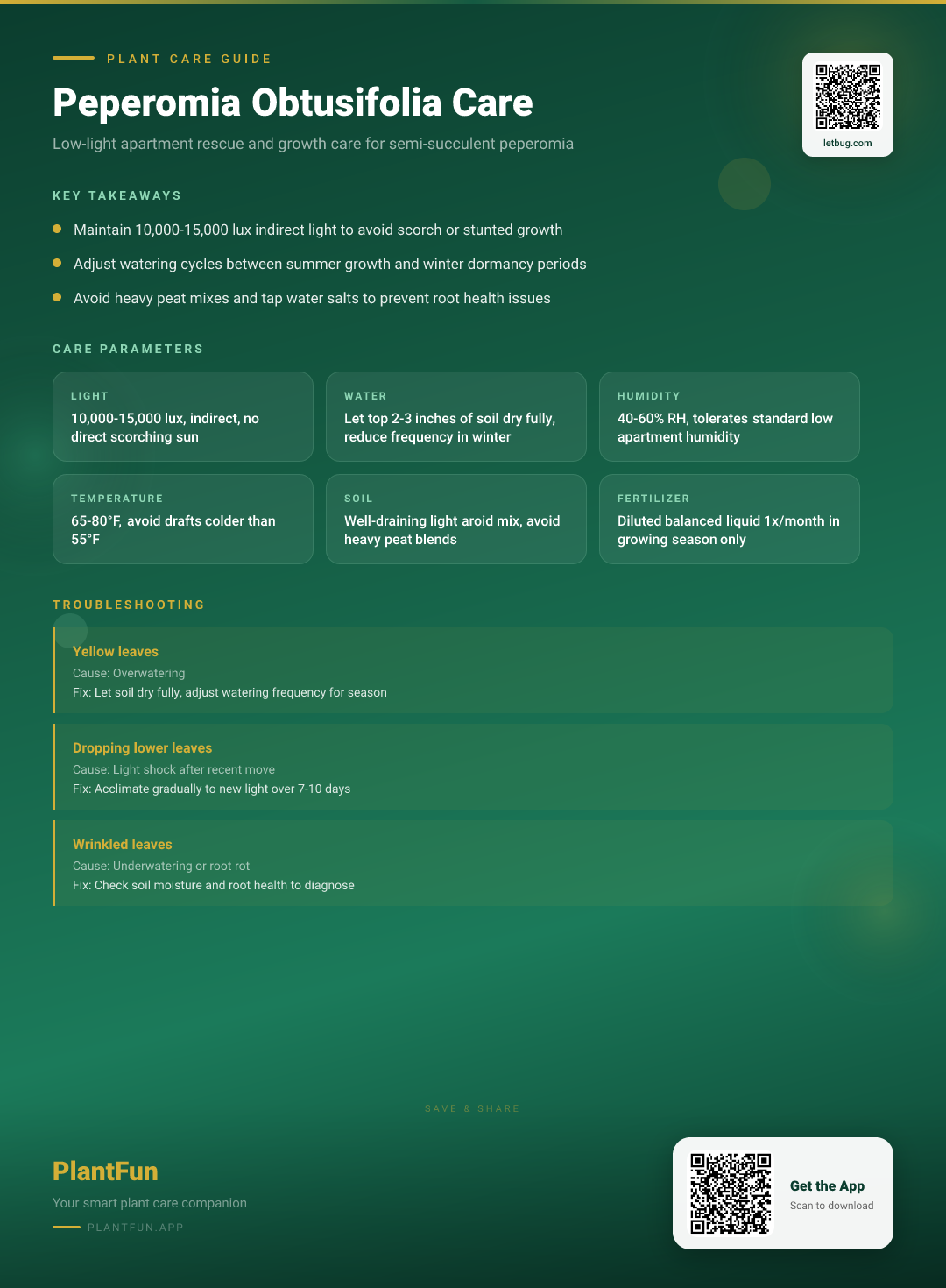
Key Takeaways
- Check soil moisture before watering — overwatering is the #1 killer of houseplants.
- Ensure your plant gets the right amount of light for its species.
- Be patient with recovery — most plants need 2–4 weeks to bounce back.
Quick Care Card: Essential Thresholds for Peperomia Success
| Feature | Optimal Range |
|---|---|
| Light | 10,000–15,000 Lux (Bright, indirect) |
| Watering | Allow top 50% of soil to dry out |
| Humidity | 40%–60% (Moderate) |
| Temperature | 65°F–75°F (18°C–24°C) |
| Soil | Chunky, well-draining aroid/succulent mix |
| Fertilizer | Balanced liquid feed, half-strength (Spring/Summer) |
| Toxicity | Non-toxic to cats and dogs (ASPCA, 2026) |
TL;DR: Why Your Peperomia Is Struggling in a Typical Apartment Setting
Your Peperomia obtusifolia is likely failing because it is being treated like a high-humidity tropical fern rather than the semi-succulent it actually is. In an apartment, the primary killers are waterlogged, dense soil and insufficient light levels. To revive your plant, move it to a brighter spot, switch to a chunky potting medium, and strictly wait for the top 50% of the soil to dry before the next watering.
Understanding the Semi-Succulent Nature: Why Your Apartment Isn’t a Greenhouse
When I first started collecting plants, I made the mistake of keeping my Peperomia obtusifolia in a dark bathroom, assuming it loved the humidity. I watched it slowly lose leaves. The reality is that while it is a tropical native, its thick, fleshy leaves are designed to store water, acting as a biological buffer (NC State Extension, 2026). In an apartment, air circulation is often lower than in a greenhouse, meaning water doesn’t evaporate from the soil surface quickly. If you treat it like a thirsty fern, the roots will inevitably suffocate.
Root Cause Analysis: Identifying Common Symptoms of Improper Care
Yellowing Leaves
Symptom: Lower leaves turning yellow and mushy.
Likely cause: Overwatering leading to root hypoxia.
Fix:
- Gently unpot the plant to inspect for brown, mushy roots.
- Trim away necrotic tissue and repot in fresh, dry, fast-draining substrate.
Leaf Drop
Symptom: Sudden loss of lower, seemingly healthy leaves.
Likely cause: Significant light deficit forcing the plant to shed energy-consuming foliage.
Fix:
- Move the plant within 2-3 feet of a south or east-facing window.
- Consider supplementing with a full-spectrum LED grow light set to 12 hours/day.
Wrinkled Foliage
Symptom: Leaves appearing puckered or thin rather than plump.
Likely cause: Chronic underwatering or root system damage preventing moisture uptake.
Fix:
- Check the soil moisture; if bone dry, perform a thorough soak-and-drain.
- If soil is wet but leaves remain wrinkled, the roots have likely rotted away—repotting is required.
Step-by-Step Recovery Plan: Rescuing a Peperomia from Overwatering or Light Deficit
- Diagnosis: Test the soil moisture with your finger. If it feels like wet clay, stop watering immediately.
- Repotting: Transfer the plant to a pot with drainage holes using a mix of 50% potting soil and 50% perlite or pumice to ensure maximum aeration.
- Sanitation: Trim back any stems that appear weak to stimulate lateral branching (Henny, 1985).
- Placement: Position in a location receiving 10,000–15,000 lux. In an apartment, this usually means an unobstructed window sill or a spot 1-2 feet from a window (Gilman, 2007).
Environmental Calibration: Achieving 10,000–15,000 Lux Without Direct Scorching
Direct, harsh sun can scorch the leaves, but Peperomia obtusifolia requires significant brightness to maintain its compact, attractive growth habit. Use a light meter app or observe the shadows: if the plant casts a sharp, defined shadow, the light is sufficient. If the shadow is blurry or non-existent, your plant is effectively starving for fuel.
Seasonal Care Calendar: Adjusting Watering Cycles from Summer Growth to Winter Dormancy
- Spring/Summer: The plant enters a growth phase. Water when the top 50% of the soil is dry. You may need to water every 7–10 days.
- Fall/Winter: Growth slows significantly. Allow the soil to dry out almost completely before watering. Always ensure no standing water remains in the cache pot.
FAQ: Why is my Peperomia dropping lower leaves after I moved it?
Plants often undergo a period of acclimatization. If you moved it to a darker spot, the plant is shedding leaves it can no longer support with its current energy intake. Return it to a brighter environment immediately.
FAQ: Can I keep my Peperomia in a windowless room with just a desk lamp?
Generally, no. Standard desk lamps do not provide the necessary light intensity or spectrum (PAR) for long-term health. Unless you have a high-output, full-spectrum LED placed within 6 inches of the foliage, the plant will eventually decline.
FAQ: How do I know if the wrinkling on my leaves is thirst or root rot?
Perform the “lift test”: If the pot feels light and the soil is bone dry, it is thirst. If the pot feels heavy and the soil remains wet, your roots have likely died due to rot and can no longer hydrate the plant. See my guide on proper soil drainage techniques for more.
Common Mistakes to Avoid: From Heavy Peat Mixes to Tap Water Salts
- Mistake: Using dense, moisture-retentive peat moss soil.
- What happens: The soil stays wet for too long, depriving roots of oxygen.
- Instead: Use a well-aerated mix featuring pine bark, perlite, and a small amount of coco coir.
- Mistake: Watering with hard tap water.
- What happens: Mineral salt buildup creates leaf tip burn.
- Instead: Use filtered or rainwater to keep soil pH stable.
References
- Gilman, E. (2007). Peperomia obtusifolia Peperomia, Baby Rubber Plant. EDIS. https://doi.org/10.32473/edis-fp466-1999. Accessed 2026-03-17.
- Henny, R. (1985). BA Induces Lateral Branching of Peperomia obtusifolia. HortScience. https://doi.org/10.21273/hortsci.20.1.115. Accessed 2026-03-17.
- ASPCA. (2026). Toxic and Non-Toxic Plants List — ASPCA. https://www.aspca.org/pet-care/animal-poison-control/toxic-and-non-toxic-plants. Accessed 2026-03-17.
- NC State Extension. (2026). Peperomia obtusifolia — NC State Extension Gardener Plant Toolbox. https://plants.ces.ncsu.edu/plants/peperomia-obtusifolia/. Accessed 2026-03-17.
Optional Helper: Plantfun.App
Plantfun.App identifies your plants by photo, diagnoses pests and diseases with clear fixes, and creates personalised watering and light schedules that adapt to your home conditions — a handy companion for putting this guide into daily practice.
Found an error or have suggestions? We'd love your feedback.
Need help identifying this problem?
Get instant identification, personalized care schedules, and effective pest treatment plans directly on your phone.
Sponsored • We may earn a commission from app downloads
Related Guides
Peperomia obtusifolia in Apartment Living: The Only Care Guide You’ll Ever Need for Resilient Growth
Revive your struggling Peperomia obtusifolia with our expert care guide. Learn exact light, water, and humidity thresholds for lush, upright leaves in any apartment.
Care GuidePeperomia Obtusifolia in a Low-Light Apartment: The Ultimate Seasonal Routine for Resilient Growth
Transform your Peperomia into a lush, thriving centerpiece. Master exact light levels, seasonal watering cycles, and apartment-specific growth hacks today.
Care GuideThe Complete Peperomia Obtusifolia Care Checklist for Resilient Growth in Typical Urban Apartments
Keep your peperomia thriving even in a small, low-humidity urban apartment. Grab our printable care checklist, exact light/water thresholds, and stress-fixing tips for resilient growth all year.
Safety GuidePeperomia Obtusifolia Placement Guide for Family Living Rooms: Pet & Child Safe Substitutions Included
Keep your family and pets safe while growing beautiful indoor greenery. Get exact Peperomia obtusifolia placement tips, care thresholds, and 3 non-toxic substitutions for common toxic living room plants.