
Key Takeaways
- Check soil moisture before watering — overwatering is the #1 killer of houseplants.
- Ensure your plant gets the right amount of light for its species.
- Be patient with recovery — most plants need 2–4 weeks to bounce back.
Quick Care Card
| Feature | Requirement |
|---|---|
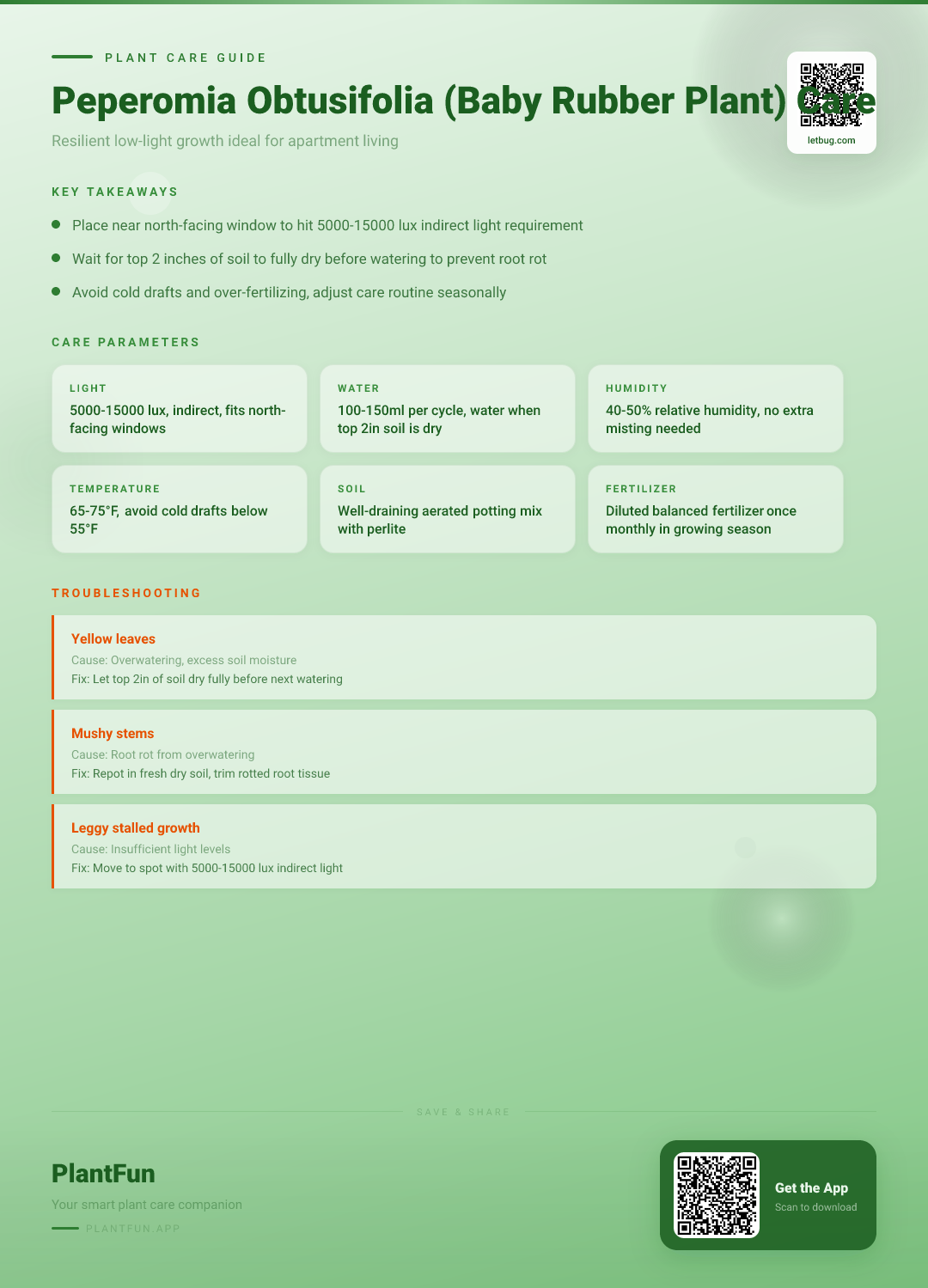
| Light | 5,000–15,000 lux (bright, indirect) |
| Water | 100-150ml when top 2 inches of soil are dry |
| Humidity | 40-50% (Ambient) |
| Temperature | 65-75°F (18-24°C) |
| Soil | Well-draining, peat-based mix |
| Fertilizer | Balanced liquid feed, monthly in spring/summer |
| Toxicity | Non-toxic to cats and dogs (ASPCA, 2026) |
TL;DR: Why Peperomia obtusifolia thrives in apartments.
The Peperomia obtusifolia, or baby rubber plant, is the ultimate urban companion. Because it naturally occupies the understory of tropical forests (Gilman, 2007), it is biologically equipped to handle lower light conditions than most houseplants. It stores water in its thick, succulent leaves, making it forgiving for beginners who occasionally forget a watering cycle.
Understanding the Baby Rubber Plant: Natural habitat vs. apartment living.
When I first started my indoor gardening journey, I assumed all “tropical” plants needed direct sun. I placed my first Peperomia on a sunny windowsill, and the leaves promptly burned. I later realized that in its native habitat, this plant grows in the dappled light of the forest floor, not in direct tropical sun (Gilman, 2007). In an apartment, this means we should mimic that canopy-filtered light rather than blasting the plant with raw southern sun.
The Lighting Threshold: Managing 5,000–15,000 lux in north-facing windows.
Finding the “sweet spot” for light is crucial. While the Peperomia obtusifolia is often labeled as a “low light” plant, it performs best when it receives consistent, indirect illumination (NC State Extension, 2026). If you have a north-facing window, place your plant within 2-3 feet of the glass. If your apartment is darker, supplemental LED growth lights can easily hit the 5,000–15,000 lux range required for steady, compact growth.
Hydration Science: Why waiting for the top 2 inches of soil to dry prevents root rot.
Root rot is the number one killer of indoor Peperomias. I make a habit of checking my plants every 7-10 days by sticking my finger two inches into the soil. If it feels damp, I walk away. The plant’s succulent nature means it prefers a “soak and dry” cycle rather than keeping the potting medium consistently moist, which can suffocate the roots (NC State Extension, 2026).
Step-by-Step Care Guide
- Potting Mix: Use a mix consisting of 50% potting soil and 50% perlite or pumice to ensure maximum drainage.
- Watering: Provide 100-150ml of water only when the top 2 inches are dry. Ensure water drains fully from the bottom; never let the pot sit in a saucer of standing water.
- Fertilizing: Apply a balanced, water-soluble fertilizer at half-strength once a month from April to August. Research indicates that specific plant growth regulators can even be used in commercial settings to induce branching, though standard pruning is sufficient for home gardeners (Henny, 1985).
- Pruning: If your plant looks unruly, snip the stems just above a leaf node to encourage new growth (Henny, 1985).
Symptom-to-Action Checklist
[Yellowing Leaves]
Symptom: Lower leaves turn yellow and drop frequently.
Likely cause: Overwatering leading to root stress.
Fix:
- Withhold water for two weeks.
- Check drainage holes for blockages.
[Mushy Stems]
Symptom: The base of the stem feels soft or translucent.
Likely cause: Advanced root rot due to waterlogged soil.
Fix:
- Remove the plant from the pot and trim away black, mushy roots.
- Repot into fresh, dry, porous soil.
[Stalled Growth]
Symptom: The plant stops producing new leaves for months.
Likely cause: Insufficient light or root-bound conditions.
Fix:
- Move to a brighter location (5,000+ lux).
- Check if roots are circling the pot and upgrade to a container only 1-2 inches larger.
Frequently Asked Questions
- Can I keep my Peperomia in a room without windows? While it might survive for a short time, it will eventually decline. You must provide artificial light to hit the 5,000 lux threshold.
- Why is my Peperomia getting long and leggy? This is a classic “stretching” response to insufficient light. The plant is literally reaching for the sun. Move it closer to your light source.
- How do I know if my Peperomia is getting too much water? If the soil stays wet for more than 5 days, or if the leaves feel soft and limp rather than firm, you are likely overwatering.
Common Apartment Mistakes
- Mistake: Using a pot without a drainage hole. What happens: Water accumulates at the bottom, rotting the root system. Instead: Always use a pot with a drainage hole or keep the plant in its nursery plastic liner inside a decorative cachepot.
- Mistake: Placing the plant near a drafty window in winter. What happens: Sudden cold temperatures can cause leaf drop. Instead: Move the plant away from windows during freezing nights or use an insulating curtain.
Seasonal Maintenance
During the winter, the sun’s intensity drops. I significantly reduce my watering frequency during these months, as the plant’s metabolic rate slows down. Avoid fertilizing entirely between November and March to prevent salt buildup in the soil (NC State Extension, 2026).
References
- Gilman, E. (2007). Peperomia obtusifolia Peperomia, Baby Rubber Plant. EDIS. https://doi.org/10.32473/edis-fp466-1999. Accessed 2026-03-09.
- Henny, R. (1985). BA Induces Lateral Branching of Peperomia obtusifolia. HortScience. https://doi.org/10.21273/hortsci.20.1.115. Accessed 2026-03-09.
- ASPCA. (2026). Toxic and Non-Toxic Plants List — ASPCA. https://www.aspca.org/pet-care/animal-poison-control/toxic-and-non-toxic-plants. Accessed 2026-03-09.
- NC State Extension. (2026). Peperomia obtusifolia — NC State Extension Gardener Plant Toolbox. https://plants.ces.ncsu.edu/plants/peperomia-obtusifolia/. Accessed 2026-03-09.
Optional Helper: Plantfun.App
Plantfun.App identifies your plants by photo, diagnoses pests and diseases with clear fixes, and creates personalised watering and light schedules that adapt to your home conditions — a handy companion for putting this guide into daily practice.
Found an error or have suggestions? We'd love your feedback.
Need help identifying this problem?
Get instant identification, personalized care schedules, and effective pest treatment plans directly on your phone.
Sponsored • We may earn a commission from app downloads
Related Guides
Baby Rubber Plant (Peperomia obtusifolia) in Small City Apartments: The Only Care Guide You'll Ever Need
Stop guessing at your Peperomia care routine. Get exact light levels, water amounts, and a seasonal apartment-specific calendar to grow lush, resilient Baby Rubber Plants all year.
Care GuideThe Complete Peperomia Obtusifolia Care Guide for Urban Apartments: Resilient Growth Made Easy
Get a step-by-step peperomia care checklist tailored for small urban apartments, with exact light, water, and humidity thresholds to grow lush, resilient plants with zero guesswork.
Care GuidePeperomia obtusifolia in a Low-Light Apartment: The Ultimate Seasonal Growth and Care Guide
Transform your dim apartment into a thriving indoor jungle. Get specific lux, precise watering ml, and a 4-season care calendar to keep your Peperomia vibrant.
Safety GuidePeperomia Obtusifolia Placement Guide for Family Living Rooms: Pet & Child Safe Substitutions Included
Keep your family and pets safe while growing beautiful indoor greenery. Get exact Peperomia obtusifolia placement tips, care thresholds, and 3 non-toxic substitutions for common toxic living room plants.