
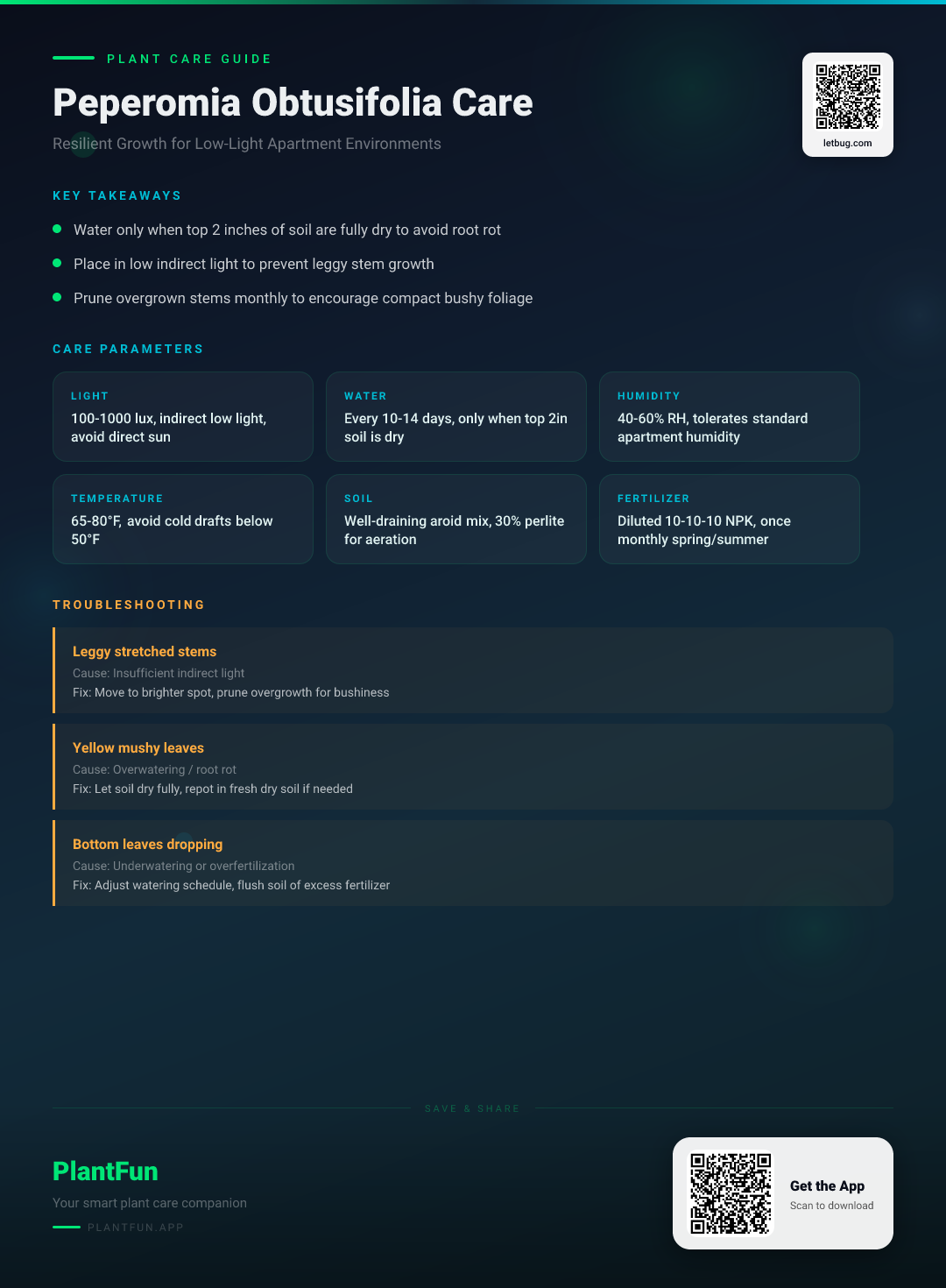
Key Takeaways
- Check soil moisture before watering — overwatering is the #1 killer of houseplants.
- Ensure your plant gets the right amount of light for its species.
- Be patient with recovery — most plants need 2–4 weeks to bounce back.
Quick Care Card: Essential Thresholds for Success
| Feature | Requirement |
|---|---|
| Light | Bright, indirect light (can tolerate lower light, but growth slows) |
| Water | Allow top 50% of soil to dry out (NC State Extension, 2026) |
| Humidity | 40-60% (average household levels are usually sufficient) |
| Temperature | 65°F to 80°F (18°C - 27°C) |
| Soil | Well-draining, peat-based mix with perlite |
| Fertilizer | Balanced liquid fertilizer, half-strength, monthly in growing season |
| Toxicity | Non-toxic to cats and dogs (ASPCA, 2026) |
TL;DR: Why Your Peperomia is Struggling in a Typical Apartment
Your Peperomia obtusifolia (Baby Rubber Plant) is likely struggling because it is receiving too little light to maintain its compact, succulent-like structure, leading it to stretch for a light source. In low-light apartment settings, this plant retains water longer than expected, which can lead to root rot. To fix this, you must adjust your watering schedule to account for the reduced photosynthesis rate and place the plant as close to a natural light source as possible without exposing it to harsh, direct midday sun.
Understanding the Habitat: Why Peperomias are Natural Apartment Champions
When I first brought home my first Peperomia obtusifolia, I made the mistake of placing it in a dark corner of my bedroom. Within a month, it had lost its signature stout, thick leaves and looked like a stringy vine. What I didn’t realize is that while these plants are native to the forest understories of Florida, Mexico, and the Caribbean (Gilman, 2007), they require enough ambient light to maintain their cellular integrity. They are “apartment champions” because they possess semi-succulent leaves, which allow them to store moisture, making them forgiving if you miss a watering session (NC State Extension, 2026). However, they are not “shade plants” in the literal sense; they simply don’t crave the direct, scorching sun that a cactus would.
Step-by-Step Care Guide: Managing Light, Water, and Soil
- Light: Place your plant in an east-facing window or 3-5 feet away from a south-facing window. If your apartment has zero windows, you will need a modest LED grow light set for 8-10 hours a day.
- Watering: Do not use a calendar. Instead, use the “finger test.” Push your index finger 2 inches into the soil. If it feels damp, wait. If it is dry, water until excess drains from the bottom of the pot (NC State Extension, 2026).
- Soil: Ensure your pot has drainage holes. Use a mix of 60% standard potting soil and 40% perlite to ensure the root zone never stays waterlogged.
The 7-Step Budget-Friendly Recovery Plan for Leggy Stems
- Assess the light: Move your plant within 2 feet of your brightest window.
- Prune strategically: Cut back the “leggy” stems just above a leaf node. This triggers the plant to push out new, compact growth (Henny, 1985).
- Clean the leaves: Dust blocks light absorption. Gently wipe leaves with a damp cloth.
- Check drainage: If the soil hasn’t dried in 14 days, repot into a container with better drainage.
- Rotate: Every week, rotate the pot 90 degrees to ensure even light distribution.
- Hold the fertilizer: Do not fertilize a stressed, leggy plant. Wait until you see new, healthy growth.
- Patience: Recovery takes 4-8 weeks. Do not rush the process by overwatering.
Seasonal Care Calendar: From High-Growth Summer to Dormant Winter
- Spring/Summer: This is the peak growth phase. Fertilize with a balanced 10-10-10 at half-strength every 4-6 weeks.
- Fall/Winter: Growth slows significantly due to lower light levels (Peperomia winter care). Reduce watering frequency by 30-50% and pause all fertilization until the days get longer (Gilman, 2007).
Common Mistakes That Kill Peperomias (And How to Avoid Them)
Overwatering
Symptom: Leaves turn yellow and drop suddenly.
Likely cause: Roots sitting in saturated soil, leading to decay.
Fix:
- Remove the plant from the pot.
- Trim away mushy, black roots.
- Repot in fresh, dry, well-draining soil.
Improper Light
Symptom: Stems are long with large gaps between leaves.
Likely cause: Etiolation (stretching to find light).
Fix:
- Move to a brighter spot.
- Prune back the leggy growth.
Voice-Search FAQ: Can I keep my Peperomia in a windowless bathroom?
While it loves the humidity of a bathroom, it cannot survive without a light source. If you have no window, you must install a dedicated full-spectrum LED grow light, or the plant will eventually die from a lack of energy production.
Voice-Search FAQ: Why is my Peperomia losing its bottom leaves?
This is often a sign of “old age” leaves shedding or, more commonly, uneven watering. If the leaves are yellowing before falling, check your soil moisture; you are likely keeping it too wet. If they are just dropping while remaining green, your plant may be trying to conserve energy due to low light levels.
Advanced Care: When and How to Propagate Your Peperomia
Propagating Peperomia obtusifolia is simple and rewarding. You can use leaf cuttings or stem cuttings. For stem cuttings, ensure you have at least 3 inches of stem and remove the bottom leaves. Place the cutting in a glass of water, changing the water weekly, or place directly into moist perlite. Rooting usually occurs in 3-4 weeks (Henny, 1985).
References and Botanical Resources
- Gilman, E. (2007). Peperomia obtusifolia Peperomia, Baby Rubber Plant. EDIS. https://doi.org/10.32473/edis-fp466-1999. Accessed 2026-03-13.
- Henny, R. (1985). BA Induces Lateral Branching of Peperomia obtusifolia. HortScience. https://doi.org/10.21273/hortsci.20.1.115. Accessed 2026-03-13.
- ASPCA. (2026). Toxic and Non-Toxic Plants List — ASPCA. https://www.aspca.org/pet-care/animal-poison-control/toxic-and-non-toxic-plants. Accessed 2026-03-13.
- NC State Extension. (2026). Peperomia obtusifolia — NC State Extension Gardener Plant Toolbox. https://plants.ces.ncsu.edu/plants/peperomia-obtusifolia/. Accessed 2026-03-13.
Optional Helper: Plantfun.App
Plantfun.App identifies your plants by photo, diagnoses pests and diseases with clear fixes, and creates personalised watering and light schedules that adapt to your home conditions — a handy companion for putting this guide into daily practice.
Found an error or have suggestions? We'd love your feedback.
Need help identifying this problem?
Get instant identification, personalized care schedules, and effective pest treatment plans directly on your phone.
Sponsored • We may earn a commission from app downloads
Related Guides
Peperomia obtusifolia in a Low-Light Apartment: The Ultimate Seasonal Growth and Care Guide
Transform your dim apartment into a thriving indoor jungle. Get specific lux, precise watering ml, and a 4-season care calendar to keep your Peperomia vibrant.
Care GuidePeperomia obtusifolia in Apartment Settings: The Only Care Guide You’ll Ever Need
Master your Peperomia obtusifolia care with 4 specific light and water thresholds. Learn how to prevent yellowing leaves and ensure resilient indoor growth.
Care GuidePeperomia Obtusifolia in Dim Apartments: The Complete Budget-Friendly Care Guide for Resilient Growth
Transform your Peperomia into a lush apartment statement piece. Master precise 200ml watering cycles and low-light management for stress-free, resilient growth.
Safety GuidePeperomia Obtusifolia Placement Guide for Family Living Rooms: Pet & Child Safe Substitutions Included
Keep your family and pets safe while growing beautiful indoor greenery. Get exact Peperomia obtusifolia placement tips, care thresholds, and 3 non-toxic substitutions for common toxic living room plants.