
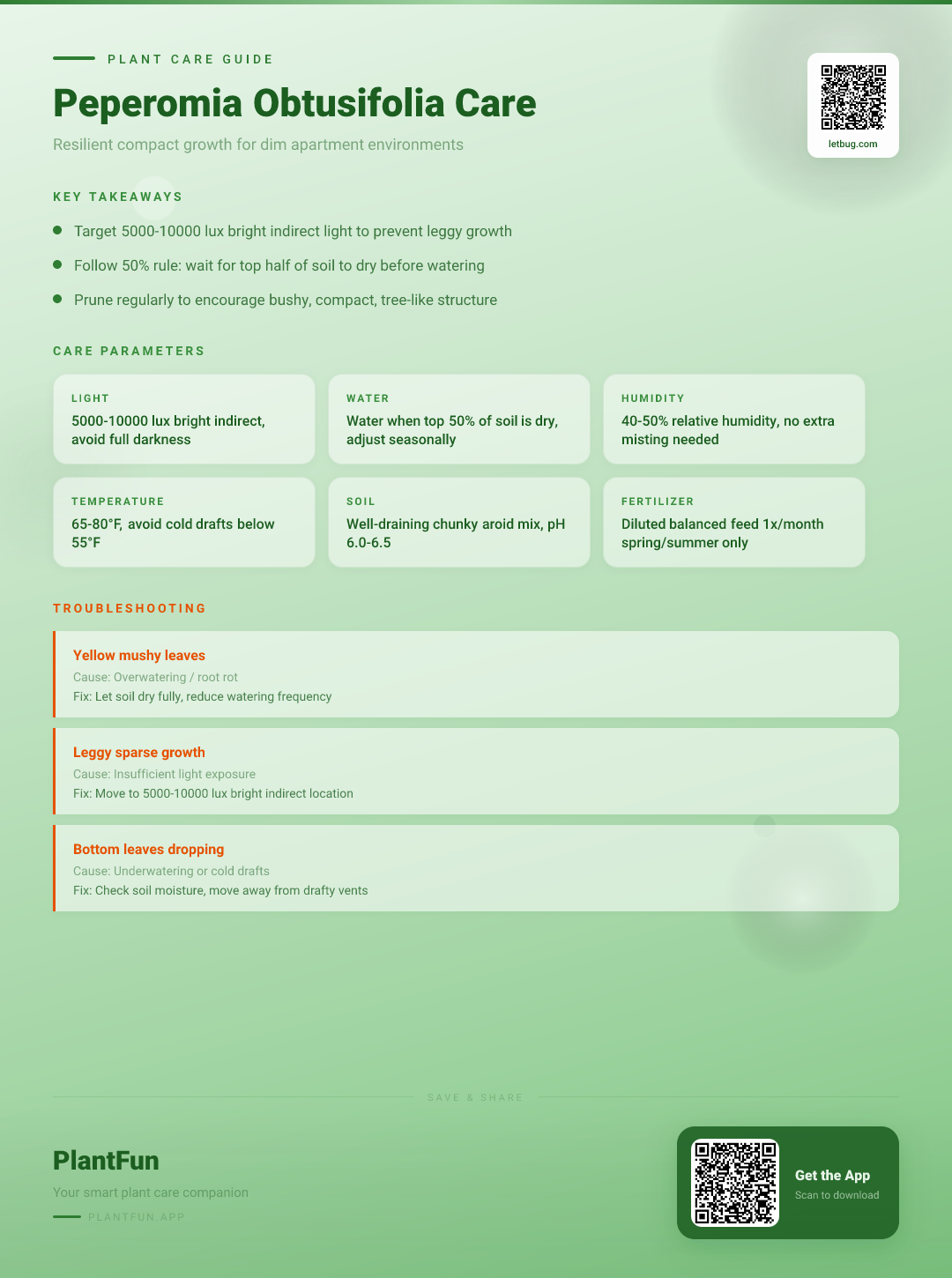
Key Takeaways
- Check soil moisture before watering — overwatering is the #1 killer of houseplants.
- Ensure your plant gets the right amount of light for its species.
- Be patient with recovery — most plants need 2–4 weeks to bounce back.
TL;DR: Quick Success
To keep your Peperomia obtusifolia compact and healthy in an apartment, prioritize bright, indirect light (5,000–10,000 lux) and allow the top 50% of the soil to dry out between waterings. If your plant becomes leggy, prune the stems just above a leaf node to stimulate branching. Avoid dark corners; while they tolerate lower light, they will not thrive or maintain their structural integrity without adequate energy for photosynthesis.
My Experience: Learning from Legginess
When I first got my Peperomia obtusifolia, I placed it in a dim corner of my living room, assuming the ‘low-light tolerant’ label meant it could survive anywhere. Within three months, it turned into a sad, sprawling mess with inches of bare stem between leaves—a classic case of etiolation. It took me a full season of pruning and relocating to a brighter windowsill to restore its bushy, rubbery charm. This guide covers exactly how to avoid those early mistakes.
Quick Care Card: The Gold Standard for Peperomia
| Category | Requirement |
|---|---|
| Light | 5,000–10,000 lux (bright, indirect) |
| Water | Allow top 50% of soil to dry |
| Humidity | 40–50% (average home) |
| Temperature | 65°F–80°F (18°C–27°C) |
| Soil | Well-draining, peat-based mix |
| Fertilizer | Balanced liquid feed, monthly in spring/summer |
| Toxicity | Non-toxic to cats and dogs (ASPCA, 2026) |
Why Your Apartment Environment Challenges Peperomia Growth
Peperomia obtusifolia is native to tropical environments where it grows as an understory plant (NC State Extension, 2026). In an apartment, our biggest enemy is ‘stagnant’ light. Unlike the dappled sunlight of a rainforest floor, an apartment wall corner provides almost no photosynthetic energy. When the plant doesn’t get enough light, it enters survival mode, stretching its stems to ‘reach’ for a light source that isn’t there, resulting in weak, elongated growth.
Measuring Light: How to find the 5,000–10,000 lux ‘Sweet Spot’
Light is the fuel for your plant. If you aren’t sure if your spot is bright enough, use a free light meter app on your smartphone. Aim for 5,000 to 10,000 lux. If you are reading below 2,000 lux, your plant is effectively starving and will eventually lose its compact shape.
The 50% Rule: Why soil moisture and relative humidity (40-50%) matter
In my experience, root rot is the #1 killer of apartment-grown Peperomias. Because these plants have succulent-like, fleshy leaves, they store water efficiently (Gilman, 2007). I follow the 50% rule: use a moisture meter or your finger to ensure the top half of the pot is completely dry before adding water. Maintaining 40–50% humidity helps keep the leaves supple without encouraging fungal issues.
Step-by-Step: Pruning for a Compact, Tree-like Structure
If your plant is already leggy, you can force it to branch out. Research shows that specific hormones can be stimulated through physical intervention (Henny, 1985).
- Identify the leggy stem you want to prune.
- Locate a healthy node (where leaves attach to the stem).
- Using sterilized shears, cut 1/4 inch above the node at a 45-degree angle.
- Within 3–6 weeks, two new branches will typically emerge from the leaf axils below the cut, creating a bushier silhouette.
The Seasonal Watering Calendar: Adjusting for apartment heating and AC
- Spring/Summer: Growth is active. Water when the top 50% of soil is dry, usually every 7–10 days.
- Fall/Winter: Growth slows. Extend the interval. Only water when the pot feels noticeably light or the soil has dried down 75%.
Myth-Busting: Do these plants actually thrive in complete darkness?
No. This is a common misconception. While Peperomia obtusifolia is more resilient than a fern in lower light, it is not a ‘dark corner’ plant. It will survive for a while, but it will lose its variegation (if present) and become structurally weak. It needs ambient light to maintain its cellular turgor pressure.
FAQ: Why is my Peperomia dropping leaves at the bottom?
This usually indicates that the plant is either overwatered or the lower leaves are simply not receiving any light because the canopy is too thick. Check the soil moisture; if it’s soggy, pull back on the water immediately.
FAQ: Can I keep my Peperomia on a dark office desk?
Only if you use a dedicated LED grow light. Without a supplemental light source, it will slowly exhaust its energy reserves.
Troubleshooting: Recognizing signs of root rot vs. underwatering
Root Rot
Symptom: Yellowing lower leaves that feel soft or mushy.
Likely cause: Excess moisture trapped in heavy soil.
Fix:
- Remove the plant from the pot and inspect the roots; cut away any black, slimy sections.
- Repot into a fresh, well-draining succulent soil mix.
Underwatering
Symptom: Leaves are wrinkled, thin, and the stem is drooping.
Likely cause: The plant has depleted its stored water.
Fix:
- Give the plant a thorough soak, letting water drain completely through the holes.
- Adjust your schedule to check the soil more frequently.
Common Mistakes to Avoid for Apartment Gardeners
- Mistake: Using a pot without drainage holes. What happens: Water pools at the bottom, leading to hypoxia (lack of oxygen) for the roots. Instead: Always use a pot with drainage; a nursery pot inside a decorative cover is a perfect compromise.
- Mistake: Ignoring dust on leaves. What happens: Dust blocks sunlight from reaching the chlorophyll. Instead: Wipe leaves gently with a damp cloth every two weeks.
References
- Gilman, E. (2007). Peperomia obtusifolia Peperomia, Baby Rubber Plant. https://doi.org/10.32473/edis-fp466-1999. Accessed 2026-03-15.
- Henny, R. (1985). BA Induces Lateral Branching of Peperomia obtusifolia. HortScience. https://doi.org/10.21273/hortsci.20.1.115. Accessed 2026-03-15.
- ASPCA. (2026). Toxic and Non-Toxic Plants List — ASPCA. https://www.aspca.org/pet-care/animal-poison-control/toxic-and-non-toxic-plants. Accessed 2026-03-15.
- NC State Extension. (2026). Peperomia obtusifolia — NC State Extension Gardener Plant Toolbox. https://plants.ces.ncsu.edu/plants/peperomia-obtusifolia/. Accessed 2026-03-15.
Optional Helper: Plantfun.App
Plantfun.App identifies your plants by photo, diagnoses pests and diseases with clear fixes, and creates personalised watering and light schedules that adapt to your home conditions — a handy companion for putting this guide into daily practice.
Found an error or have suggestions? We'd love your feedback.
Need help identifying this problem?
Get instant identification, personalized care schedules, and effective pest treatment plans directly on your phone.
Sponsored • We may earn a commission from app downloads
Related Guides
Peperomia obtusifolia in Apartment Settings: The Only Care Guide You’ll Ever Need
Master your Peperomia obtusifolia care with 4 specific light and water thresholds. Learn how to prevent yellowing leaves and ensure resilient indoor growth.
Care GuidePeperomia obtusifolia in Apartment Living: The Only Care Guide You’ll Ever Need for Resilient Growth
Revive your struggling Peperomia obtusifolia with our expert care guide. Learn exact light, water, and humidity thresholds for lush, upright leaves in any apartment.
Care GuidePeperomia obtusifolia in a Low-Light Apartment: The Complete Care Guide for Resilient Growth
Revive your leggy Peperomia obtusifolia with our budget-friendly care plan. Master exact light levels, watering schedules, and soil mixes for resilient growth.
Safety GuidePeperomia Obtusifolia Placement Guide for Family Living Rooms: Pet & Child Safe Substitutions Included
Keep your family and pets safe while growing beautiful indoor greenery. Get exact Peperomia obtusifolia placement tips, care thresholds, and 3 non-toxic substitutions for common toxic living room plants.