
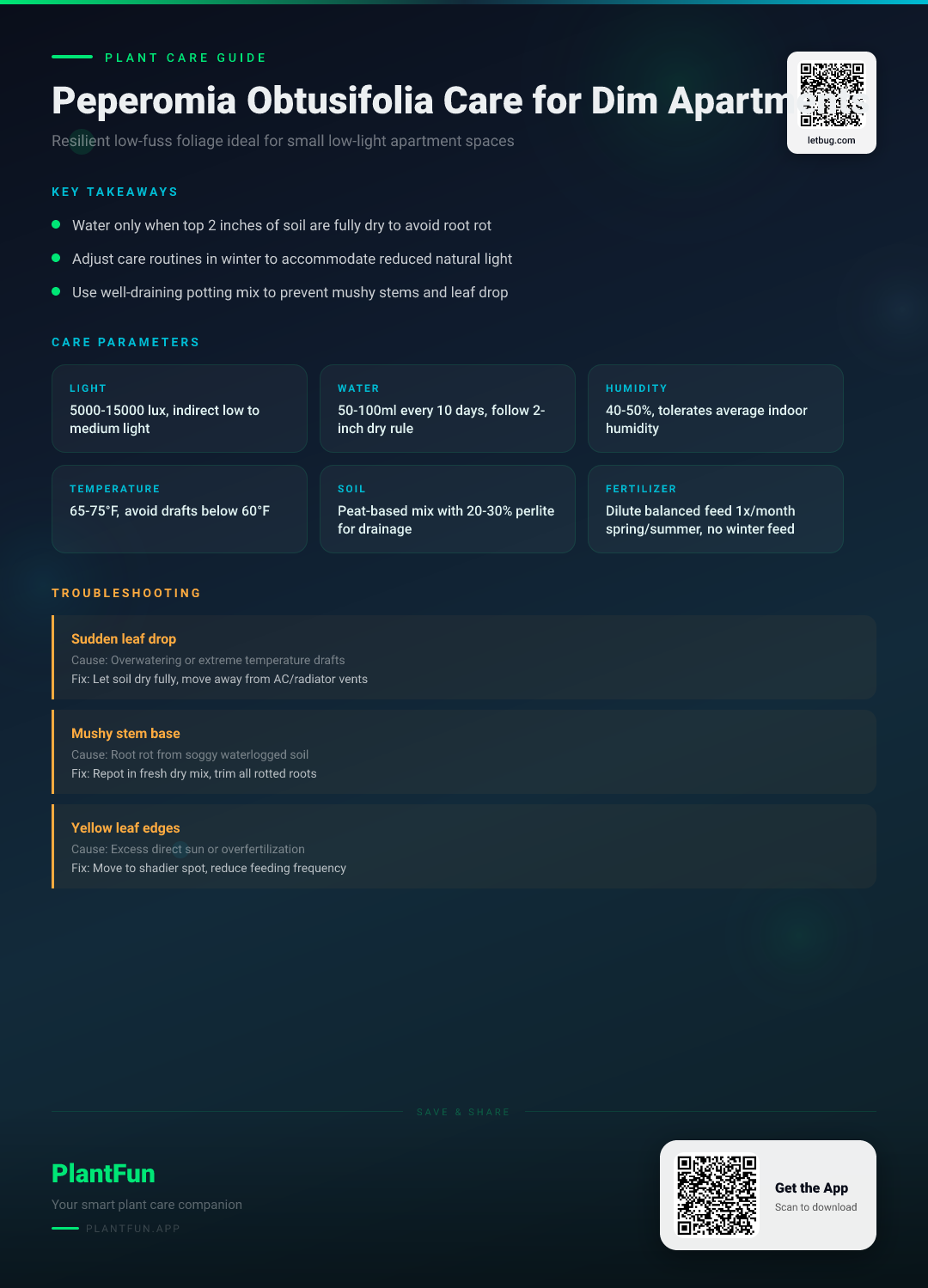
Key Takeaways
- Check soil moisture before watering — overwatering is the #1 killer of houseplants.
- Ensure your plant gets the right amount of light for its species.
- Be patient with recovery — most plants need 2–4 weeks to bounce back.
Quick Care Card: Essential Data
| Feature | Requirement |
|---|---|
| Light | 5,000–15,000 Lux (Bright, indirect) |
| Water | 50–100ml per 10 days (When top 2” dry) |
| Humidity | 40–50% |
| Temperature | 65–75°F (18–24°C) |
| Soil | Well-draining peat or coco-coir based mix |
| Fertilizer | Balanced liquid feed during growing season |
| Toxicity | Non-toxic (ASPCA, 2026) |
TL;DR: The Apartment Reality Check
Peperomia obtusifolia, or the Baby Rubber Plant, is a fantastic choice for apartment living because it tolerates lower light levels better than most tropicals. The secret to success isn’t light intensity, but consistent watering and avoiding root rot. If you keep the soil aerated and only water when the top two inches are dry, you can thrive in even the dimmest urban spaces. It is also non-toxic to pets, making it a safe choice for shared living spaces (ASPCA, 2026).
Why Peperomia Obtusifolia Thrives in Lower Light Than You Think
When I first got my own Peperomia obtusifolia, I made the mistake of placing it in direct, harsh sun, which scorched the leaves. I later learned that in its native habitat, it grows as an understory plant, meaning it evolved to utilize dappled light (Gilman, 2007). In a dark apartment, it doesn’t need to be right against a window; it just needs a steady, ambient light source to maintain its leaf color and structure.
Step 1: Decoding the Light Requirements for City Living
Your Peperomia obtusifolia needs between 5,000 and 15,000 lux (NC State Extension, 2026). In an apartment, this usually means placing it 3–5 feet away from a North or East-facing window. If your home has no natural light, a standard full-spectrum LED bulb left on for 8–10 hours a day is a perfect surrogate for natural sunlight.
Step 2: Mastering the Soak-and-Dry Watering Technique (The 2-Inch Rule)
Overwatering is the number one killer of these plants. I never water on a schedule. Instead, I use the “2-inch rule.” Stick your finger into the soil up to the second knuckle. If the soil feels damp, walk away. If it is dry, add 50–100ml of water. This prevents the root system from sitting in stagnant, anaerobic conditions.
Step 3: Humidity Hacks for Radiators and AC Units
Apartment living often involves dry air from radiators in winter or AC in summer. While Peperomia is resilient, it prefers 40–50% humidity. If you notice crispy edges on the leaves, place your plant on a tray filled with pebbles and a little water—just ensure the pot is sitting on the pebbles, not in the water, to prevent rot.
Step 4: Soil Composition for Apartment Containers
Standard potting soil is often too dense for Peperomia. I recommend mixing your potting medium with 30% perlite or pumice to ensure proper aeration. According to research on branching and growth, maintaining a well-drained substrate allows for more consistent lateral growth without risking base rot (Henny, 1985).
Step 5: Seasonal Maintenance: Adjusting for Winter Light Cycles
In winter, your apartment’s light intensity drops significantly. I reduce my watering frequency by about 30% and move my plant closer to the window. Because growth slows down, I stop fertilizing entirely until the days start getting longer in March.
Troubleshooting Guide: Why Is My Peperomia Dropping Leaves?
Yellowing Leaves
Symptom: Lower leaves turn yellow and drop off.
Likely cause: Overwatering or poor drainage.
Fix:
- Check for wet soil at the bottom of the pot.
- Repot into a container with drainage holes and fresh, airy soil.
Crispy, Brown Leaf Tips
Symptom: Dry, crunchy edges on the foliage.
Likely cause: Low humidity or inconsistent water.
Fix:
- Increase ambient humidity with a pebble tray.
- Ensure you are watering deeply enough so that water runs through the drainage holes.
Leggy, Stretched Stems
Symptom: Large gaps between leaves (etiolation).
Likely cause: Insufficient light.
Fix:
- Move the plant 1-2 feet closer to a light source.
- Prune the stems back to encourage fuller growth (Henny, 1985).
Voice Search FAQ: Can I keep my Peperomia in a bathroom with no window?
While Peperomia loves humidity, it cannot survive without a light source. If your bathroom has no window, it will eventually lose its leaves. You must add a dedicated grow light or move the plant to a brighter room.
Voice Search FAQ: Why is my Peperomia plant stem getting mushy at the base?
This is a classic sign of stem rot caused by overwatering or soil that is too dense. You should inspect the roots immediately; if they are dark and slimy, the plant is struggling to breathe (NC State Extension, 2026).
Common Mistakes to Avoid in Small Spaces
-
Mistake: Using a pot without drainage.
What happens: Water accumulates at the bottom, leading to root rot.
Instead: Always use a pot with a drainage hole. -
Mistake: Letting the plant sit directly in front of an AC vent.
What happens: Sudden cold drafts cause leaf drop.
Instead: Keep the plant at least 3 feet away from vents.
References
- Gilman, E. (2007). Peperomia obtusifolia Peperomia, Baby Rubber Plant. https://doi.org/10.32473/edis-fp466-1999. Accessed 2026-03-18.
- Henny, R. (1985). BA Induces Lateral Branching of Peperomia obtusifolia. https://doi.org/10.21273/hortsci.20.1.115. Accessed 2026-03-18.
- ASPCA. (2026). Toxic and Non-Toxic Plants List — ASPCA. https://www.aspca.org/pet-care/animal-poison-control/toxic-and-non-toxic-plants. Accessed 2026-03-18.
- NC State Extension. (2026). Peperomia Obtusifolia Care — NC State Extension Gardener Plant Toolbox. https://plants.ces.ncsu.edu/plants/peperomia-obtusifolia/. Accessed 2026-03-18.
Optional Helper: Plantfun.App
Plantfun.App identifies your plants by photo, diagnoses pests and diseases with clear fixes, and creates personalised watering and light schedules that adapt to your home conditions — a handy companion for putting this guide into daily practice.
Found an error or have suggestions? We'd love your feedback.
Need help identifying this problem?
Get instant identification, personalized care schedules, and effective pest treatment plans directly on your phone.
Sponsored • We may earn a commission from app downloads
Related Guides
Peperomia obtusifolia in a Low-Light Apartment: The Complete Care Guide for Resilient Growth
Revive your leggy Peperomia obtusifolia with our budget-friendly care plan. Master exact light levels, watering schedules, and soil mixes for resilient growth.
Care GuidePeperomia obtusifolia in Apartment Settings: The Only Care Guide You’ll Ever Need
Master your Peperomia obtusifolia care with 4 specific light and water thresholds. Learn how to prevent yellowing leaves and ensure resilient indoor growth.
Care GuidePeperomia Obtusifolia in Dim Apartments: The Complete Budget-Friendly Care Guide for Resilient Growth
Transform your Peperomia into a lush apartment statement piece. Master precise 200ml watering cycles and low-light management for stress-free, resilient growth.
Safety GuidePeperomia Obtusifolia Placement Guide for Family Living Rooms: Pet & Child Safe Substitutions Included
Keep your family and pets safe while growing beautiful indoor greenery. Get exact Peperomia obtusifolia placement tips, care thresholds, and 3 non-toxic substitutions for common toxic living room plants.