
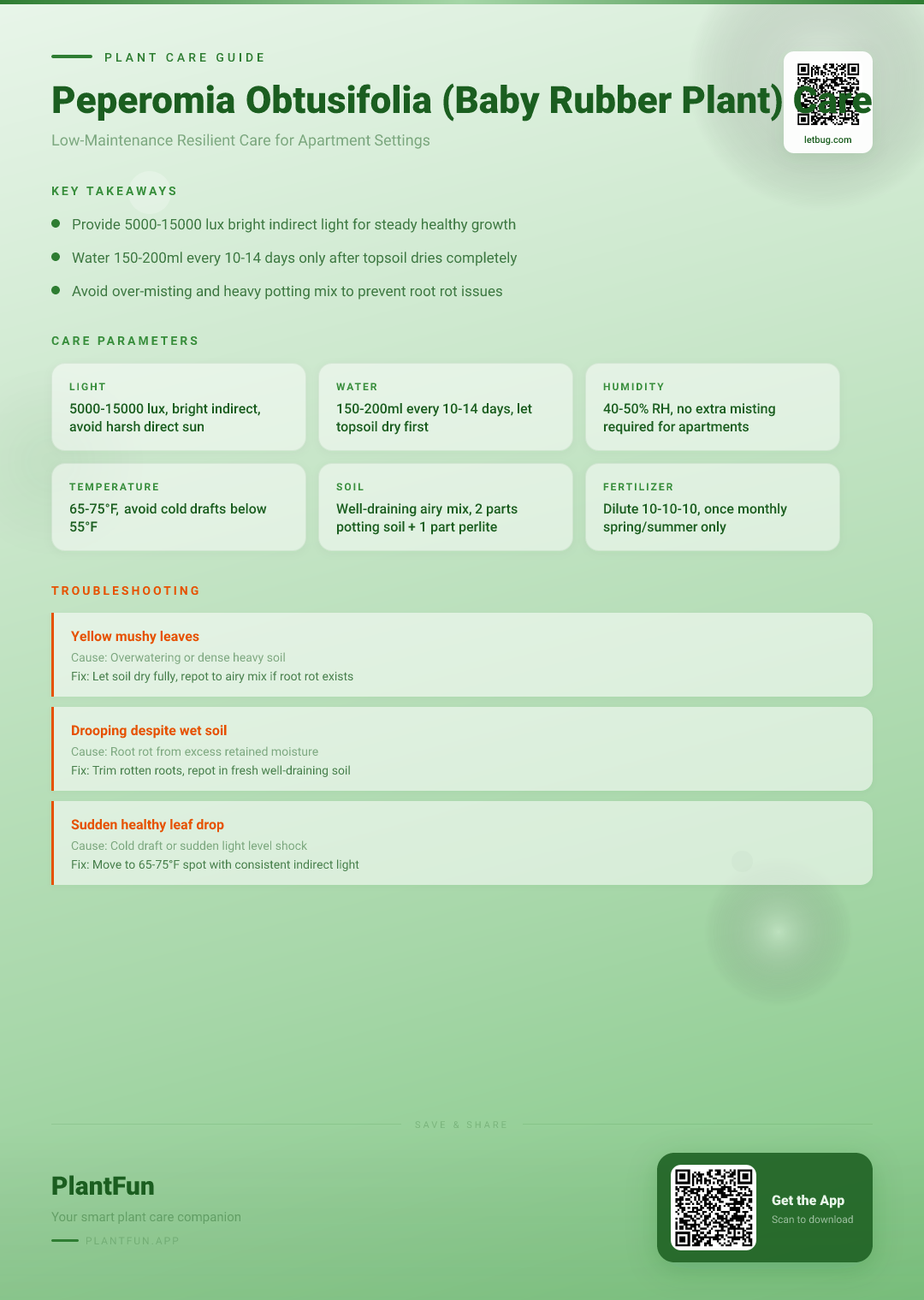
Key Takeaways
- Check soil moisture before watering — overwatering is the #1 killer of houseplants.
- Ensure your plant gets the right amount of light for its species.
- Be patient with recovery — most plants need 2–4 weeks to bounce back.
Quick Care Card: Essential Data
| Feature | Requirement |
|---|---|
| Light | 5,000–15,000 lux (bright, indirect) |
| Water | 150–200ml per 10–14 days |
| Humidity | 40–50% |
| Temperature | 65–75°F (18–24°C) |
| Soil | Well-draining, peat-based mix |
| Fertilizer | Balanced liquid, dilute strength, monthly |
| Toxicity | Non-toxic to pets and humans (ASPCA, 2026) |
TL;DR: The Apartment Reality for Peperomia
Stop overthinking your Peperomia obtusifolia. These plants thrive in typical apartment conditions when you mimic their natural epiphytic growth habits. Keep them in bright, indirect light, let the top two inches of soil dry out completely between waterings, and keep them away from cold drafts. If you do this, you will stop the common cycle of yellow leaves and root rot that plagues many beginners.
Why Your Apartment Environment Matters for Peperomia Success
When I first brought home my Peperomia obtusifolia, I made the mistake of treating it like a thirsty tropical fern. I kept it in a dark corner and watered it whenever the surface looked dry. Within weeks, the plant began dropping leaves, and the stems became soft. I learned the hard way that Peperomia obtusifolia is a succulent-like plant. According to the NC State Extension (2026), they require excellent drainage to prevent the root suffocation common in dense, apartment-grade potting soils.
Light Requirements: Decoding 5,000-15,000 Lux for Peperomia
Many apartments suffer from low light, which often leads to leggy, stretched growth in Baby Rubber Plants. While they are often labeled as “low-light tolerant,” they prefer bright, indirect light to maintain their compact, architectural form.
- The Target: 5,000 to 15,000 lux is ideal. This is roughly the amount of light you find on a windowsill that receives light but no direct, scorching sun (NC State Extension, 2026).
- The Test: If you can comfortably read a book in the spot where the plant is placed without squinting, the light levels are likely sufficient.
The Watering Protocol: Precise Measurement and Soil Drying Cues
Overwatering is the primary cause of Peperomia obtusifolia yellow leaves. Because these plants store water in their thick, fleshy leaves, they are prone to root rot in saturated soil (Gilman, 2007).
- The Finger Test: Insert your finger two inches into the soil. If it feels moist, do not water.
- Measurement: When dry, apply 150–200ml of water directly to the base. Avoid getting water on the crown of the plant to prevent stem rot.
- Drainage: Ensure your pot has drainage holes. If you have a decorative cachepot, empty it after 15 minutes of drainage.
Step-by-Step: The Correct Way to Repot Your Baby Rubber Plant
Repotting should only be done when the plant is root-bound, as they prefer to be slightly snug in their containers (Gilman, 2007).
- Prepare: Choose a pot only 1-2 inches larger than the current root ball.
- Soil Mix: Use a mixture of standard peat-based potting soil mixed with 30% perlite or pumice to ensure fast drainage.
- Placement: Gently tease the roots. Do not pack the soil down too firmly, as this restricts airflow to the roots.
- Settling: Water lightly immediately after repotting to help the roots establish contact with the fresh medium.
Seasonal Care Calendar: From Summer Growth to Winter Dormancy
- Spring/Summer: Increase watering slightly as temperatures rise. This is the prime time for growth and branching (Henny, 1985). Apply a balanced fertilizer monthly at half-strength.
- Autumn/Winter: Your Peperomia will slow its growth. Reduce water frequency, allowing the soil to dry out even further. Keep the plant away from drafty windows or heating vents, as dry winter air and fluctuating temperatures can cause leaf drop.
Troubleshooting: Why is my Peperomia dropping healthy leaves?
Yellowing Leaves
Symptom: Lower leaves turn yellow and drop off.
Likely cause: Excessive moisture or poor soil drainage leading to root stress.
Fix:
- Stop watering immediately.
- Check for root rot (smelly, mushy roots) and trim away damage.
Drooping Stems
Symptom: The entire plant looks limp even when the soil is wet.
Likely cause: Root rot preventing water uptake or cold-stress.
Fix:
- Check roots for decay immediately.
- Move the plant to a warmer location (above 65°F).
Leggy, Stretched Stems
Symptom: Large gaps between leaf nodes.
Likely cause: Insufficient light intensity.
Fix:
- Move the plant to a brighter location with indirect light.
- Prune the long stems to encourage bushier growth (Henny, 1985).
FAQ: Why is my Peperomia drooping even though the soil is wet?
This is a classic sign of root suffocation. If the soil stays wet for too long, the roots cannot “breathe” oxygen, causing them to stop functioning. This is a common issue when using pots without drainage holes or using potting media that is too heavy (NC State Extension, 2026).
FAQ: Can I keep my Peperomia in a room with no windows?
Unfortunately, no. While they are resilient houseplants for apartments, they still require photosynthesis to survive. A room with no windows will eventually lead to the plant exhausting its energy reserves and dying. Consider a grow light if you absolutely must keep one in a windowless room.
Common Mistakes to Avoid: Over-misting and Heavy Potting Media
-
Mistake: Daily misting of foliage.
-
What happens: It creates a breeding ground for fungal pathogens and doesn’t actually raise long-term humidity.
-
Instead: Use a humidity tray with pebbles and water near the plant if your air is very dry.
-
Mistake: Using standard garden soil.
-
What happens: It compacts and retains too much water, suffocating the roots.
-
Instead: Always use a well-aerated, peat or coco-coir-based mix with added drainage material (perlite).
References: Botanical Guidelines for Peperomia obtusifolia
- ASPCA. (2026). Toxic and Non-Toxic Plants List. https://www.aspca.org/pet-care/animal-poison-control/toxic-and-non-toxic-plants. Accessed 2026-03-12.
- Gilman, E. (2007). Peperomia obtusifolia Peperomia, Baby Rubber Plant. https://doi.org/10.32473/edis-fp466-1999. Accessed 2026-03-12.
- Henny, R. (1985). BA Induces Lateral Branching of Peperomia obtusifolia. HortScience. https://doi.org/10.21273/hortsci.20.1.115. Accessed 2026-03-12.
- NC State Extension. (2026). Peperomia obtusifolia — NC State Extension Gardener Plant Toolbox. https://plants.ces.ncsu.edu/plants/peperomia-obtusifolia/. Accessed 2026-03-12.
Optional Helper: Plantfun.App
Plantfun.App identifies your plants by photo, diagnoses pests and diseases with clear fixes, and creates personalised watering and light schedules that adapt to your home conditions — a handy companion for putting this guide into daily practice.
Found an error or have suggestions? We'd love your feedback.
Need help identifying this problem?
Get instant identification, personalized care schedules, and effective pest treatment plans directly on your phone.
Sponsored • We may earn a commission from app downloads
Related Guides
Peperomia obtusifolia in a Low-Light Apartment: The Ultimate Seasonal Growth and Care Guide
Transform your dim apartment into a thriving indoor jungle. Get specific lux, precise watering ml, and a 4-season care calendar to keep your Peperomia vibrant.
Care GuidePeperomia obtusifolia in a Low-Light Apartment: The Complete Care Guide for Resilient Growth
Revive your leggy Peperomia obtusifolia with our budget-friendly care plan. Master exact light levels, watering schedules, and soil mixes for resilient growth.
Care GuideThe Complete Peperomia Obtusifolia Care Guide for Urban Apartments: Resilient Growth Made Easy
Get a step-by-step peperomia care checklist tailored for small urban apartments, with exact light, water, and humidity thresholds to grow lush, resilient plants with zero guesswork.
Safety GuidePeperomia Obtusifolia Placement Guide for Family Living Rooms: Pet & Child Safe Substitutions Included
Keep your family and pets safe while growing beautiful indoor greenery. Get exact Peperomia obtusifolia placement tips, care thresholds, and 3 non-toxic substitutions for common toxic living room plants.