
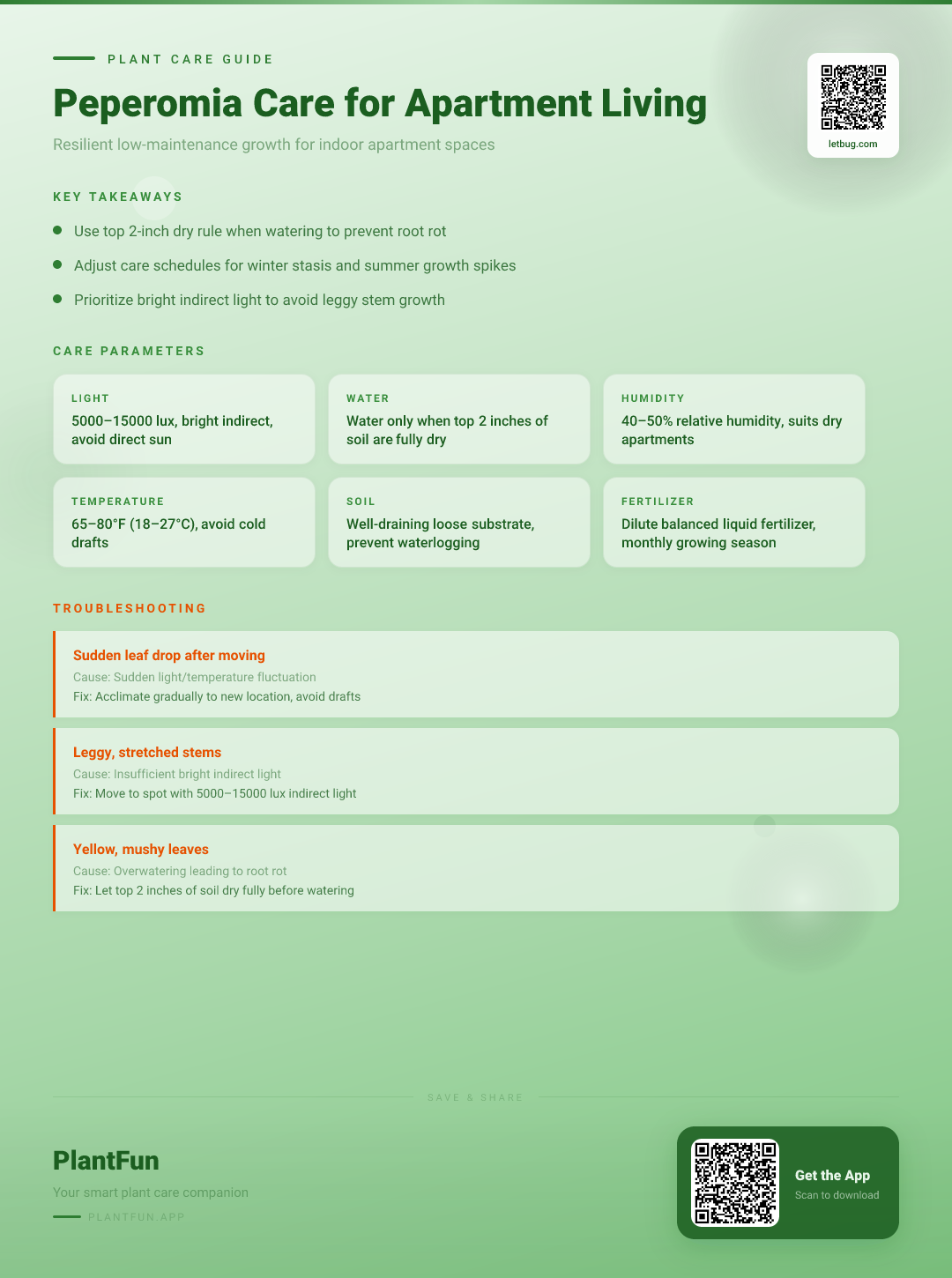
Key Takeaways
- Check soil moisture before watering — overwatering is the #1 killer of houseplants.
- Ensure your plant gets the right amount of light for its species.
- Be patient with recovery — most plants need 2–4 weeks to bounce back.
TL;DR: Keep your Peperomia in bright, indirect light (5,000–15,000 lux) and water only when the top 2 inches of soil are dry. These plants thrive in 65–80°F temperatures and high-drainage, aerated soil. Prevent root rot by avoiding waterlogged conditions, and ensure your apartment maintains 40–50% humidity to keep foliage vibrant.
My Experience
When I first brought home my Peperomia obtusifolia, I tucked it into a dark corner of my studio apartment, thinking its waxy leaves meant it was indestructible. Within weeks, the stems became elongated and the variegation faded to a dull green. I learned the hard way that “low-light tolerant” doesn’t mean “no-light capable.” After moving it closer to a north-facing window and adjusting my watering to wait for true soil dryness, it finally regained its signature, compact, bushy growth.
Quick Care Card: Essential Thresholds for Your Peperomia
| Feature | Requirement |
|---|---|
| Light | 5,000–15,000 Lux (Bright, indirect) |
| Water | Allow top 2 inches to dry completely |
| Humidity | 40–50% (Moderate) |
| Temperature | 65–80°F (18–27°C) |
| Soil | Well-draining, peat-perlite mix |
| Fertilizer | Balanced liquid feed, diluted, spring/summer |
| Toxicity | Non-toxic to cats and dogs (ASPCA, 2026) |
Understanding Your Peperomia: Why Apartment Living Can Be a Challenge
Living in a compact apartment means dealing with fluctuating microclimates. Unlike greenhouses, our living spaces often have stagnant air or extreme temperature shifts near vents. According to (NC State Extension, 2026), Peperomias are primarily epiphytic or terrestrial plants that require excellent aeration to prevent fungal issues. Managing the balance between limited natural light and the drying effect of apartment heaters is the primary challenge in long-term Peperomia care.
Light Requirements: Managing 5,000–15,000 Lux in Typical Living Rooms
Peperomias thrive in bright, indirect light. If you can read a book comfortably without a lamp, the light level is likely sufficient. If your apartment faces north or has deep shadows, consider adding a full-spectrum LED bulb. As noted in the study on Peperomia sandwicensis (Baldos et al., 2021), compact species are particularly sensitive to light intensity, which dictates their overall structural integrity.
Watering Mastery: Using the Top-2-Inch Rule to Prevent Root Rot
Overwatering is the fastest way to kill a Peperomia. I use a simple “finger test”: stick your finger 2 inches into the soil. If you feel any moisture, wait two more days. Because Peperomias have semi-succulent leaves, they store water, making them resilient to occasional neglect but highly susceptible to rot if left sitting in water (Gilman, 2007).
Humidity and Airflow: Maintaining 40–50% Relative Humidity in Dry Apartments
Apartments often have dry air due to HVAC systems. While Peperomias are not as demanding as ferns, they appreciate a stable 40–50% humidity level. If your air is drier than this, consider grouping your plants or using a small pebble tray to elevate local moisture levels without saturating the roots.
The Seasonal Care Calendar: Adjusting for Winter Stasis and Summer Spikes
- Spring/Summer: Growth is active. Increase water frequency slightly and apply a balanced liquid fertilizer at half-strength every 4–6 weeks.
- Autumn/Winter: Growth slows as light levels drop. Reduce watering significantly—often once every 2–3 weeks depending on the dryness of your home.
Temperature Control: Why 65–80°F (18–27°C) is the Apartment ‘Goldilocks’ Zone
Peperomias suffer when temperatures dip below 60°F. Keep them away from drafty windows or front doors during winter months. A consistent 65–80°F range ensures the metabolic processes of the plant remain optimal for consistent leaf production.
FAQ: Why is my Peperomia dropping leaves after I moved it?
Leaf drop is often a sign of environmental shock. When you move a plant to a new location in your apartment, it needs time to acclimate to the new light levels and airflow. Ensure it isn’t sitting directly in a cold draft.
FAQ: How often should I water my Peperomia if the apartment is drafty?
If your apartment has high airflow, the soil will dry out faster. Do not follow a strict calendar; instead, check the soil moisture weekly using the 2-inch depth test. In drafty conditions, you may need to check the soil more frequently than in a stagnant room.
FAQ: Can I keep my Peperomia on a low-light bookshelf?
While they can survive in lower light, they will become “leggy” (stretching for light). If you want your plant to stay bushy, place it within 3 feet of a window or add a small grow light directly above the shelf.
Soil Science: Creating the Perfect Well-Draining Substrate Mix
I recommend a mix consisting of 50% potting soil and 50% perlite or pumice. This ensures that when you water, excess moisture passes through quickly, preventing the root suffocation that leads to rot (NC State Extension, 2026).
Common Mistakes: Identifying Overwatering Symptoms Early
- Mistake: Watering on a set schedule (e.g., every Monday).
- What happens: The soil remains waterlogged, leading to yellowing lower leaves.
- Instead: Check the soil moisture manually and only water when the top 2 inches are dry.
Troubleshooting Guide: Addressing Leggy Stems and Faded Foliage
Leggy Stems
Symptom: The distance between leaves on the stem is increasing.
Likely cause: Insufficient light intensity forcing the plant to stretch.
Fix:
- Move the plant to a brighter location (closer to a window).
- Prune the long stems to encourage branching at the base.
Faded or Yellowing Leaves
Symptom: Leaves lose their deep, dark color or turn yellow suddenly.
Likely cause: Often caused by overwatering leading to root issues.
Fix:
- Inspect the roots; remove any black, mushy, or decaying sections.
- Repot into fresh, dry, well-draining soil.
Brown, Crispy Leaf Tips
Symptom: The edges of the leaves are turning brown and brittle.
Likely cause: Humidity levels are too low for the plant’s needs.
Fix:
- Increase ambient humidity through grouping or a pebble tray.
- Ensure the plant is not placed directly next to a heat vent.
Wilting Despite Wet Soil
Symptom: The plant looks thirsty even though the soil is damp.
Likely cause: Root rot has damaged the plant’s ability to take up water.
Fix:
- Remove from the pot and trim away all damaged root tissue.
- Sterilize the container and repot in fresh, sterile, airy mix.
References
- ASPCA. (2026). Toxic and Non-Toxic Plants List — ASPCA. https://www.aspca.org/pet-care/animal-poison-control/toxic-and-non-toxic-plants. Accessed 2026-03-16.
- Baldos, O., Corpuz, A., Watanabe, L. (2021). Peperomia sandwicensis ‘Palikea’: A Small, Native Hawaiian Plant for Compact Indoor Spaces. HortScience. https://doi.org/10.21273/hortsci16099-21. Accessed 2026-03-16.
- Gilman, E. (2007). Peperomia obtusifolia Peperomia, Baby Rubber Plant. EDIS. https://doi.org/10.32473/edis-fp466-1999. Accessed 2026-03-16.
- NC State Extension. (2026). Peperomia Care — NC State Extension Gardener Plant Toolbox. https://plants.ces.ncsu.edu/plants/peperomia-care/. Accessed 2026-03-16.
Optional Helper: Plantfun.App
Plantfun.App identifies your plants by photo, diagnoses pests and diseases with clear fixes, and creates personalised watering and light schedules that adapt to your home conditions — a handy companion for putting this guide into daily practice.
Found an error or have suggestions? We'd love your feedback.
Need help identifying this problem?
Get instant identification, personalized care schedules, and effective pest treatment plans directly on your phone.
Sponsored • We may earn a commission from app downloads
Related Guides
Peperomia Obtusifolia in Dim Apartments: The Complete Budget-Friendly Care Guide for Resilient Growth
Transform your Peperomia into a lush apartment statement piece. Master precise 200ml watering cycles and low-light management for stress-free, resilient growth.
Care GuidePeperomia obtusifolia in a Low-Light Apartment: The Complete Guide to Resilient Growth
Revive your struggling Peperomia obtusifolia with our expert-backed care guide. Learn exact light levels, watering schedules, and 3 fixes for vibrant growth.
Care GuidePeperomia obtusifolia in Apartment Settings: The Only Care Guide You’ll Ever Need
Master your Peperomia obtusifolia care with 4 specific light and water thresholds. Learn how to prevent yellowing leaves and ensure resilient indoor growth.
Safety GuidePeperomia Obtusifolia Placement Guide for Family Living Rooms: Pet & Child Safe Substitutions Included
Keep your family and pets safe while growing beautiful indoor greenery. Get exact Peperomia obtusifolia placement tips, care thresholds, and 3 non-toxic substitutions for common toxic living room plants.