
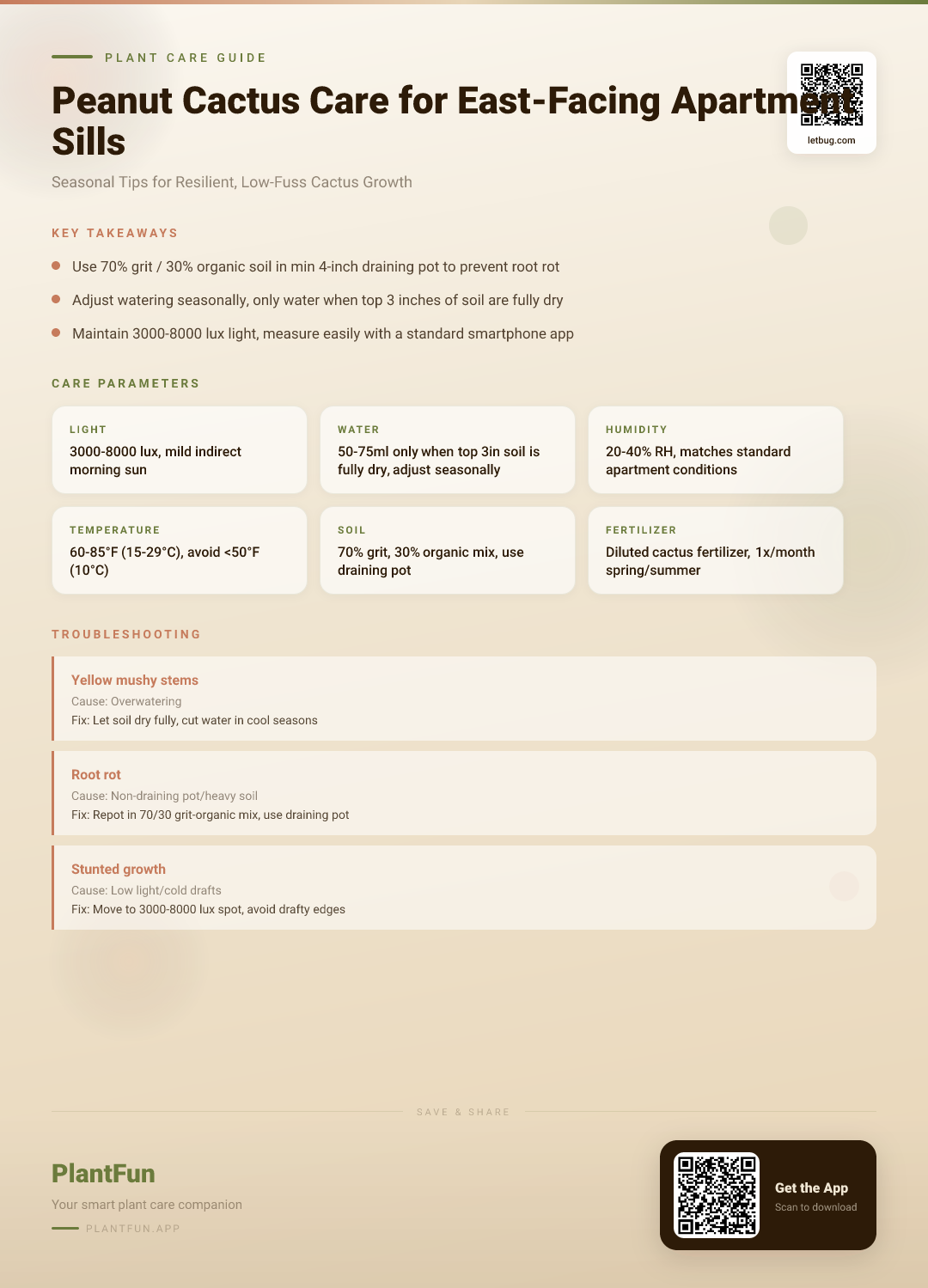
Key Takeaways
- Check soil moisture before watering — overwatering is the #1 killer of houseplants.
- Ensure your plant gets the right amount of light for its species.
- Be patient with recovery — most plants need 2–4 weeks to bounce back.
Quick Care Card
Print this at-a-glance snapshot for easy reference between checks:
| Parameter | Exact Threshold for East-Facing Sills |
|---|---|
| Light | 3,000-8,000 lux of morning sun |
| Water | 50-75ml only when top 3 inches of soil are completely dry |
| Humidity | 20-40% (no extra humidification needed) |
| Temperature | 60-85°F (15-29°C), minimum 50°F (10°C) |
| Soil | 70% grit (perlite/pumice/coarse sand) + 30% organic potting mix |
| Fertilizer | 2x per year (early spring, late summer) with 10-10-10 cactus fertilizer diluted to 50% strength |
| Toxicity | Non-toxic to cats, dogs, and humans (ASPCA, 2026) |
Why Peanut Cacti Thrive (Or Fail) On East-Facing Apartment Windowsills
East-facing apartment sills are nearly perfect for peanut cacti (Echinopsis chamaecereus), delivering 2-4 hours of mild morning sun that avoids the harsh midday burn that damages most small cacti (NC State Extension, 2026). This makes the peanut cactus the best cactus for east-facing apartment setups, especially for beginners looking for low-fuss greenery.
The only common pitfalls of this placement come from standard apartment conditions: dry air from central heating or AC (Henry, 2022) and occasional cold drafts from old window seals. A common myth you can ignore: all cacti need full south-facing sun. Peanut cacti scorch at light levels over 10,000 lux, so the softer east-facing exposure is ideal for consistent, resilient growth.
Step-by-Step Potting & Soil Setup for Resilient Root Growth
Proper potting is the easiest way to avoid 80% of common peanut cactus issues, including root rot. Follow these exact steps:
- Use a pot with a minimum 4-inch diameter and at least one ¼-inch drainage hole. If you prefer decorative cachepots, keep the cactus in a plastic nursery pot inside the decorative holder to simplify drainage management.
- Mix your peanut cactus soil mix to a 70% grit (perlite, pumice, or coarse horticultural sand) to 30% organic potting mix ratio (no added slow-release fertilizer) (NC State Extension, 2026). If you don’t want to mix your own, you can use a pre-made succulent mix amended with extra perlite, per our guide to choosing succulent soil mixes.
- Add a ½-inch layer of gravel to the bottom of the pot for extra drainage, then fill halfway with your soil mix.
- Place the cactus in the center of the pot, fill gaps with remaining soil, and press gently to secure the plant. Avoid packing the soil tightly, as this reduces airflow to roots.
- Wait 7 full days before watering to let any damaged roots from repotting callus over, which prevents infection.
Core Care Parameter 1: Light Requirements
Peanut cacti have a narrow ideal light range of 3,000-8,000 lux for east-facing sills (Wagner, 2007), which aligns almost perfectly with the typical morning sun exposure of this placement. To test your light levels:
- Download a free light meter app on your smartphone, hold it at the same height as your cactus at 9am (when morning sun is strongest on east sills), and take a reading.
- If your reading is over 8,000 lux (rare for east sills, but possible in unobstructed summer setups), move the cactus 6 inches back from the window to avoid scorched segments.
- If your reading is under 3,000 lux (common in winter or if your sill is shaded by nearby buildings), add a low-wattage grow light 12 inches above the cactus for 2 hours per day. The peanut cactus is one of many low-light succulents that works well with supplemental grow lights, as covered in our guide to low-light succulents for apartments.
Consistent light in this range is also the key to how to get peanut cactus to bloom, as buds set in early spring when light levels rise above 4,000 lux consistently.
Core Care Parameter 2: Watering Schedule
Overwatering is the #1 cause of peanut cactus death, so follow these exact rules for east-facing sills:
- Only give 50-75ml of room-temperature water when the top 3 inches of soil are completely dry. Test this by sticking your clean finger 3 inches into the soil: if you feel any moisture at all, wait to water.
- Adjust your check frequency by season:
- Spring/fall: Check soil every 21-28 days
- Summer: Check soil every 10-14 days (this is your standard peanut cactus summer watering cadence for east sills)
- Winter: Check soil every 45-60 days Never follow a fixed monthly watering schedule, as humidity and light levels shift constantly in apartment environments.
Core Care Parameter 3: Temperature & Humidity
Peanut cacti are perfectly adapted to standard apartment conditions, with an ideal temperature range of 60-85°F (15-29°C) and a hard minimum of 50°F (10°C) (NC State Extension, 2026). They thrive in 20-40% relative humidity, which is exactly the range of most centrally heated or air conditioned apartments (Henry, 2022). There is no need for extra humidification, which is a big part of peanut cactus low maintenance care appeal.
If you’re wondering can peanut cactus survive dry heating, the answer is yes: the only adjustment you need to make is avoiding overwatering to compensate for dry air, as excess moisture will cause root rot far faster than dry air will damage the plant.
4-Season Peanut Cactus Care Calendar
Follow this month-by-month routine tailored explicitly for east-facing apartment sills:
Spring (March-May)
- Check soil every 21 days, water 50-75ml when completely dry
- Fertilize once in early April with 10-10-10 cactus fertilizer diluted to 50% strength
- Keep light levels consistent between 4,000-8,000 lux to trigger bud set for spring blooms
- Prune any shriveled or dead segments to encourage new growth
Summer (June-August)
- Check soil every 10-14 days, water 75ml when completely dry
- Fertilize once more in late June, no additional fertilizer for the rest of the year
- Wipe dust off segments monthly to improve light absorption
- Move 6 inches back from the window if uncharacteristic midday sun reaches the sill in late summer
Fall (September-November)
- Check soil every 28 days, water 50ml when completely dry
- Gradually reduce watering frequency to prepare for dormancy
- Ensure temperatures near the window never drop below 50°F at night
Winter (December-February)
- Check soil every 45-60 days, only water if segments start to wrinkle slightly
- No fertilizer during this period, as this is peanut cactus dormancy care phase
- Keep the cactus at least 3 inches away from direct heat vents and drafty window seals
- For more general tips on overwintering succulents in heated apartments, check our winter succulent care guide
Common Mistakes to Avoid With East-Facing Sill Peanut Cacti
-
Mistake: Overwatering on a fixed monthly schedule regardless of soil moisture
What happens: Mushy roots and rotting segments, the top answer to why is my peanut cactus mushy
Instead: Test the top 3 inches of soil for moisture every 10-60 days (depending on season) before watering -
Mistake: Using a decorative pot with no drainage hole
What happens: Water pools at the bottom of the pot, causing root rot even if you water the correct amount
Instead: Use a draining nursery pot inside a decorative cachepot, and empty any excess water from the cachepot 10 minutes after watering -
Mistake: Ignoring dormancy and watering/fertilizing normally in winter
What happens: Stunted growth, no blooms the following spring, and weak, prone-to-rot segments
Instead: Cut back watering to once every 45-60 days and skip all fertilizer from September to February for proper dormancy -
Mistake: Placing the cactus within 1 inch of drafty window seals in winter
What happens: Cold drafts drop temperature below 50°F, causing frost damage even if the rest of the apartment is warm
Instead: Keep the cactus at least 3 inches away from window seals in winter, or add a thin foam insulating strip to the seal if drafts are severe
FAQ
Can I keep my peanut cactus on my east-facing apartment sill in winter when the heat runs 24/7?
Yes! Peanut cacti thrive in 20-40% humidity, which is exactly the range of most centrally heated apartments (Henry, 2022). Just make sure it’s at least 3 inches away from direct heat vents, cut back watering to once every 45-60 days, and avoid cold drafts from window seals, and it will do fine. This is part of why peanut cactus apartment care is so low-fuss for busy renters.
How often should I water my peanut cactus on an east-facing windowsill during summer?
For east-facing sills, you’ll typically need to water every 10-14 days in summer, but always test the soil first: stick your finger 3 inches deep, and only give 50-75ml of water if the soil is completely dry (NC State Extension, 2026). If your sill gets less than 4 hours of morning sun, you may only need to water every 21 days even in summer, so never rely on a fixed schedule.
Why is my peanut cactus turning mushy even though I only water it once a month?
Mushy segments almost always come from root rot, which can happen even with infrequent watering if your soil holds too much moisture or your pot has no drainage hole (Wagner, 2007). First, check if your pot has a drainage hole, and test if your soil is still damp 3 inches down 2 weeks after watering: if yes, you need to repot into a grittier 70/30 peanut cactus soil mix to improve drainage. For step-by-step rescue steps for rotting cacti, see our guide to fixing root rot in cacti.
Troubleshooting Quick Fix Guide
Yellowing Segments
Symptom: Pale yellow, soft segments at the base of the plant, no brown or mushy spots.
Likely cause: Overwatering, or too much direct sun over 8,000 lux.
Fix:
- Stop watering immediately, test soil 3 inches deep: if damp, remove the plant from the pot for 3 days to let roots air dry before repotting if needed.
- Move the cactus 6 inches back from the window if your light meter reads over 8,000 lux at 9am.
Mushy Brown Spots
Symptom: Squishy, brown or black spots on segments that leak clear fluid when pressed.
Likely cause: Root rot from excess moisture, or cold draft damage in winter.
Fix:
- Use a clean, sharp knife to cut off all mushy segments, dust the cut ends with cinnamon to prevent infection.
- Repot into fresh 70/30 peanut cactus soil mix in a draining pot, wait 7 days before watering again.
Lack of Blooms
Symptom: Healthy green growth, but no bright orange or red flowers in late spring.
Likely cause: Insufficient light in the 3,000-8,000 lux range during spring, or missed dormancy the previous winter.
Fix:
- Ensure the cactus gets consistent 5,000-8,000 lux of morning sun from March to May, no extra shading.
- Follow dormancy care guidelines the previous winter: reduce watering, skip fertilizer, keep temperatures between 50-60°F for 6-8 weeks to trigger bud set.
Stunted Growth
Symptom: No new segment growth for 6+ months, existing segments stay small and firm.
Likely cause: Lack of fertilizer in spring/summer, or root bound in a pot smaller than 4 inches.
Fix:
- Fertilize once in early April and once in late June with diluted 10-10-10 cactus fertilizer.
- Repot into a pot 2 inches larger than the current one every 2-3 years in early spring, using fresh soil mix.
References
- NC State Extension. (2026). Peanut Cactus Care Guide — NC State Extension Gardener Plant Toolbox. https://plants.ces.ncsu.edu/plants/peanut-cactus/. Accessed 2026-03-02.
- Wagner, D. (2007). LITHOPS from seed to scanner bed. Cactus and Succulent Journal. https://doi.org/10.2985/0007-9367(2007)79[264:lfstsb]2.0.co;2. Accessed 2026-03-02.
- Henry, H. (2022). Understanding indoor air quality: A guide for primary care nurses. Independent Nurse. https://doi.org/10.12968/indn.2022.6.22. Accessed 2026-03-02.
- ASPCA. (2026). Toxic and Non-Toxic Plants List — ASPCA. https://www.aspca.org/pet-care/animal-poison-control/toxic-and-non-toxic-plants. Accessed 2026-03-02.
Optional Helper: Plantfun.App
Plantfun.App identifies your plants by photo, diagnoses pests and diseases with clear fixes, and creates personalised watering and light schedules that adapt to your home conditions — a handy companion for putting this guide into daily practice.
Found an error or have suggestions? We'd love your feedback.
Need help identifying this problem?
Get instant identification, personalized care schedules, and effective pest treatment plans directly on your phone.
Sponsored • We may earn a commission from app downloads
Related Guides
Anthurium andraeanum in Small Urban Apartments: The Complete Resilient Growth Checklist for Year-Round Blooms
Stop watching your Anthurium wilt and drop blooms. Get exact light, water, and humidity thresholds, plus a 12-point checklist to keep it thriving in your apartment year-round.
Care GuideBunny Ear Cactus Apartment Care Checklist: Budget Tips for Resilient Year-Round Growth
Keep your bunny ear cactus thriving in your apartment for under $10 a year. Get exact light, water, and soil thresholds plus a printable care checklist to avoid common growing mistakes.
Care GuideBunny Ear Cactus Care Guide for Small Low-Light Apartments: Resilient Growth On A Budget
Grow a thriving bunny ear cactus in your small low-light apartment without expensive supplies. Get exact light, water, and soil specs, plus a free weekly checklist for resilient, low-fuss growth.
Pest ControlAnts on Plants: What They Mean and What to Do
Ants usually aren't eating your plant. They are farming other pests.