
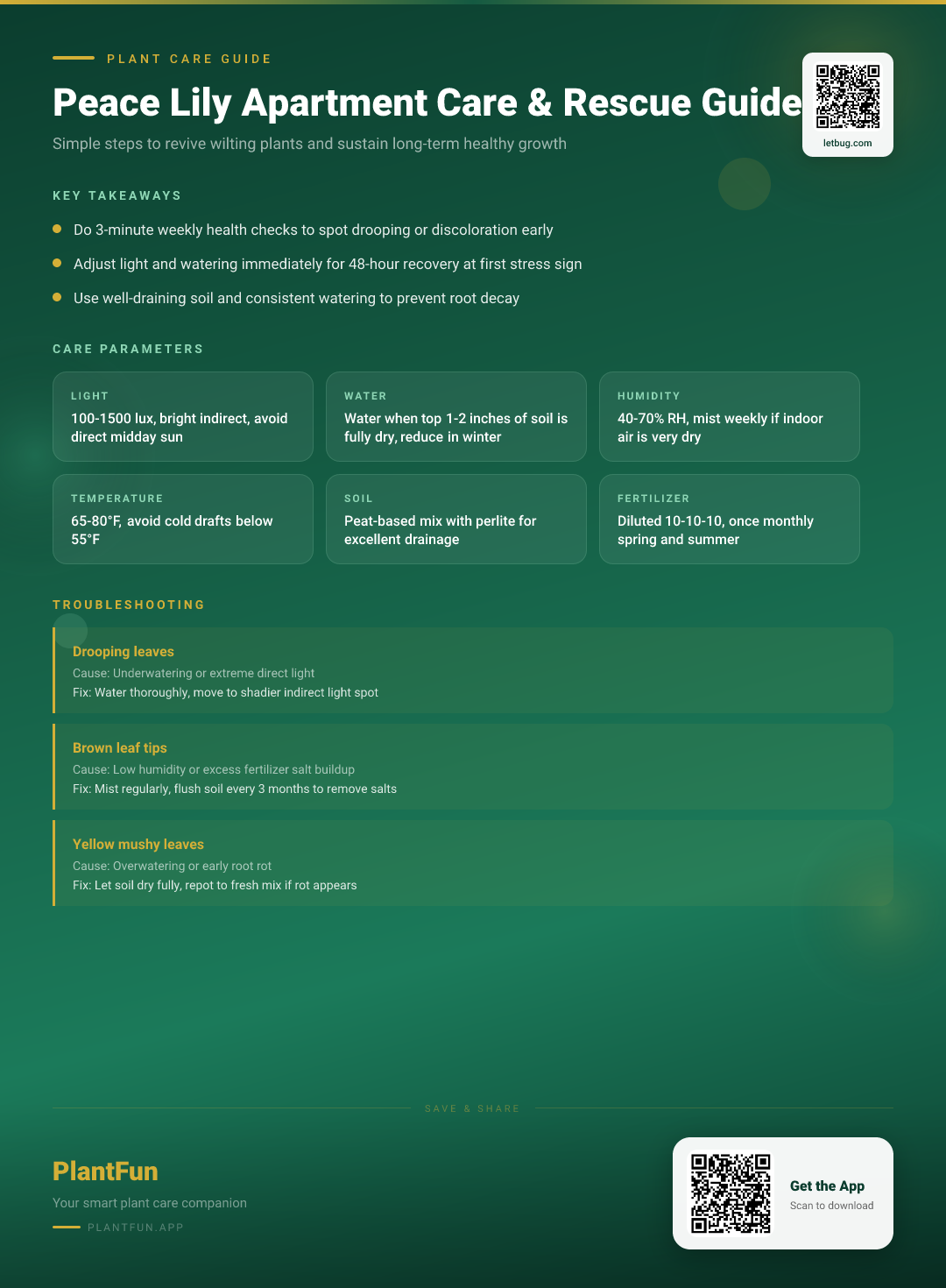
Key Takeaways
- Check soil moisture before watering — overwatering is the #1 killer of houseplants.
- Ensure your plant gets the right amount of light for its species.
- Be patient with recovery — most plants need 2–4 weeks to bounce back.
Peace Lily Rescue: A Step-by-Step Recovery Plan for Your Declining Apartment Plant
When I first brought my first Spathiphyllum (Peace Lily) into my city apartment, I treated it like a plastic decoration—setting it in a dim corner and ignoring it until the leaves hit the floor. I learned the hard way that while these plants are famous for their “drama” when thirsty, they are not “set-it-and-forget-it” specimens. If your plant is struggling, don’t panic. With a few targeted adjustments to your indoor environment, you can restore its lush, glossy health.
Quick Care Card: Measuring Light, Water, and Temperature
| Category | Requirement |
|---|---|
| Light | Bright, indirect (500–1,500 lux) |
| Water | When top 2 inches of soil feel dry |
| Humidity | 50–60% (mist or use a pebble tray) |
| Temperature | 68°F–85°F (20°C–29°C) |
| Soil | Well-draining peat-based mix |
| Fertilizer | Balanced liquid (10-10-10) during growth |
| Toxicity | Toxic to cats and dogs (ASPCA, 2026) |
TL;DR: The Immediate 3-Minute Peace Lily Health Check
If your Peace Lily is wilting, check the soil moisture immediately. If the soil is bone dry, give it a thorough soak until water runs out the drainage holes. If the soil is soggy, check for root rot. Remove yellow or brown leaves to redirect energy, and move the plant away from drafty vents or direct afternoon sun. Peace Lilies thrive on consistency, not neglect (NC State Extension, 2026).
Identifying the Problem: Why Your Peace Lily is Drooping or Yellowing
Drooping Foliage
Symptom: Leaves collapse suddenly.
Likely cause: Water stress (either extreme drought or root suffocation).
Fix:
- Perform the “finger test”: insert your finger 2 inches into the soil.
- If dry, water deeply; if wet, allow to dry out for 48 hours.
Yellowing Leaves
Symptom: Lower leaves turn pale yellow.
Likely cause: Overwatering or low nitrogen status (Wang et al., 2004).
Fix:
- Check drainage holes to ensure the pot isn’t sitting in standing water.
- Reduce watering frequency by 25% for two weeks.
Root Cause Analysis: Navigating Apartment Light and Humidity Variables
Apartment living often means unpredictable light. Peace Lilies are tropical understory plants. In nature, they exist in dappled shade. In a city apartment, placing them directly in a South-facing window usually results in scorched leaves, while a windowless hallway causes leggy, non-flowering growth. According to (NC State Extension, 2026), these plants require moderate, filtered light to maintain chlorophyll levels. If you notice your leaves are becoming translucent or pale, your plant is likely light-starved.
Immediate Rescue Steps: The Critical 48-Hour Recovery Protocol
- Hydration Reset: If the plant is severely wilted, submerge the nursery pot in a basin of tepid water (approximately 20°C) for 15 minutes. Let it drain completely.
- Pruning: Use sterile shears to remove any brown, crunchy, or yellowed leaves. This reduces the plant’s transpiration load (Karzai, 2023).
- Relocation: Move the plant at least 3 feet away from any heating or AC vents, which dry out the air.
- Humidity Boost: Place the plant on a pebble tray filled with water to increase localized relative humidity.
Why is my Peace Lily leaves turning brown at the tips? (Voice Search FAQ)
Brown tips are almost always a sign of low humidity or chemical sensitivity. Tap water often contains chlorine or fluoride, which can accumulate in the tips. Try switching to filtered water or letting your tap water sit for 24 hours before use.
How do I know when my Peace Lily actually needs more water? (Voice Search FAQ)
Instead of a strict calendar, use the soil texture. When the top 2 inches of soil feel dry to the touch, it is time to hydrate. If the plant begins to droop slightly, it is signaling a water deficit, but try to water it just before it reaches the wilting point to reduce stress.
Can I keep my Peace Lily in a windowless bathroom? (Voice Search FAQ)
Only if you provide supplemental grow lighting. A bathroom offers excellent humidity, but without a light source, the plant will eventually exhaust its stored energy (Wang et al., 2004).
Correcting the Cycle: Establishing a Sustainable Watering Rhythm
Consistency is key to preventing common indoor plant diseases. During summer, your Peace Lily will drink more. In winter, reduce the frequency by half. Always empty the saucer after watering to prevent root rot—the silent killer of apartment-grown Peace Lilies.
Soil Science: Choosing the Right Mix for Apartment Drainage
I recommend a mix of 60% potting soil, 20% perlite, and 20% orchid bark. This creates the aeration required to keep roots healthy. Avoid heavy, dense garden soil, which traps moisture and invites fungal issues.
Preventing Future Stalk Decay: Seasonal Care Shifts
As seasons change, so do your apartment’s light levels. Move your plant closer to windows in winter and further back in summer to avoid thermal stress. Remember, the ASPCA (2026) lists this plant as toxic, so keep it away from curious pets.
References
- American Society for the Prevention of Cruelty to Animals. (2026). Toxic and Non-Toxic Plants List — ASPCA. https://www.aspca.org/pet-care/animal-poison-control/toxic-and-non-toxic-plants. Accessed 2026-03-14.
- Karzai, S. (2023). In Care of a Peace Lily. The Massachusetts Review. https://doi.org/10.1353/mar.2023.a900402. Accessed 2026-03-14.
- NC State Extension. (2026). Peace Lily Rescue: — NC State Extension Gardener Plant Toolbox. https://plants.ces.ncsu.edu/plants/lily-care/. Accessed 2026-03-14.
- Wang, Q.; Chen, J.; Li, Y. (2004). Nondestructive and Rapid Estimation of Leaf Chlorophyll and Nitrogen Status of Peace Lily Using a Chlorophyll Meter. Journal of Plant Nutrition. https://doi.org/10.1081/pln-120028878. Accessed 2026-03-14.
Optional Helper: Plantfun.App
Plantfun.App identifies your plants by photo, diagnoses pests and diseases with clear fixes, and creates personalised watering and light schedules that adapt to your home conditions — a handy companion for putting this guide into daily practice.
Found an error or have suggestions? We'd love your feedback.
Need help identifying this problem?
Get instant identification, personalized care schedules, and effective pest treatment plans directly on your phone.
Sponsored • We may earn a commission from app downloads
Related Guides
The Complete Peace Lily Care Checklist for Resilient Year-Round Growth in Typical Low-Light Apartments
Stop guessing at Peace Lily care for your apartment. Get a 10-point actionable checklist, exact light, water, and humidity thresholds, and fixes for yellow leaves and drooping to keep your plant resilient all year.
Care GuidePeace Lily in Small Urban Apartments: The Only Care Checklist for Resilient Growth
Grow a lush, flowering peace lily even in a cramped small urban apartment. Grab our free 10-point care checklist, exact light/water thresholds, and zero-floor-space hacks for resilient growth.
Care GuideThe Complete Peace Lily Care Checklist for Resilient Growth in Low-Light Apartments
Stop guessing at peace lily care for your low-light apartment. Get exact light, water, and humidity thresholds plus a printable checklist to grow lush, blooming plants year-round.
Pest ControlAnts on Plants: What They Mean and What to Do
Ants usually aren't eating your plant. They are farming other pests.