
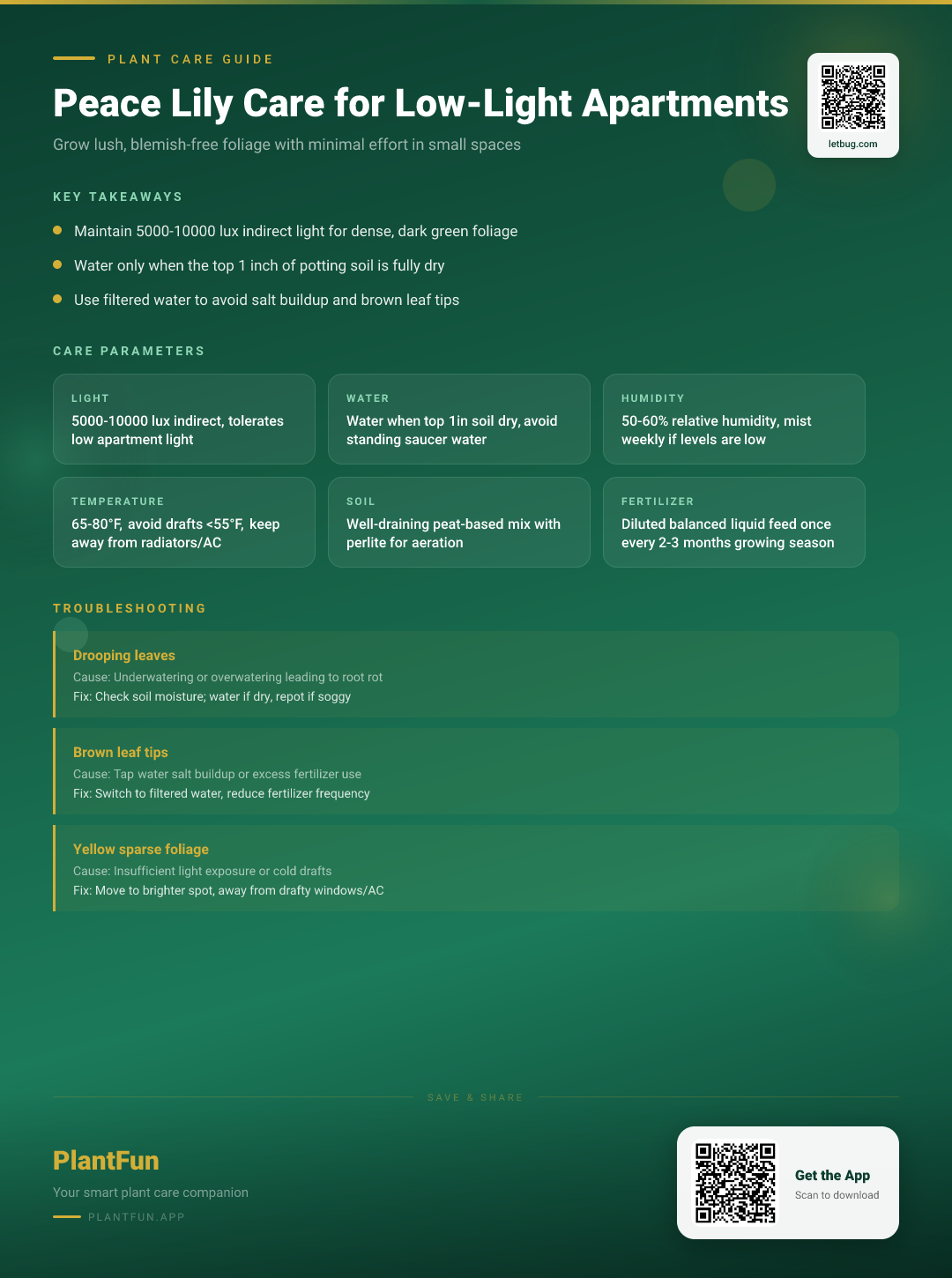
Key Takeaways
- Check soil moisture before watering — overwatering is the #1 killer of houseplants.
- Ensure your plant gets the right amount of light for its species.
- Be patient with recovery — most plants need 2–4 weeks to bounce back.
TL;DR: The 3-Step Resiliency Audit for Your Peace Lily
If you want your Peace Lily to thrive in an apartment, follow these three rules:
- Light: Place it in bright, indirect light (5,000–10,000 lux). Avoid direct sun which scorches leaves.
- Water: Use filtered water to prevent salt buildup. Water only when the top 2 inches of soil feel dry to the touch.
- Humidity: Keep levels above 50% to prevent brown tips.
*Note: Peace Lilies are toxic to pets; keep them out of reach of curious cats and dogs (ASPCA, 2026).
Quick Care Card: The Non-Negotiable Thresholds (Lux, Humidity, Temp, Water)
| Feature | Requirement |
|---|---|
| Light | 5,000–10,000 Lux (Bright, Indirect) |
| Watering | When top 2” of soil are dry |
| Humidity | 50% – 60% |
| Temperature | 65°F – 80°F |
| Soil | Well-draining, peat-based mix |
| Fertilizer | Balanced 20-20-20, half-strength monthly |
| Toxicity | Toxic to cats and dogs (ASPCA, 2026) |
Why Peace Lilies Struggle in Apartment Environments
When I first brought home my Spathiphyllum, I placed it in a dim corner, assuming it was a “low-light” plant. Within weeks, the leaves yellowed and growth stalled. The reality is that “low light” in an apartment often means “no light” for a plant that needs photosynthetically active radiation to maintain its nitrogen status (Wang, Chen, & Li, 2004). Apartments also suffer from inconsistent humidity, particularly during winter, which creates physiological stress that manifests as crispy brown tips.
Understanding Light: How Much is 5,000–10,000 Lux Actually?
Lux is a measure of light intensity. Many apartment dwellers mistake a shady corner for a suitable home for a Peace Lily. In reality, 5,000–10,000 lux is equivalent to the light found about 2–3 feet away from a bright, north-facing window. If you are struggling to gauge this, a simple app-based light meter can help. If your plant isn’t blooming, it is almost certainly a light deficiency rather than a lack of fertilizer (Wang, Chen, & Li, 2004).
The Watering Science: Why Your Peace Lily Droops Even When Soil is Moist
It sounds counterintuitive, but I have seen many Peace Lilies collapse while sitting in damp soil. This is often a sign of root rot caused by poor soil drainage. When roots suffocate in water-logged soil, they stop absorbing moisture, leading to the same wilting response as under-watering. Always check the soil depth with your finger before adding more water. If the soil stays wet for more than a week, your drainage is insufficient (Karzai, 2023).
Environmental Thresholds: Maintaining 50-60% Humidity and 65-80°F Temperature
Peace Lilies are native to tropical rainforest floors. In an apartment, forced-air heating and air conditioning strip the air of moisture. I use a hygrometer to monitor my space; if it drops below 40%, I cluster my plants together to create a micro-climate or use a pebble tray. Keep temperatures steady; drafts from windows or doors can cause leaf drop.
Step-by-Step Diagnostic: Is It Under-Watering, Salt Burn, or Low Light?
[Under-Watering]
Symptom: The entire plant droops significantly and the soil is bone-dry.
Likely cause: The plant has depleted the available water in its root zone.
Fix:
- Submerge the pot in a basin of water for 20 minutes.
- Allow it to drain completely before returning it to its spot.
[Salt Burn]
Symptom: The very tips of the leaves are crispy and brown, despite regular watering.
Likely cause: Tap water minerals and chlorine buildup in the soil (Karzai, 2023).
Fix:
- Flush the soil with distilled water.
- Switch to filtered water for future care.
[Low Light]
Symptom: The leaves are turning yellow or losing their deep green luster.
Likely cause: The plant cannot maintain its chlorophyll levels due to lack of light (Wang, Chen, & Li, 2004).
Fix:
- Gradually move the plant to a brighter location.
- Increase light exposure by 20% per week to avoid shock.
Seasonal Calendar: Adjusting Care from Winter Radiator Heat to Summer AC
- Winter: Radiators dry out the air. Move your plant away from direct heat sources and increase misting or use a humidifier.
- Summer: If your AC is running, ensure the plant is not sitting directly in the path of the vent, as the constant cool, dry breeze will dry out the foliage.
Common Mistakes: The Perils of Over-Fertilizing and Tap Water Sensitivity
- Mistake: Using high-strength fertilizer.
- What happens: Fertilizer burn on the roots and yellowing leaf edges.
- Instead: Use a balanced fertilizer at half-strength, only during the growing season (spring and summer).
- Mistake: Watering with tap water high in chlorine.
- What happens: Cumulative salt buildup leading to brown, crispy leaf margins (Karzai, 2023).
- Instead: Use filtered or room-temperature distilled water.
FAQ: Why is my Peace Lily drooping even though the soil is wet?
This is likely a sign of root rot or soil compaction. If the soil remains saturated, the roots cannot breathe, leading to root death. You may need to repot into a fresh, well-draining soil mix.
FAQ: Can I keep my Peace Lily in a windowless bathroom with a grow light?
Yes, as long as the grow light provides at least 5,000 lux. Many owners successfully maintain indoor plants in bathrooms, provided the light source is on for 8–10 hours a day.
FAQ: How do I know if my Peace Lily needs repotting?
If roots are growing out of the drainage holes or the plant droops within 24 hours of watering, it is likely root-bound and needs a new, slightly larger container.
References
- ASPCA. (2026). Toxic and Non-Toxic Plants List — ASPCA. https://www.aspca.org/pet-care/animal-poison-control/toxic-and-non-toxic-plants. Accessed 2026-03-11.
- Karzai, S. (2023). In Care of a Peace Lily. The Massachusetts Review. https://doi.org/10.1353/mar.2023.a900402. Accessed 2026-03-11.
- Wang, Q.; Chen, J.; Li, Y. (2004). Nondestructive and Rapid Estimation of Leaf Chlorophyll and Nitrogen Status of Peace Lily Using a Chlorophyll Meter. Journal of Plant Nutrition. https://doi.org/10.1081/pln-120028878. Accessed 2026-03-11.
Optional Helper: Plantfun.App
Plantfun.App identifies your plants by photo, diagnoses pests and diseases with clear fixes, and creates personalised watering and light schedules that adapt to your home conditions — a handy companion for putting this guide into daily practice.
Found an error or have suggestions? We'd love your feedback.
Need help identifying this problem?
Get instant identification, personalized care schedules, and effective pest treatment plans directly on your phone.
Sponsored • We may earn a commission from app downloads
Related Guides
The Complete Peace Lily Care Checklist for Resilient Growth in Low-Light Apartments
Stop guessing at peace lily care for your low-light apartment. Get exact light, water, and humidity thresholds plus a printable checklist to grow lush, blooming plants year-round.
Care GuideThe Complete Peace Lily Care Checklist for Resilient Year-Round Growth in Typical Low-Light Apartments
Stop guessing at Peace Lily care for your apartment. Get a 10-point actionable checklist, exact light, water, and humidity thresholds, and fixes for yellow leaves and drooping to keep your plant resilient all year.
Care GuidePeace Lily Rescue: A Step-by-Step Recovery Plan for Your Declining Apartment Plant
Revive your wilting Peace Lily with these 5 recovery steps. Learn exact light thresholds and watering fixes to get your plant thriving in your apartment today.
Pest ControlAnts on Plants: What They Mean and What to Do
Ants usually aren't eating your plant. They are farming other pests.