
Key Takeaways
- Check soil moisture before watering — overwatering is the #1 killer of houseplants.
- Ensure your plant gets the right amount of light for its species.
- Be patient with recovery — most plants need 2–4 weeks to bounce back.
TL;DR: Peace Lily Quick Care
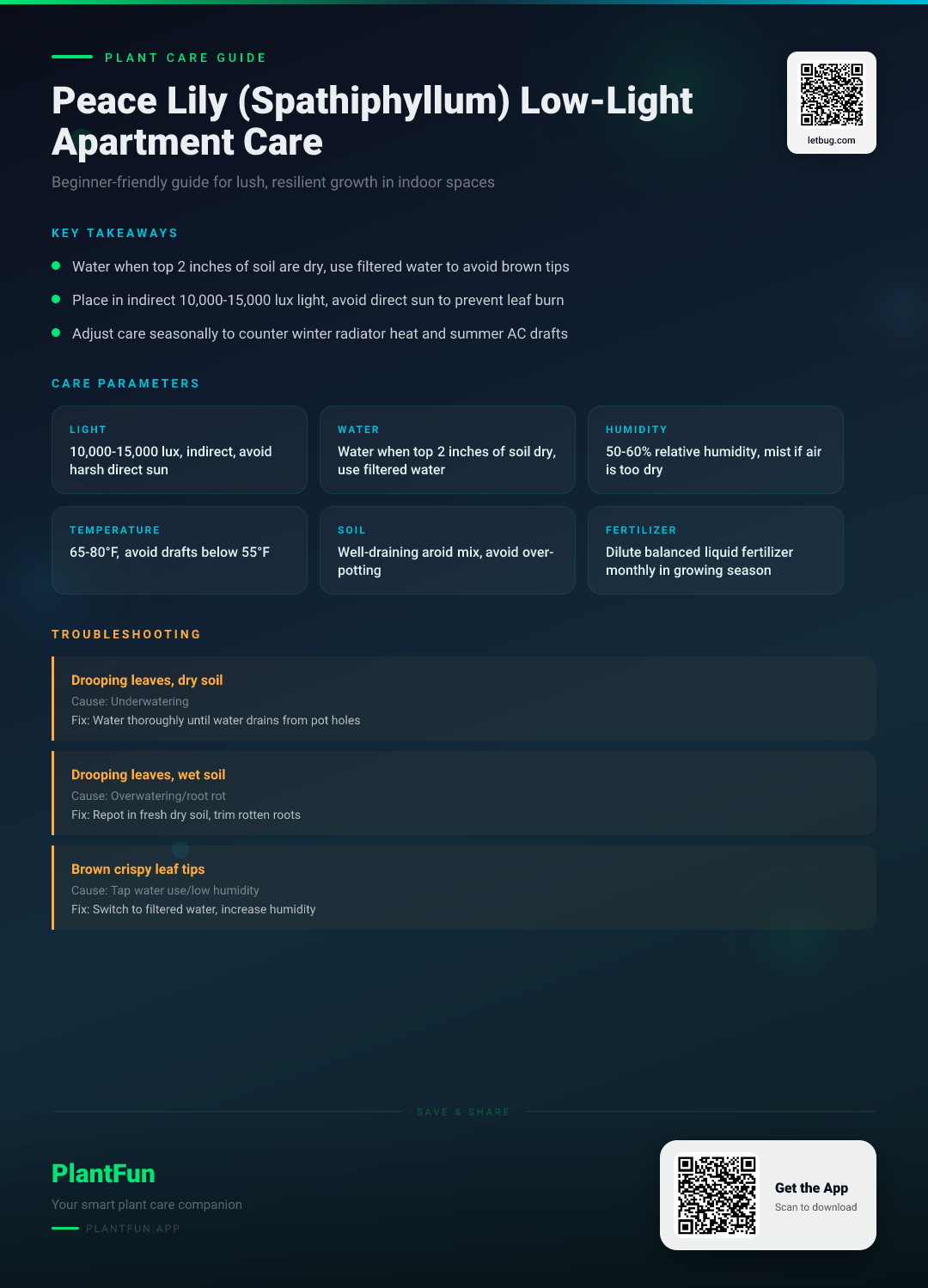
If you want your Spathiphyllum to thrive, keep it in bright, indirect light (10,000-15,000 lux) and water only when the top 2 inches of soil feel dry to the touch (NC State Extension, 2026). Avoid direct sun, which causes leaf burn, and use filtered water to prevent brown tips. Keep temperatures between 65-80°F and humidity at 50-60%. Note: Peace Lilies are toxic if ingested by pets (ASPCA, 2026).
Quick Care Card
| Category | Requirement |
|---|---|
| Light | 10,000–15,000 lux (bright, indirect) |
| Water | Top 2” dry; use filtered/distilled |
| Humidity | 50–60% (mist or pebble tray) |
| Temperature | 65–80°F (18–27°C) |
| Soil | Well-draining peat-based mix |
| Fertilizer | Balanced liquid feed, monthly in spring/summer |
| Toxicity | Toxic to cats and dogs (ASPCA, 2026) |
My Experience
When I first bought my Spathiphyllum, I fell into the trap of over-watering every time I saw a slight droop. I thought the plant was crying out for a drink, but I was actually suffocating the roots. My plant ended up with yellowing leaves and a musty-smelling pot. It took me months to realize that the “drama” of a Peace Lily isn’t always thirst—it’s often a reaction to environmental stress or root suffocation.
Why Your Apartment is Perfect for a Peace Lily
Peace Lilies are tropical understory plants, meaning they evolved to thrive on the forest floor beneath a canopy of trees. In your apartment, you can replicate this by providing stable, indirect light. They are surprisingly resilient in lower light settings compared to high-energy tropicals, making them ideal for living rooms or bedrooms (NC State Extension, 2026).
The 5-Step Resilient Growth Protocol
- Acclimation: Place your plant in a spot with stable temperatures away from heating vents or AC units.
- The Finger Test: Before watering, stick your finger 2 inches into the soil. If it is damp, wait two more days.
- Quality Control: Use filtered or distilled water. Chemicals in tap water, like fluoride, often cause brown crispy leaf tips.
- Light Adjustment: Measure light levels if possible. If the plant stops growing, move it 1-2 feet closer to a window.
- Maintenance: Wipe the dust off leaves monthly with a damp cloth to allow maximum photosynthesis.
Mastering the ‘Droop’ Signals
Distinguishing between thirst and root stress is critical. If the plant droops but the soil is wet, you are likely dealing with root rot or poor drainage, which can lead to permanent decline (NC State Extension, 2026). If the soil is bone-dry and the plant is drooping, it is simply thirsty.
Light Thresholds Explained
Peace Lilies require consistent light to bloom. While they can survive in lower light, they will not flower without at least 10,000 lux (NC State Extension, 2026). If your apartment is too dim, consider a low-output LED grow light to bridge the gap.
Hydration Science
Why do tips turn brown? It is often an accumulation of salts and minerals from tap water. Using distilled water or letting tap water sit for 24 hours can mitigate this. Proper hydration cycles are essential for the health of the root system (Karzai, 2023).
Seasonal Apartment Maintenance
Winter radiator heat dries the air rapidly. During these months, group your plants together to create a humid micro-climate or use a humidifier to maintain 50-60% humidity. In summer, ensure air circulation is good to prevent fungal issues.
[Peace Lily Drooping Even When Wet]
Symptom: Leaves hang low despite moist soil.
Likely cause: Root suffocation or early-stage rot.
Fix:
- Check drainage holes; ensure the pot isn’t sitting in a saucer of standing water.
- Gently remove the plant and inspect roots for mushy, brown, or foul-smelling sections; trim these off.
FAQ
- Can I keep my Peace Lily in the bedroom? Yes, it is a great air-purifying choice, but keep it out of reach of pets as it is toxic (ASPCA, 2026).
- How do I get my indoor Peace Lily to bloom more often? Ensure it gets bright, indirect light and a balanced fertilizer during the growing season (NC State Extension, 2026).
- Can I keep my Peace Lily in a windowless bathroom? Only if you provide a dedicated LED grow light, as they cannot survive on artificial room lighting alone.
Common Mistakes to Avoid
- Mistake: Over-potting into a huge container. What happens: The soil stays wet for too long, leading to root rot. Instead: Only size up by 1-2 inches in diameter.
- Mistake: Using standard garden soil. What happens: It compacts and suffocates roots. Instead: Use a well-draining potting mix with added perlite.
Conclusion
Peace Lily care is a balance of observation. By respecting its tropical origins and avoiding the urge to over-water, you will enjoy a lush, flowering companion for years. Observe the leaves, test the soil, and adjust slowly.
References
- ASPCA. (2026). Toxic and Non-Toxic Plants List — ASPCA. https://www.aspca.org/pet-care/animal-poison-control/toxic-and-non-toxic-plants. Accessed 2026-03-17.
- Karzai, S. (2023). In Care of a Peace Lily. The Massachusetts Review. https://doi.org/10.1353/mar.2023.a900402. Accessed 2026-03-17.
- NC State Extension. (2026). Peace Lily Care — NC State Extension Gardener Plant Toolbox. https://plants.ces.ncsu.edu/plants/lily-care/. Accessed 2026-03-17.
- PINCUS, L. (1984). PERSONAL POSTSCRIPT. Bereavement Care. https://doi.org/10.1080/02682628408657111. Accessed 2026-03-17.
Optional Helper: Plantfun.App
Plantfun.App identifies your plants by photo, diagnoses pests and diseases with clear fixes, and creates personalised watering and light schedules that adapt to your home conditions — a handy companion for putting this guide into daily practice.
Found an error or have suggestions? We'd love your feedback.
Need help identifying this problem?
Get instant identification, personalized care schedules, and effective pest treatment plans directly on your phone.
Sponsored • We may earn a commission from app downloads
Related Guides
The Complete Peace Lily Care Guide for Dim Apartments: Light, Water & Soil Secrets
Stop the constant drooping with this precise Peace Lily care plan. Learn the exact light thresholds, soil moisture levels, and hydration schedule for apartments.
Care GuideThe Complete Peace Lily Care Checklist for Resilient Growth in Low-Light Apartments
Stop guessing at peace lily care for your low-light apartment. Get exact light, water, and humidity thresholds plus a printable checklist to grow lush, blooming plants year-round.
Care GuidePeace Lily in a Low-Light Apartment: The Complete Care Guide for Resilient Growth
Master your Peace Lily care with 4 exact environmental thresholds. Stop the drooping, fix browning tips, and achieve lush, dark foliage in your apartment today.
Pest ControlAnts on Plants: What They Mean and What to Do
Ants usually aren't eating your plant. They are farming other pests.