
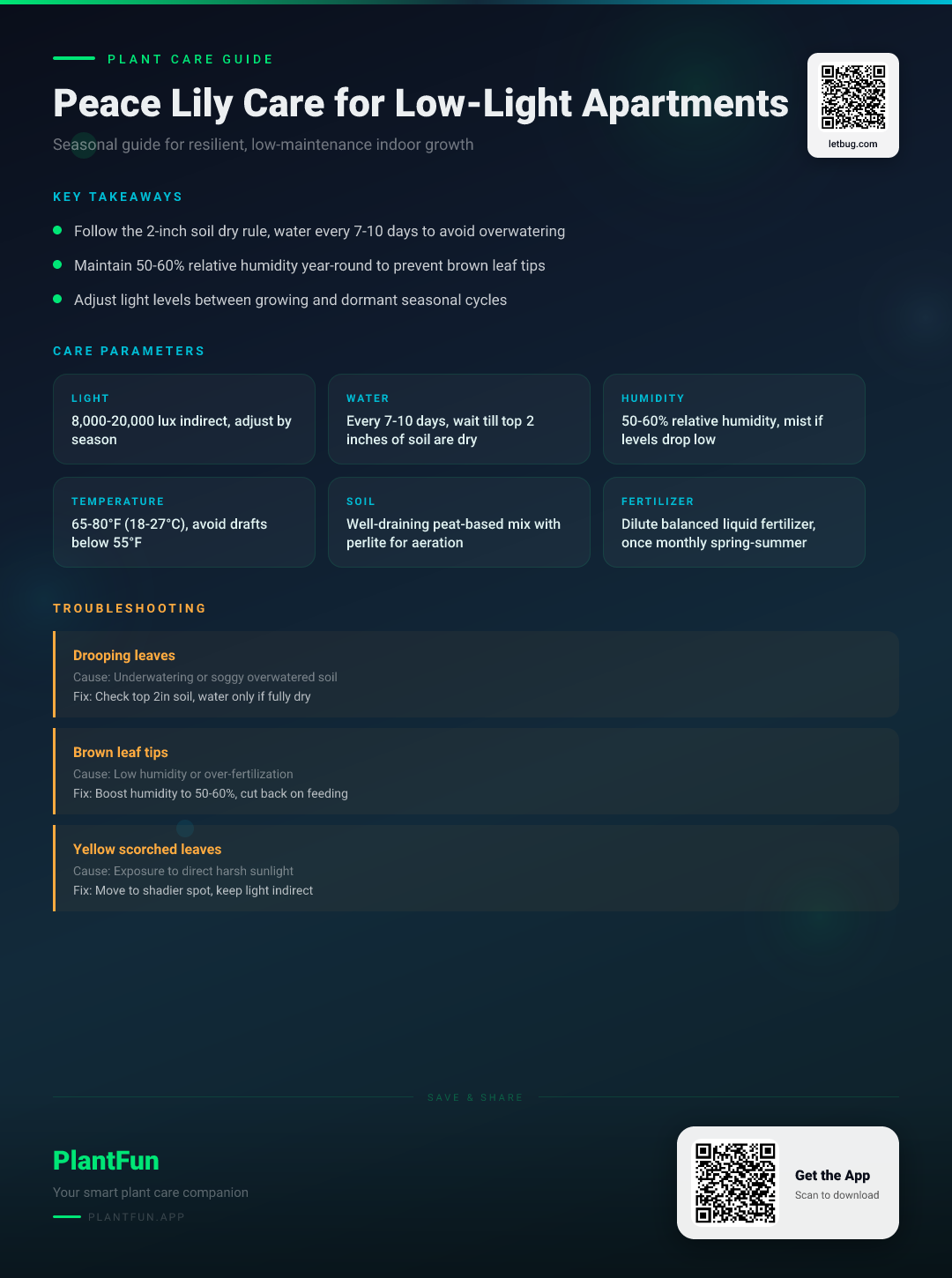
Key Takeaways
- Check soil moisture before watering — overwatering is the #1 killer of houseplants.
- Ensure your plant gets the right amount of light for its species.
- Be patient with recovery — most plants need 2–4 weeks to bounce back.
Quick Care Card: Essential Peace Lily Parameters
| Feature | Requirement |
|---|---|
| Light | 8,000–20,000 Lux (Bright, indirect) |
| Water | When top 2 inches of soil are dry |
| Humidity | 50%–60% Relative Humidity |
| Temperature | 65°F–80°F (18°C–27°C) |
| Soil | Well-draining, peat-based potting mix |
| Fertilizer | Balanced liquid feed (monthly in summer) |
| Toxicity | Toxic to cats and dogs (ASPCA, 2026) |
TL;DR: The 60-Second Peace Lily Apartment Success Summary
To keep a Spathiphyllum thriving in an apartment, prioritize stable light and consistent moisture. Keep your plant in bright, indirect light (avoid direct sun) and water only when the top two inches of soil feel dry. Maintain humidity above 50% to prevent brown tips. Note that the ASPCA (2026) classifies this plant as toxic to household pets, so keep it out of reach. When I first got my Spathiphyllum, I made the mistake of placing it in a dark corner; it survived but never bloomed. Moving it closer to an east-facing window transformed its growth overnight.
Why Peace Lilies Struggle in Typical Apartments: The Science of Home Stress
Apartments are often artificial environments that contradict the plant’s natural habitat. Spathiphyllum are understory tropical plants, meaning they thrive on filtered light and high, stable humidity (NC State Extension, 2026). When we place them in climate-controlled apartments, they suffer from localized humidity drops and erratic light patterns. The stress of these fluctuations often leads to the classic “drooping” response, which is the plant’s way of conserving turgor pressure (the internal water pressure in cells) (Karzai, 2023).
Seasonal Routine: Spring & Summer Growth Cycles (15,000-20,000 Lux)
During the active growing season, my Peace Lily needs more energy. I aim for 15,000 to 20,000 lux. If you don’t have a light meter, imagine the light intensity needed to read a book comfortably without squinting. I increase my watering frequency during these months, checking the soil every 5-7 days.
Seasonal Routine: Managing Autumn & Winter Dormancy (8,000-12,000 Lux)
As the days shorten, growth slows. I pull my plants slightly back from the window to avoid cold drafts. You must reduce watering; the soil will take longer to dry. Overwatering in winter is the fastest way to kill a Peace Lily because the roots are not actively uptaking moisture at the same rate.
Measuring Moisture: The 2-Inch Rule for Watering (Typically every 7-10 days)
Don’t rely on a schedule; rely on the soil. I insert my index finger 2 inches into the potting mix. If it feels dry, I water. If it’s still damp, I wait. This prevents the root rot that frequently plagues container-grown indoor plants (NC State Extension, 2026).
The Humidity Factor: Why 50-60% Relative Humidity Prevents Brown Tips
Low ambient humidity in apartments causes moisture to transpire from leaf tips faster than the roots can replace it, leading to crispy brown edges. I keep mine near a pebble tray or run a humidifier to maintain a steady 50-60% environment.
Temperature Sensitivity: Maintaining 65-80°F (18-27°C) for Optimal Vitality
Peace Lilies hate temperature swings. Keep them away from radiators in the winter and air conditioning vents in the summer. Consistency is the key to maintaining their vigor (Karzai, 2023).
Common Mistakes: Avoiding Overwatering and Cold Drafts
- Mistake: Using “ice cube” watering. What happens: Thermal shock to the roots. Instead: Use room-temperature water.
- Mistake: Ignoring drainage. What happens: Root suffocation. Instead: Always use a pot with a drainage hole.
Frequently Asked Questions
Can I keep my Peace Lily in a room without windows? No, a plant cannot survive without a light source. If you have no windows, you will need a dedicated grow light to provide at least 8,000 lux for 10-12 hours a day.
Why is my Peace Lily drooping even when the soil feels wet? This is often a sign of root rot or soil compaction. If the roots cannot breathe, the plant cannot uptake water, causing it to droop as if it were thirsty.
How do I know if my apartment has enough light for a Spathiphyllum? If you can read a book in that spot during the day without additional light, it is likely sufficient for a Peace Lily.
Troubleshooting Guide: Identifying Nutrient Deficiencies vs. Sunburn
Nutrient Deficiency
Symptom: Leaves turn yellow while veins remain green.
Likely cause: Lack of nitrogen or iron in the potting medium.
Fix:
- Apply a balanced liquid fertilizer at half-strength.
- Repot into fresh, high-quality indoor potting soil.
Sunburn
Symptom: Bleached, papery patches on leaves.
Likely cause: Excessive direct sunlight.
Fix:
- Move the plant to an area with filtered light.
- Trim away heavily damaged foliage to encourage new growth.
References
- Karzai, S. (2023). In Care of a Peace Lily. The Massachusetts Review. https://doi.org/10.1353/mar.2023.a900402. Accessed 2026-03-16.
- Pincus, L. (1984). Personal Postscript. Bereavement Care. https://doi.org/10.1080/02682628408657111. Accessed 2026-03-16.
- ASPCA. (2026). Toxic and Non-Toxic Plants List — ASPCA. https://www.aspca.org/pet-care/animal-poison-control/toxic-and-non-toxic-plants. Accessed 2026-03-16.
- NC State Extension. (2026). Peace Lily Care — NC State Extension Gardener Plant Toolbox. https://plants.ces.ncsu.edu/plants/lily-care/. Accessed 2026-03-16.
Optional Helper: Plantfun.App
Plantfun.App identifies your plants by photo, diagnoses pests and diseases with clear fixes, and creates personalised watering and light schedules that adapt to your home conditions — a handy companion for putting this guide into daily practice.
Found an error or have suggestions? We'd love your feedback.
Need help identifying this problem?
Get instant identification, personalized care schedules, and effective pest treatment plans directly on your phone.
Sponsored • We may earn a commission from app downloads
Related Guides
The Complete Peace Lily Care Checklist for Resilient Year-Round Growth in Typical Low-Light Apartments
Stop guessing at Peace Lily care for your apartment. Get a 10-point actionable checklist, exact light, water, and humidity thresholds, and fixes for yellow leaves and drooping to keep your plant resilient all year.
Care GuideSpathiphyllum in a Low-Light Apartment: The Complete Peace Lily Care Guide for Resilience
Stop guessing when to water your Peace Lily. Master precise lux levels, humidity hacks, and a seasonal calendar to keep your apartment plant lush and thriving.
Care GuidePeace Lily in Small Urban Apartments: The Only Care Checklist for Resilient Growth
Grow a lush, flowering peace lily even in a cramped small urban apartment. Grab our free 10-point care checklist, exact light/water thresholds, and zero-floor-space hacks for resilient growth.
Pest ControlAnts on Plants: What They Mean and What to Do
Ants usually aren't eating your plant. They are farming other pests.