
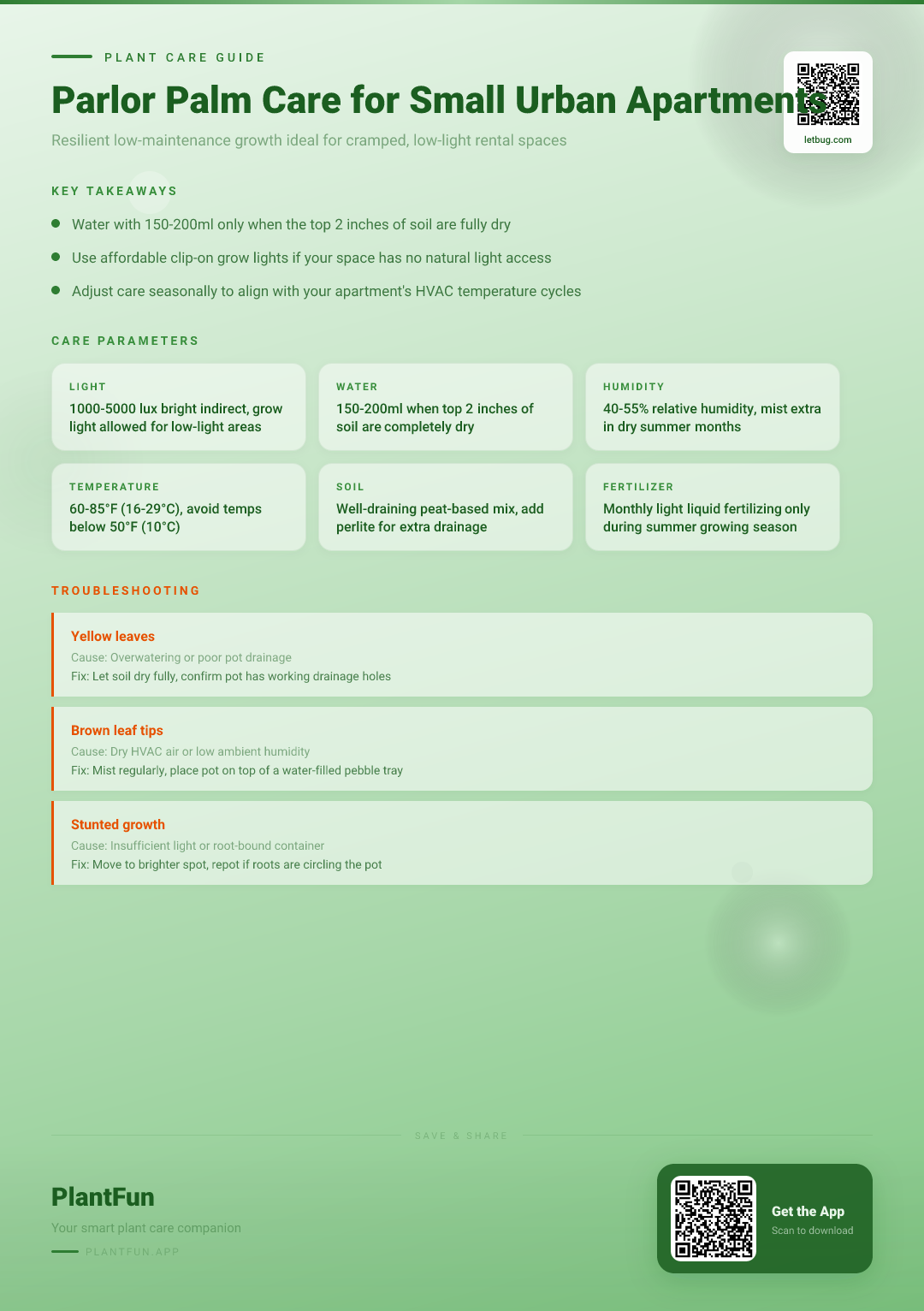
Key Takeaways
- Check soil moisture before watering — overwatering is the #1 killer of houseplants.
- Ensure your plant gets the right amount of light for its species.
- Be patient with recovery — most plants need 2–4 weeks to bounce back.
Quick Care Card
| Category | Apartment-Specific Threshold |
|---|---|
| Light | 1000-5000 lux bright indirect light (no direct midday sun) |
| Water | 150-200ml of room-temperature filtered water, only when top 2 inches of soil are completely dry |
| Humidity | 40-55% relative humidity, no sustained levels below 30% |
| Temperature | 60-85°F (16-29°C), never expose to temperatures below 50°F (10°C) |
| Soil | Well-draining mix: 60% organic potting soil, 20% perlite, 20% orchid bark |
| Fertilizer | ½ strength diluted liquid houseplant fertilizer, once monthly only March-August |
| Toxicity | Non-toxic to cats, dogs, and humans (ASPCA, 2026) |
Why Parlor Palms Are Perfect for Small Urban Apartments
Native to the understory of Central American rainforests, parlor palms (Chamaedorea elegans) evolved to thrive in low, filtered light and infrequent rainfall, making them ideal for the constraints of small urban rental living. They grow slowly, reaching a maximum of 4 feet tall indoors over 10 years, with a compact, clumping growth habit that fits in 12-inch corner nooks, shelf tops, or entryway tables without crowding your space. Unlike fast-growing, high-maintenance plants, they tolerate missed waterings, low light, and temperature fluctuations common in apartment buildings, and are safe for households with pets or small children (ASPCA, 2026). This guide focuses specifically on parlor palm care for beginners living in small, low-light rentals, with no generic filler advice.
8-Step Parlor Palm Care Checklist for Resilient Apartment Growth
Follow these rental-specific actionable steps for consistent, healthy growth:
- Pick your no-drill placement: Position your palm 3-5 feet away from a north or east-facing window, avoiding direct midday sun. This fits in tight corner nooks with no wall modifications required.
- Use rental-friendly potting: Choose a pot 2 inches larger than the nursery pot with drainage holes, and place a plastic saucer underneath to avoid staining window sills or hardwood floors.
- Mix your soil: Combine 60% organic potting soil, 20% perlite, and 20% orchid bark for a fast-draining mix that prevents root rot.
- Test soil moisture weekly: Stick your index finger 2 inches deep into the soil (up to your second knuckle) as a quick test. Only water if the soil is completely dry to answer how often to water parlor palm for your specific apartment conditions.
- Water with a measured amount: Pour 150-200ml of room-temperature filtered water directly onto the soil, avoiding wetting fronds to prevent fungal spots.
- Boost humidity without equipment: Group your palm with 2-3 other small houseplants to naturally raise local humidity by 10-15% with no extra purchases.
- Fertilize only in growing season: Apply ½ strength diluted liquid houseplant fertilizer once a month from March to August, skipping all feedings in winter.
- Prune sparingly: Only trim fully brown or yellow fronds at the base with clean scissors, never cut green tips as this stops further growth of that frond.
Non-Negotiable Measurable Care Thresholds
Skip guesswork with these science-backed parameters tailored to apartment environments:
- 1000-5000 lux bright indirect light: Meets parlor palm light requirements indoors, equivalent to light on a cloudy day near a window. Any level above 10,000 lux (direct midday sun) will burn fronds.
- 40-55% relative humidity: Matches typical indoor levels, avoiding the <30% dry air from running HVAC that causes brown tips. A common myth is that parlor palms need 70%+ humidity; in reality, they tolerate levels as low as 30% for short periods with no permanent damage.
- 150-200ml water when top 2 inches of soil are dry: Prevents overwatering, the #1 cause of parlor palm yellow leaves and root rot.
- 60-85°F (16-29°C) temperature, never below 50°F (10°C): Avoid placement near drafty windows, AC vents, or space heaters that cause rapid temperature swings.
Seasonal Care Calendar for Apartment Dwellers
Adjust your care to match typical apartment HVAC cycles:
- Winter (December-February, parlor palm winter care): Water only every 2-3 weeks, move the plant 1 foot away from drafty windows and forced-air heaters, skip all fertilizer, and mist fronds once a week if humidity drops below 35%.
- Summer (June-August, parlor palm summer watering): Test soil moisture every 5-7 days, add an extra 50ml of water if temperatures stay above 80°F for 3+ consecutive days, fertilize once monthly, and wipe fronds with a damp cloth every 2 weeks to remove dust that blocks light.
Most Common Parlor Palm Apartment Mistakes (And Easy 24-Hour Fixes)
- Mistake: Watering on a fixed weekly schedule instead of testing soil moisture. What happens: Overwatering leads to root rot, parlor palm yellow leaves, and stunted growth. Instead: Use the finger test weekly to check moisture. For a parlor palm overwatering fix, pour off any standing water in the saucer immediately and move the plant to a spot with 3000 lux light to help soil dry faster within 24 hours.
- Mistake: Placing directly in a south-facing window with full midday sun. What happens: Fronds get sunburned, turn crispy brown at the edges, and growth stalls. Instead: Keep the plant 3-5 feet away from south-facing windows, or hang a cheap sheer curtain to filter light to the required 1000-5000 lux range.
- Mistake: Ignoring humidity drops from running HVAC year-round. What happens: Parlor palm tips turn brown, and fronds droop even when watered correctly. Dry air also increases risk of spider mite infestations (Reinert & Neel, 1977). Instead: Use a $10 humidity meter to track parlor palm humidity levels, and set up a pebble tray under the pot to boost humidity by 10% within 24 hours.
- Mistake: Repotting every year even if the plant isn’t root bound. What happens: Root shock leads to stunted growth and yellow fronds, especially problematic for renters who move frequently. Instead: Only repot every 2-3 years, when roots are visibly growing out of the drainage holes, and use a pot only 2 inches larger than the current one.
Voice Search FAQs
Why is my parlor palm turning yellow even though I water it regularly?
Most often this is caused by overwatering, which leads to root rot and prevents the plant from taking up nutrients, or poor drainage from a pot without holes that traps excess water. Dry air below 30% from running heaters or AC can also cause yellowing along frond edges. To fix, stop watering immediately until the top 3 inches of soil are completely dry, confirm your pot has drainage holes, and add a humidity boost if levels are low.
Can I keep my parlor palm in a windowless apartment office?
Yes! Parlor palm low light care works perfectly with artificial light as long as you provide 1000-2000 lux of light for 8-10 hours a day. A cheap $15 clip-on LED grow light placed 12 inches above the plant will meet all its light requirements, no natural light needed.
How do I make my parlor palm grow faster in a small apartment?
First, place it in a spot that gets 3000-5000 lux of bright indirect light (3 feet away from an east-facing window) to give it the energy it needs to grow. Fertilize once a month in the growing season with ½ strength diluted houseplant fertilizer, and repot only when root bound to avoid shock. Parlor palms grow slowly, only 4-6 inches a year indoors, so don’t expect rapid growth, but these steps will help it reach its maximum potential without crowding your small space.
Troubleshooting Quick Reference
Use this printable table to diagnose common apartment-specific issues at a glance:
| Symptom | Likely Root Cause | Quick Fix |
|---|---|---|
| Brown crispy frond tips | Low humidity from HVAC, excess fertilizer | Mist fronds, flush soil with filtered water |
| Drooping limp fronds | Underwatering or root rot from overwatering | Test soil, water if dry or repot if soggy |
| No new growth in growing season | Insufficient light, root bound | Move to brighter spot, repot if roots are growing out of drainage holes |
| Uniform yellow fronds | Overwatering, cold drafts | Stop watering, move away from drafts |
| Brown spots with yellow halos | Sunburn, rare viral infection (Lee et al., 2022) | Move away from direct sun, trim damaged fronds |
Brown Frond Tips
Symptom: Dry, crispy brown edges on the tips of otherwise green fronds.
Likely cause: Sustained low humidity below 30% from running HVAC, or excess fertilizer build-up in soil.
Fix:
- Mist fronds with room-temperature water immediately to boost local humidity.
- Flush soil with 3x the pot volume of filtered water to wash away excess fertilizer salts.
Drooping Fronds
Symptom: Limp, wilted fronds that hang downward even when you haven’t moved the plant.
Likely cause: Either severe underwatering, or root rot from overwatering.
Fix:
- Test soil moisture: if bone dry, add 200ml of water and wait 2 hours for fronds to perk up.
- If soil is soggy, remove the plant from its pot, trim any mushy brown roots, and repot in fresh dry soil.
No New Growth
Symptom: No new green fronds appear for 6+ months during the spring and summer growing season.
Likely cause: Insufficient light, or the plant is root bound and has no room to grow.
Fix:
- Move the plant to a spot 3ft away from an east-facing window to get 3000-5000 lux of bright indirect light.
- Check drainage holes for roots growing out; if visible, repot in a pot 2 inches larger than the current one.
Yellow Fronds
Symptom: Uniform yellowing of entire fronds, starting with the lower older leaves first.
Likely cause: Overwatering leading to root rot, or exposure to cold drafts from AC vents or windows.
Fix:
- Stop watering immediately until the top 3 inches of soil are completely dry.
- Move the plant at least 1ft away from drafty windows or AC vents to avoid temperature swings.
Crispy Brown Spots on Fronds
Symptom: Irregular dry brown spots in the middle of fronds, often with yellow halos.
Likely cause: Sunburn from direct midday sun, or rare viral infection (Lee et al., 2022).
Fix:
- Move the plant 2ft further away from the window to filter out direct sun.
- Trim off any badly spotted fronds with clean scissors to prevent spread of disease.
Long-Term Resilience Tips for Renters
- Pet-safe parlor palm small apartment placement: Per ASPCA (2026), parlor palms are non-toxic to cats and dogs, so you can place them on low floor corners, entryway tables, or low shelves without worrying about nibbling pets, even if you don’t have much high shelf space.
- Moving transport tips: If you’re relocating rentals, wrap fronds loosely in a soft bedsheet to avoid breaking delicate stems, place the pot in a cardboard box lined with crumpled newspaper to prevent tipping, and avoid leaving the plant in a cold moving truck for more than 2 hours if temperatures are below 50°F.
- No-drill display hacks: Use weighted freestanding plant stands, over-the-shelf hooks, or window sill suction cup holders to display your parlor palm without drilling holes in rental walls, saving valuable floor space in small apartments.
- Low-effort humidity hacks: Skip bulky expensive humidifiers that take up counter space. Instead, group your parlor palm with 2-3 other small houseplants to naturally raise local humidity by 10-15%, or use a pebble tray (fill a shallow tray with pebbles and water, set the pot on top of the pebbles so it’s not sitting in standing water) to boost humidity as the water evaporates.
References
- ASPCA. (2026). Toxic and Non-Toxic Plants List — ASPCA. https://www.aspca.org/pet-care/animal-poison-control/toxic-and-non-toxic-plants. Accessed 2026-03-01.
- Lee, H.; Kim, N.; Hwang, S. (2022). First report of tomato spotted wilt virus infecting parlor palm (Chamaedorea elegans) with leaf mosaic and ring spot disease in Korea. Journal of Plant Pathology. https://doi.org/10.1007/s42161-021-00980-5. Accessed 2026-03-01.
- Reinert, J.; Neel, P. (1977). Tumid Spider Mite Control on Parlor Palm Grown in Containers1. HortScience. https://doi.org/10.21273/hortsci.12.4.339b. Accessed 2026-03-01.
Optional Helper: Plantfun.App
Plantfun.App identifies your plants by photo, diagnoses pests and diseases with clear fixes, and creates personalised watering and light schedules that adapt to your home conditions — a handy companion for putting this guide into daily practice.
Found an error or have suggestions? We'd love your feedback.
Need help identifying this problem?
Get instant identification, personalized care schedules, and effective pest treatment plans directly on your phone.
Sponsored • We may earn a commission from app downloads
Related Guides
The Complete Parlor Palm Care Checklist for Resilient Growth in Typical Urban Apartments
Stop guessing at parlor palm care for your apartment. Get measurable light, water, and humidity targets, plus a printable checklist to keep your plant lush and stress-free year-round.
Care GuideParlor Palm Care Checklist for Small Apartments: Grow Lush Resilient Fronds Without Common Mistakes
Stop dealing with yellow, crispy parlor palm fronds. Get our apartment-specific checklist, exact light/water thresholds, and 5 easy fixes for the most common growth mistakes.
Care GuideThe Complete Parlor Palm Care Guide for 1-Bedroom Apartments: Budget Tips for Resilient Growth
Skip expensive plant gadgets and grow a lush, full Parlor Palm in your standard apartment. Get exact light levels, watering amounts, and a free printable checklist to avoid common care mistakes.
Safety GuideParlor Palm in Low-Light Playrooms: Non-Toxic Care & Placement Guide for Pet & Child Safety
Keep your playroom green and safe for toddlers and cats with this parlor palm care guide. Get exact light, water, and placement tips to avoid toxic exposure and keep your plant lush long-term.