
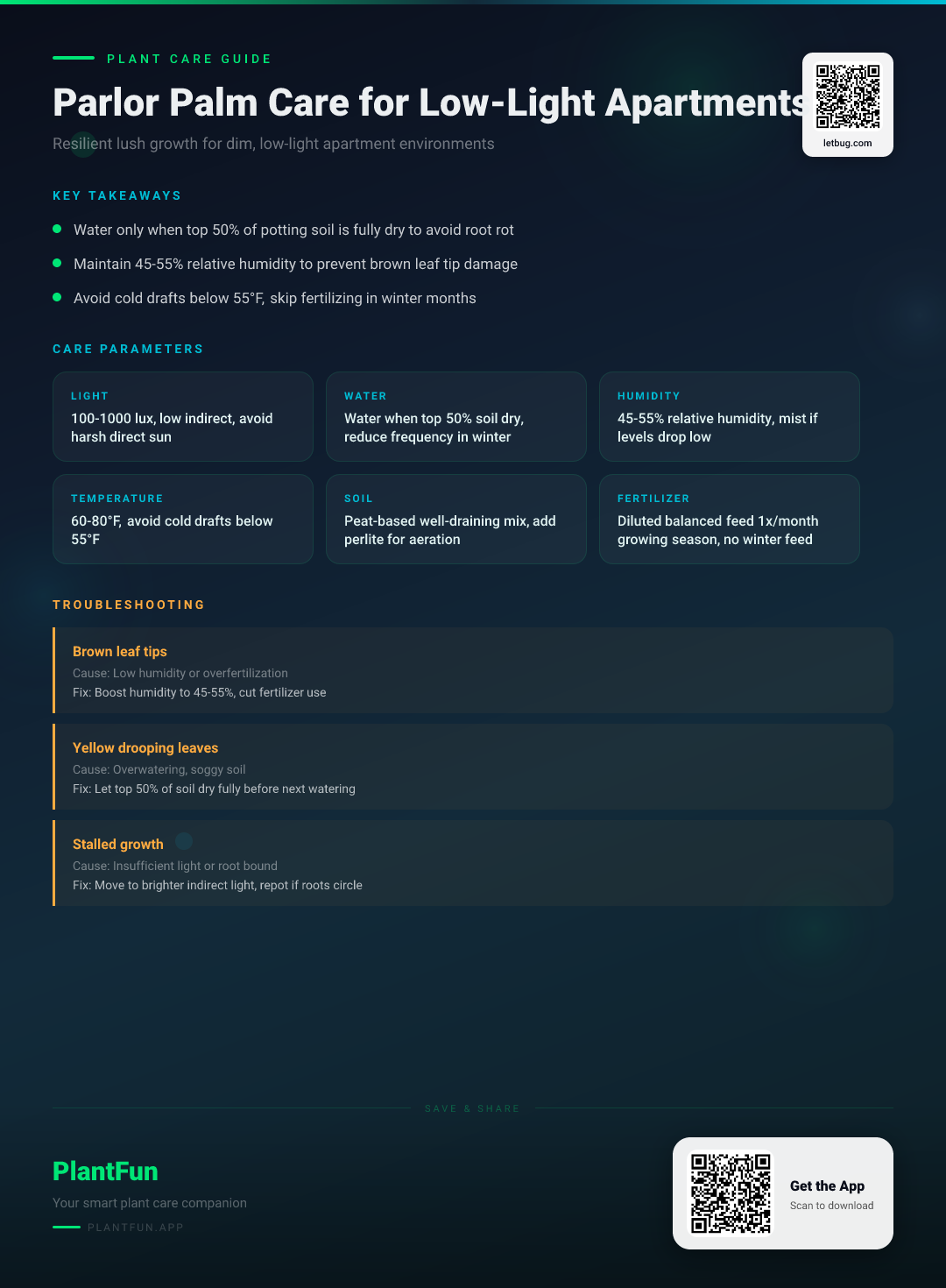
Key Takeaways
- Check soil moisture before watering — overwatering is the #1 killer of houseplants.
- Ensure your plant gets the right amount of light for its species.
- Be patient with recovery — most plants need 2–4 weeks to bounce back.
Quick Care Card: Essential Thresholds for Parlor Palms
| Feature | Requirement |
|---|---|
| Light | Bright indirect to low light (100–500 foot-candles) |
| Water | Allow top 50% of soil to dry between waterings |
| Humidity | 45–55% (ideal); misting or tray usage recommended |
| Temperature | 65°F–80°F (18°C–27°C) |
| Soil | Well-draining, peat-based potting mix |
| Fertilizer | Balanced liquid 10-10-10 at half-strength (monthly in summer) |
| Toxicity | Non-toxic to cats and dogs (ASPCA, 2026) |
TL;DR: Why the Parlor Palm is the Ultimate Apartment Companion
The Chamaedorea elegans is the gold standard for apartment dwellers. It tolerates lower light levels better than almost any other palm species (NC State Extension, 2026). If you have a north-facing window or a dim corner, this plant will not just survive; it will thrive, provided you avoid overwatering and keep it away from direct, scorching sun.
My Experience: Learning to Listen to the Palm
When I first brought my Chamaedorea elegans home, I made the classic mistake of treating it like a succulent. I let it dry out completely, which resulted in crunchy, brown leaflets. Conversely, a friend of mine watered hers on a strict calendar, leading to yellowing lower fronds—the classic sign of root suffocation. I eventually learned that the palm isn’t a clock-watcher; it’s a feel-tester. Today, I treat my palm as an individual, checking the moisture level every Sunday rather than just blindly pouring water.
The Science of Low Light: Why Your Palm Struggles in Dim Corners
While these plants are shade-tolerant, “low light” does not mean “no light.” Palms are photosynthetically active plants that need enough energy to maintain their delicate fronds. When light is insufficient, the plant metabolizes its stored energy, leading to slow growth and eventually, a susceptibility to pests like spider mites, which thrive on stressed plants (Reinert & Neel, 1977). Furthermore, weakened plants are more prone to opportunistic pathogens (Lee et al., 2022). Aim for a spot where you can comfortably read a book during the day.
Step-by-Step Watering Ritual: Mastering the 50% Soil Dryness Rule
Do not rely on a schedule. Instead, follow this ritual:
- The Finger Test: Insert your index finger 2 inches into the soil. If it feels damp, wait. If it feels dry, it is time.
- The Hydration: Use room-temperature water. Pour until water runs through the drainage holes.
- The Drainage: Wait 15 minutes, then empty the saucer. Never let the roots sit in standing water, as this invites root rot.
Optimizing Humidity: Achieving 45-55% Levels for Tip Health
Indoor heating often drops apartment humidity to sub-30% levels, which causes the characteristic brown tips on your palm. I suggest grouping your plants together to create a microclimate or using a dedicated humidifier to keep levels near 50%.
Seasonal Shift: Adjusting Your Care Calendar for Summer vs Winter
- Summer: Your palm is in active growth. Increase watering frequency and apply a half-strength fertilizer once a month.
- Winter: Growth slows significantly. Let the soil dry out slightly more than you would in summer. Avoid fertilizing entirely from November to February (NC State Extension, 2026).
Why is my Parlor Palm getting brown tips even when I water it?
Often, this is caused by low ambient humidity or mineral buildup from tap water. If your water is heavily treated with chlorine or fluoride, try using filtered water or letting your tap water sit out for 24 hours to allow gases to dissipate.
How do I know if my apartment has enough light for a Parlor Palm?
If you can comfortably read a newspaper or book in your chosen spot without turning on a lamp during the day, your palm will be happy. If the plant looks “leggy” (stretching with wide gaps between fronds), it is starving for light and needs to move closer to a window.
Common Apartment Mistakes: Avoiding Drafts and Fertilizer Burn
- Mistake: Placing the palm near an AC vent or radiator. What happens: Rapid moisture loss and tissue damage. Instead: Keep the palm at least 5 feet away from HVAC vents.
- Mistake: Over-fertilizing. What happens: Salt accumulation in the soil, which burns the roots. Instead: Only fertilize during the peak growing season (April-August).
When to Repot: Signs Your Palm is Ready for a New Vessel
Check your palm once a year. If you see roots circling the bottom of the pot or growing out of the drainage holes, it is time for a pot 1–2 inches larger in diameter. Use a high-quality, well-draining indoor potting mix with extra perlite.
Troubleshooting Guide: Quick Symptom-to-Action Checklist
Yellowing Leaves at the Base
Symptom: The oldest, lowest fronds turn yellow.
Likely cause: Overwatering or poor drainage.
Fix:
- Check the soil for sogginess; allow it to dry out.
- Ensure the pot has functioning drainage holes.
Brown, Crispy Leaf Tips
Symptom: The tips of the fronds are brown and dry to the touch.
Likely cause: Low humidity or salt buildup from fertilizer.
Fix:
- Increase humidity via a pebble tray or humidifier.
- Flush the soil with distilled water to remove excess salts.
Webbing on Fronds
Symptom: Fine, silken webs appear between the leaflets.
Likely cause: Spider mite infestation (Reinert & Neel, 1977).
Fix:
- Wipe the leaves with a damp cloth and mild insecticidal soap.
- Increase humidity, as mites avoid moist environments.
Leaf Mosaic or Spotting
Symptom: Unusual ring spots or mosaic patterns on leaves.
Likely cause: Viral infection (Lee et al., 2022).
Fix:
- Isolate the plant immediately to prevent spread.
- If symptoms are severe, discard the plant to protect your other indoor garden members.
Frequently Asked Questions
- Can I put my Parlor Palm in a bathroom? Yes, if there is a window. The humidity is perfect for them, but they still need light to thrive.
- Is it safe to have a Parlor Palm with my cat? Yes, the ASPCA (2026) lists Chamaedorea elegans as non-toxic to cats and dogs.
- How often should I wipe the dust off my palm? Once a month is ideal to help the leaves photosynthesize efficiently.
References
- American Society for the Prevention of Cruelty to Animals. (2026). Toxic and Non-Toxic Plants List — ASPCA. https://www.aspca.org/pet-care/animal-poison-control/toxic-and-non-toxic-plants. Accessed 2026-03-18.
- Lee, H., Kim, N., & Hwang, S. (2022). First report of tomato spotted wilt virus infecting parlor palm (Chamaedorea elegans) with leaf mosaic and ring spot disease in Korea. Journal of Plant Pathology. https://doi.org/10.1007/s42161-021-00980-5. Accessed 2026-03-18.
- North Carolina State University Extension. (2026). Parlor Palm — NC State Extension Gardener Plant Toolbox. https://plants.ces.ncsu.edu/plants/palm-care/. Accessed 2026-03-18.
- Reinert, J. & Neel, P. (1977). Tumid Spider Mite Control on Parlor Palm Grown in Containers. HortScience. https://doi.org/10.21273/hortsci.12.4.339b. Accessed 2026-03-18.
Optional Helper: Plantfun.App
Plantfun.App identifies your plants by photo, diagnoses pests and diseases with clear fixes, and creates personalised watering and light schedules that adapt to your home conditions — a handy companion for putting this guide into daily practice.
Found an error or have suggestions? We'd love your feedback.
Need help identifying this problem?
Get instant identification, personalized care schedules, and effective pest treatment plans directly on your phone.
Sponsored • We may earn a commission from app downloads
Related Guides
Chamaedorea Elegans in Low-Light Apartments: 5 Steps to Stop Browning Leaf Tips
Stop the heartbreak of crispy, brown Parlor Palm leaves. Get precise water volumes, humidity hacks, and light thresholds to keep your palm thriving indoors.
Care GuideChamaedorea Elegans in Low-Light Apartments: The Complete Care Guide for Resilient Growth
Transform your dim apartment into a lush oasis. Master Parlor Palm care with exact lux thresholds, watering cycles, and humidity tips for resilient indoor growth.
Care GuideChamaedorea elegans in a Dim Apartment: The Ultimate Budget-Friendly Care Guide for Resilient Growth
Transform your dim apartment into a lush oasis. Master Parlor Palm care with 4 exact environmental thresholds and a watering schedule that prevents root rot.
Safety GuideParlor Palm in Low-Light Playrooms: Non-Toxic Care & Placement Guide for Pet & Child Safety
Keep your playroom green and safe for toddlers and cats with this parlor palm care guide. Get exact light, water, and placement tips to avoid toxic exposure and keep your plant lush long-term.