
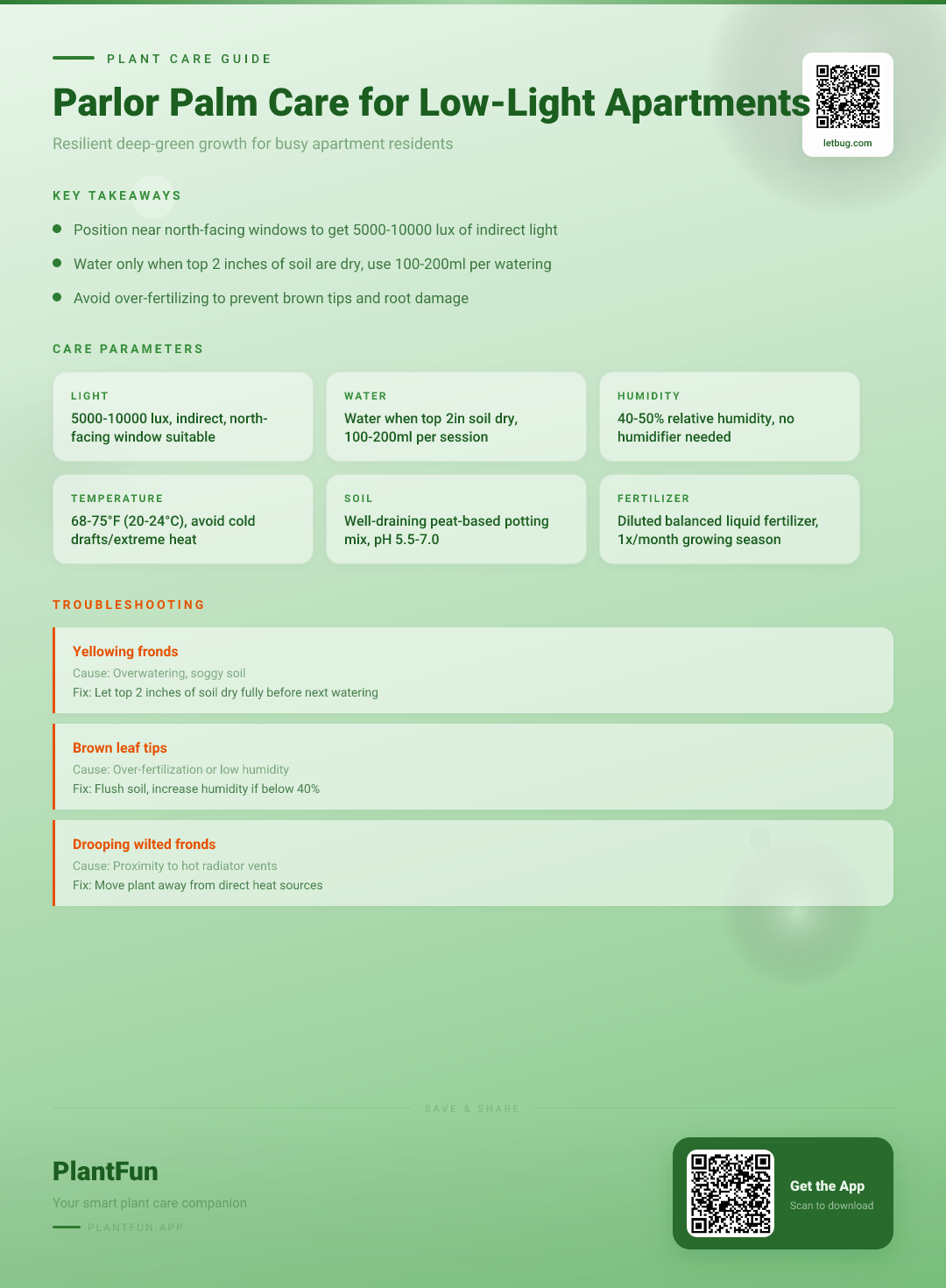
Key Takeaways
- Check soil moisture before watering — overwatering is the #1 killer of houseplants.
- Ensure your plant gets the right amount of light for its species.
- Be patient with recovery — most plants need 2–4 weeks to bounce back.
Quick Care Card: Essential Thresholds for Success
| Feature | Requirement |
|---|---|
| Light | 5,000-10,000 lux (Indirect) |
| Water | When top 2 inches of soil are dry |
| Humidity | 40-50% relative humidity |
| Temperature | 68-75°F (20-24°C) |
| Soil | Well-draining, peat-based mix |
| Fertilizer | Balanced liquid 10-10-10 (monthly, spring/summer) |
| Toxicity | Non-toxic to cats and dogs (ASPCA, 2026) |
TL;DR: The Parlor Palm Blueprint for Busy Apartment Residents
The Parlor Palm (Chamaedorea elegans) thrives in apartments because it tolerates lower light levels better than most indoor palms (NC State Extension, 2026). To keep yours vibrant, place it in bright, indirect light, water only when the top 2 inches of soil feel dry, and keep it away from direct heating vents. It is a non-toxic companion for your pets (ASPCA, 2026).
Why Your Parlor Palm Needs This Specific Care Protocol
When I first got my Parlor Palm, I assumed it wanted the same treatment as my sun-loving succulents. I made the mistake of placing it in a south-facing window with direct exposure, which quickly scorched its delicate fronds. Learning that this species originates from the shaded floors of rainforests changed everything. It needs stability; it doesn’t crave intensity. Providing a consistent environment is the secret to avoiding the slow decline many owners face.
Light Requirements: Achieving 5,000-10,000 lux in North-Facing Windows
Unlike many tropical plants, Chamaedorea elegans functions efficiently in the lower light conditions typical of apartment living. Aim for 5,000 to 10,000 lux. If you don’t have a light meter, a simple rule is: if you can read a book comfortably in the spot without straining your eyes, the light is sufficient. North or East-facing windows are ideal because they provide consistent, soft light without the harsh UV rays that cause leaf burn.
Hydration Science: Why Water When Top 2 Inches of Soil Are Dry (100-200ml)
Overwatering is the fastest way to kill a Parlor Palm. I recommend using the “finger test”: stick your index finger 2 inches into the soil. If it feels damp, wait. If it’s dry, apply 100-200ml of room-temperature water. Ensure your pot has drainage holes to allow excess water to escape, preventing root rot, which is a common physiological stressor.
Humidity Calibration: Maintaining 40-50% Without a Humidifier
While palms love tropical air, you don’t need a bulky humidifier. I keep my palm on a tray filled with pebbles and a small amount of water. As the water evaporates, it creates a localized micro-climate around the leaves. This maintains the 40-50% humidity levels required to keep frond tips from turning brown.
Temperature Control: Keeping 68-75°F (20-24°C) for Optimal Metabolism
These plants are sensitive to sudden temperature fluctuations. Keep your palm in a steady 68-75°F range. Avoid placing it near drafty doors or air conditioning units, as thermal shock can trigger a dormant metabolic state.
Seasonal Adjustment: Winter Dormancy vs. Summer Growth spurts
In the summer, your palm will enter an active growth phase. Increase your water frequency slightly and begin a light, monthly feeding schedule. Come winter, the plant naturally slows down. Reduce your water significantly; the soil will take longer to dry out, and fertilizer should be paused entirely until spring.
Troubleshooting: Interpreting Yellowing Fronds as SOS Signals
Yellowing Leaf Tips
Symptom: The tips of the lower fronds turn yellow or crispy.
Likely cause: Low humidity or inconsistent watering.
Fix:
- Increase the frequency of your pebble tray refill.
- Ensure you are watering deeply enough to reach the root ball.
Brown, Mushy Stems
Symptom: The base of the stems appears dark, soft, or smells musty.
Likely cause: Root rot from standing water.
Fix:
- Immediately cease watering.
- Check for standing water in the saucer and discard it.
FAQ: Why is my Parlor Palm getting brown tips even when I water it?
This is usually a humidity issue rather than a watering one. If your indoor air is very dry, especially during winter heating months, the moisture escapes the leaves faster than the roots can replace it (NC State Extension, 2026).
FAQ: Can I place my Parlor Palm directly on an apartment radiator vent?
No. Radiator heat creates extreme, localized dry heat that will desiccate the fronds in days. Keep the plant at least 5 feet away from heat sources.
FAQ: How do I know when my Parlor Palm is ready for a repot?
If you see roots circling the surface or protruding from the drainage holes, it is time for an upgrade. Choose a pot only 1-2 inches larger than the current one to prevent excess moisture retention.
Common Apartment Mistakes: The Over-Fertilizer Trap
- Mistake: Heavy fertilization in winter.
- What happens: Fertilizer salts build up in the soil, causing “burn” on leaf edges.
- Instead: Only fertilize once a month during the active growing season (Spring/Summer) using a diluted liquid feed.
Optional Helper: Plantfun.App
Plantfun.App identifies your plants by photo, diagnoses pests and diseases with clear fixes, and creates personalised watering and light schedules that adapt to your home conditions — a handy companion for putting this guide into daily practice.
Summary: The Resilient Growth Checklist
- Position in bright, indirect light (North/East window).
- Test soil moisture 2 inches deep before adding 100-200ml of water.
- Maintain a consistent room temperature (68-75°F).
- Use a pebble tray for localized humidity.
- Keep pets safe; it is a non-toxic addition to your home (ASPCA, 2026).
References
- ASPCA. (2026). Toxic and Non-Toxic Plants List — ASPCA. https://www.aspca.org/pet-care/animal-poison-control/toxic-and-non-toxic-plants. Accessed 2026-03-09.
- NC State Extension. (2026). Parlor Palm Care — NC State Extension Gardener Plant Toolbox. https://plants.ces.ncsu.edu/plants/palm-care/. Accessed 2026-03-09.
- Kolar, K.; Atchison, C.; Bungay, V. (2014). Sexual safety practices of massage parlor-based sex workers and their clients. AIDS Care. https://doi.org/10.1080/09540121.2014.894611. Accessed 2026-03-09.
- Flynn, J.; Mithcell, S.; Wynne, J. (2022). 1088: TATTOO-INDUCED SARCOIDOSIS: A LATE RARE TATTOO PARLOR COMPLICATION. Critical Care Medicine. https://doi.org/10.1097/01.ccm.0000810676.81445.1e. Accessed 2026-03-09.
Found an error or have suggestions? We'd love your feedback.
Need help identifying this problem?
Get instant identification, personalized care schedules, and effective pest treatment plans directly on your phone.
Sponsored • We may earn a commission from app downloads
Related Guides
The Complete Parlor Palm Care Checklist for Resilient Growth in Typical Urban Apartments
Stop guessing at parlor palm care for your apartment. Get measurable light, water, and humidity targets, plus a printable checklist to keep your plant lush and stress-free year-round.
Care GuideThe Budget Parlor Palm Care Checklist for Resilient Growth in Small Urban Apartments
Skip overpriced plant supplies and get your parlor palm thriving on a tight budget. This scenario-specific checklist has exact light, water, and humidity rules for small urban apartments, no guesswork required.
Care GuideChamaedorea Elegans in Low-Light Apartments: 5 Steps to Stop Browning Leaf Tips
Stop the heartbreak of crispy, brown Parlor Palm leaves. Get precise water volumes, humidity hacks, and light thresholds to keep your palm thriving indoors.
Safety GuideParlor Palm in Low-Light Playrooms: Non-Toxic Care & Placement Guide for Pet & Child Safety
Keep your playroom green and safe for toddlers and cats with this parlor palm care guide. Get exact light, water, and placement tips to avoid toxic exposure and keep your plant lush long-term.