
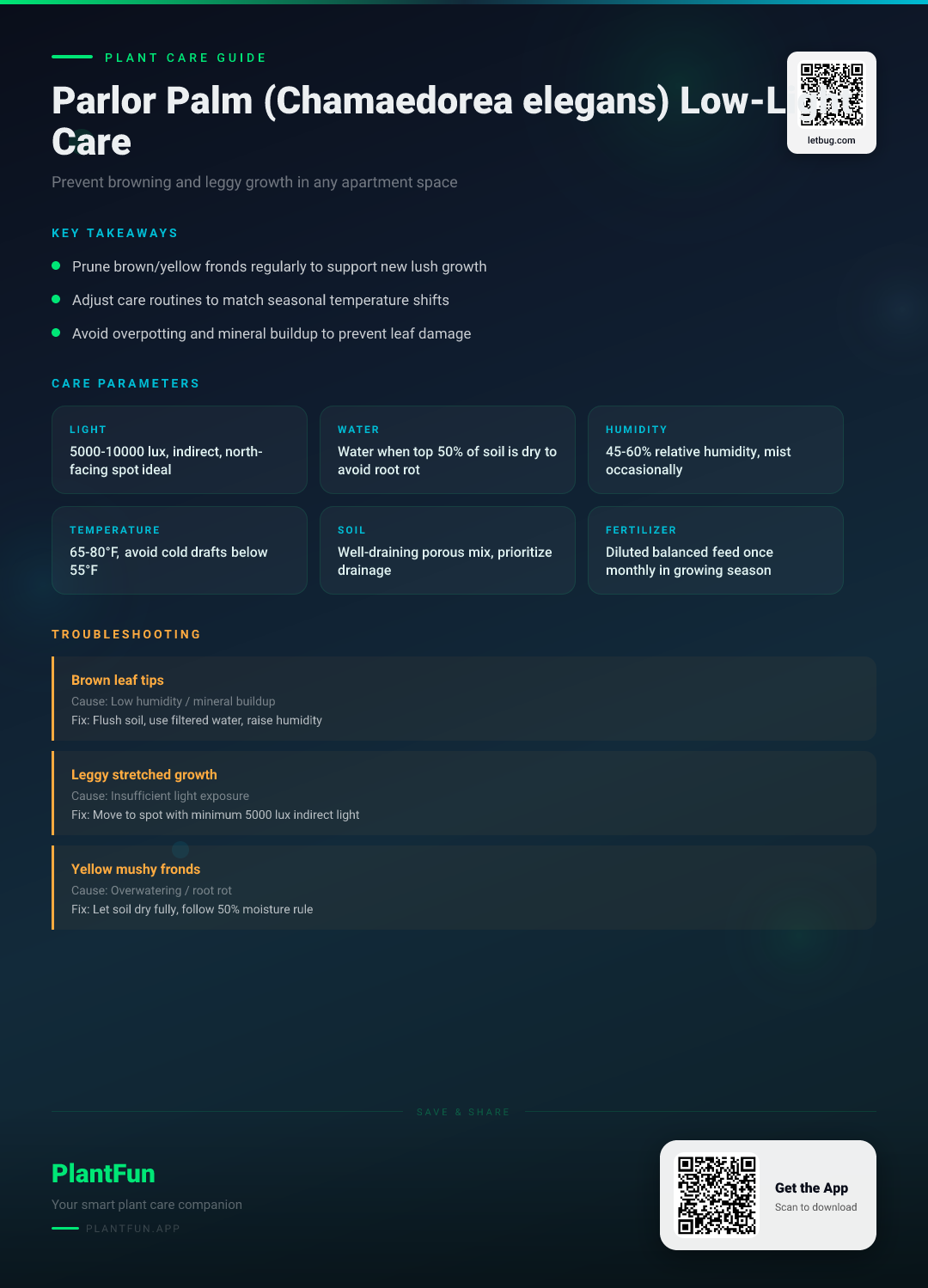
Key Takeaways
- Check soil moisture before watering — overwatering is the #1 killer of houseplants.
- Ensure your plant gets the right amount of light for its species.
- Be patient with recovery — most plants need 2–4 weeks to bounce back.
Quick Care Card: Essential thresholds for the Chamaedorea elegans
| Feature | Requirement |
|---|---|
| Light | 5,000–10,000 lux (bright, indirect) |
| Water | Allow top 50% of soil to dry |
| Humidity | 45–60% relative humidity |
| Temperature | 65–80°F (18–27°C) |
| Soil | Well-draining, peat-based mix |
| Fertilizer | Balanced liquid feed, monthly in summer |
| Toxicity | Non-toxic to cats and dogs (ASPCA, 2026) |
TL;DR: The 60-second summary of why your Parlor Palm is currently struggling
Most Chamaedorea elegans owners struggle because they treat the plant like a plastic decoration in a dark corner. Your palm is failing because it likely lacks sufficient light for photosynthesis, suffers from “wet feet” due to poor drainage, or is reacting to dry air from apartment heating systems. To fix this, move it within 3-5 feet of a north-facing window, stop watering on a schedule, and increase ambient humidity.
Understanding the Habitat: Why your apartment is a poor substitute for a rainforest
When I first started keeping plants in my studio apartment, I assumed my Parlor Palm would love the dim bathroom corner. I was wrong. In their native Mexican rainforest understory, these palms grow in dappled light and high humidity. In an apartment, we often force them into stagnant, dry air and near-darkness. Understanding this habitat shift is the key to preventing the common yellowing of leaves that plagues so many indoor collectors.
Light Requirements: Providing 5,000-10,000 lux in a north-facing living room
While marketed as “low-light tolerant,” Chamaedorea elegans care for beginners is easier when you accept that “low light” does not mean “no light.” To maintain healthy, dark green fronds, aim for 5,000–10,000 lux (NC State Extension, 2026). In my experience, a north-facing window is ideal because it provides consistent, non-burning light. If you notice your palm becoming “leggy”—reaching frantically toward the window—it is starved for photons and needs to be moved closer to the glass.
Watering Mastery: Using the 50% moisture rule to prevent root rot in typical pots
Knowing how often to water a Parlor Palm is the most common point of failure. I never water on a calendar schedule. Instead, I use the 50% rule: insert your finger into the soil. If the top half of the potting medium feels dry, it is time to water. If it is still damp, walk away. Over-watering causes root hypoxia, which eventually leads to the dreaded brown tips on palms that many owners confuse with underwatering.
Humidity & Temperature: Keeping your palm between 65-80°F and 45-60% humidity
Parlor palms thrive in the same temperature range as humans (65-80°F). However, winter apartment heating drops humidity significantly. If your home humidity is below 40%, you will likely see crispy leaf edges. Placing your plant on a tray filled with pebbles and water can create a micro-climate to help stabilize these levels.
The 3-Step Rescue Plan: How to identify and prune yellowing or brown-tipped fronds
- Diagnostic Check: Look at the leaf color. Uniform yellowing often indicates over-watering or nitrogen deficiency. Crispy brown tips point to low humidity or mineral buildup.
- Strategic Pruning: Using sterilized shears, trim only the brown, dead tissue. Do not cut into the healthy green tissue, as this causes a fresh wound that can invite pathogens.
- Repotting Check: If the roots are circling the bottom of the pot, they are suffocating. Move to a pot only 1-2 inches larger to prevent excess moisture retention.
Seasonal Care Calendar: Adapting your routine for winter heating and summer growth
- Spring/Summer: Increase light exposure and begin monthly fertilization with a balanced, water-soluble fertilizer.
- Autumn/Winter: Reduce water frequency significantly as metabolic processes slow down. Keep away from cold drafts or direct vent heating.
FAQ: Why is my Parlor Palm getting brown tips even though I water it?
Brown tips are often an atmospheric issue rather than a watering issue. Check your humidity levels. Also, if you use tap water with high fluoride or chlorine, the salts can accumulate in the leaf tips. Try using filtered water for a few weeks to see if the new growth improves.
FAQ: Can I keep my Parlor Palm in a bedroom with no windows?
No. While the plant may survive for a few weeks in a windowless room, it will eventually decline. It requires a light source to perform photosynthesis. If your bedroom has no natural light, you must supplement with a full-spectrum LED grow light.
Common Mistakes to Avoid
- Mistake: Using decorative pots without drainage holes.
- What happens: Water collects at the bottom, leading to root rot.
- Instead: Use a plastic nursery pot with drainage holes inside your decorative planter.
- Mistake: Over-potting the plant.
- What happens: Excess soil holds too much water, keeping roots wet for too long.
- Instead: Increase pot size by only 1-2 inches at a time.
The Best Soil Mix: Why drainage is more important than fertilizer
The best soil for a Parlor Palm is a well-aerated, peat-based mix amended with perlite. This ensures that even when you water thoroughly, oxygen can still reach the root zone. Avoid heavy, moisture-retentive garden soil at all costs.
References
- ASPCA. (2026). Toxic and Non-Toxic Plants List — ASPCA. https://www.aspca.org/pet-care/animal-poison-control/toxic-and-non-toxic-plants. Accessed 2026-03-10.
- Flynn, J.; Mithcell, S.; Wynne, J. (2022). 1088: TATTOO-INDUCED SARCOIDOSIS: A LATE RARE TATTOO PARLOR COMPLICATION. Critical Care Medicine. https://doi.org/10.1097/01.ccm.0000810676.81445.1e. Accessed 2026-03-10.
- Kolar, K.; Atchison, C.; Bungay, V. (2014). Sexual safety practices of massage parlor-based sex workers and their clients. AIDS Care. https://doi.org/10.1080/09540121.2014.894611. Accessed 2026-03-10.
- NC State Extension. (2026). Parlor Palm Care — NC State Extension Gardener Plant Toolbox. https://plants.ces.ncsu.edu/plants/palm-care/. Accessed 2026-03-10.
Optional Helper: Plantfun.App
Plantfun.App identifies your plants by photo, diagnoses pests and diseases with clear fixes, and creates personalised watering and light schedules that adapt to your home conditions — a handy companion for putting this guide into daily practice.
Found an error or have suggestions? We'd love your feedback.
Need help identifying this problem?
Get instant identification, personalized care schedules, and effective pest treatment plans directly on your phone.
Sponsored • We may earn a commission from app downloads
Related Guides
Parlor Palm Care in Dim Apartments: The Complete Guide for Lush, Resilient Growth
Revive your struggling Parlor Palm. Master exact watering intervals, light positioning, and humidity hacks to keep your foliage lush in low-light apartments.
Care GuideParlor Palm Care for Low-Light Apartments: The 5-Step Guide to Thriving Greenery
Revitalize your Parlor Palm with precise light and water metrics. Learn the 5-step maintenance routine that guarantees resilient, deep-green growth every time.
Care GuideChamaedorea Elegans in Low-Light Apartments: 5 Steps to Stop Browning Leaf Tips
Stop the heartbreak of crispy, brown Parlor Palm leaves. Get precise water volumes, humidity hacks, and light thresholds to keep your palm thriving indoors.
Safety GuideParlor Palm in Low-Light Playrooms: Non-Toxic Care & Placement Guide for Pet & Child Safety
Keep your playroom green and safe for toddlers and cats with this parlor palm care guide. Get exact light, water, and placement tips to avoid toxic exposure and keep your plant lush long-term.