
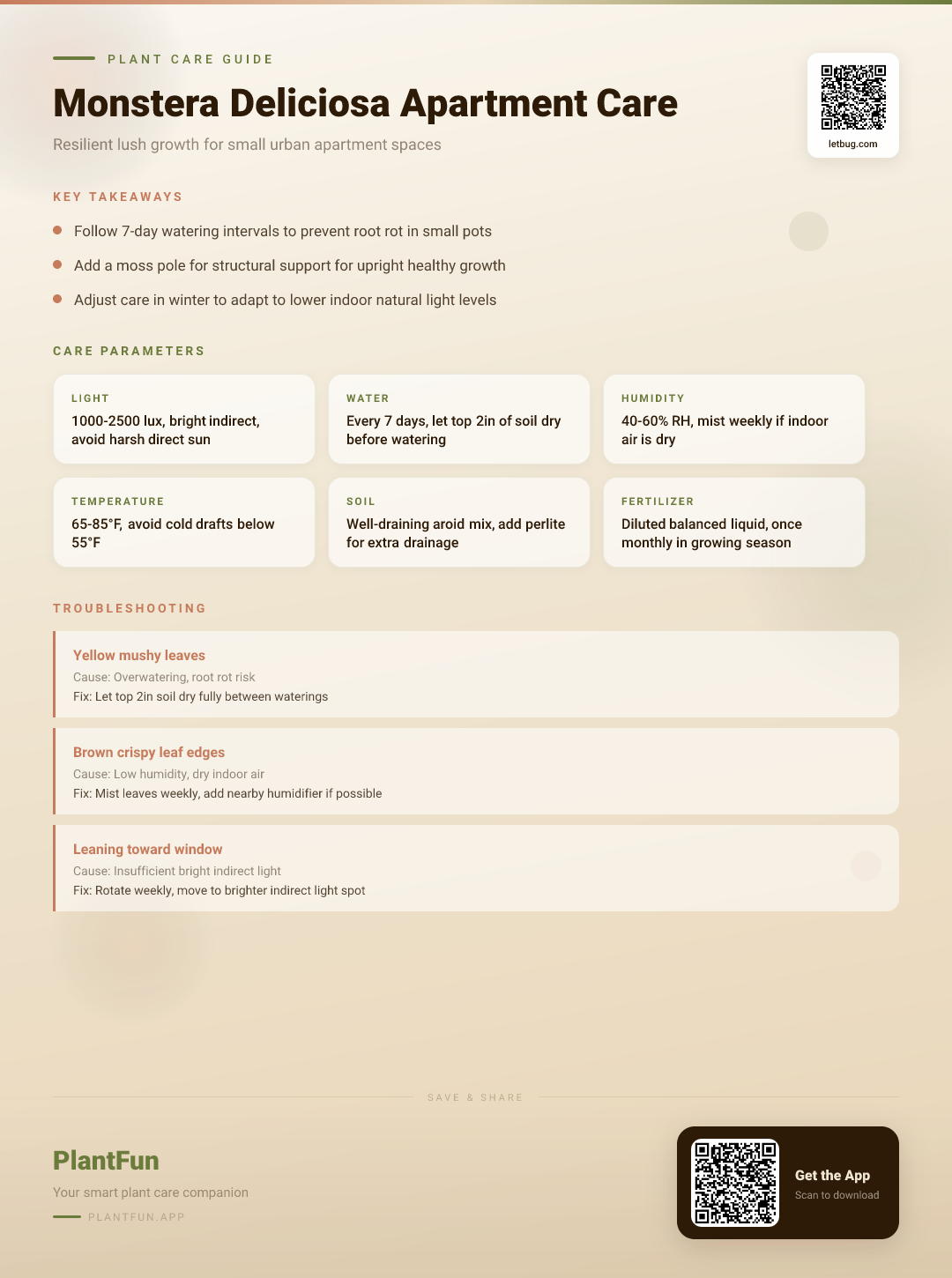
Key Takeaways
- Check soil moisture before watering — overwatering is the #1 killer of houseplants.
- Ensure your plant gets the right amount of light for its species.
- Be patient with recovery — most plants need 2–4 weeks to bounce back.
TL;DR: Quick Maintenance
To keep your Monstera deliciosa thriving in an apartment, prioritize bright, indirect light (minimum 1,500 lux) and allow the top 2 inches of soil to dry before watering. Avoid soggy soil to prevent root rot, and ensure a moss pole is used to mimic its natural climbing habit. Keep the plant away from pets as it is toxic (ASPCA, 2026).
My Experience
When I first bought my Monstera deliciosa, I made the classic mistake of placing it in a dark corner of my apartment, thinking it was a “low-light plant.” Within weeks, it stopped producing fenestrated (split) leaves and started leaning dangerously toward the window. I learned the hard way that while these plants are resilient, they require specific environmental cues to remain truly healthy. My apartment’s stagnant air and inconsistent light were the real culprits, not my “green thumb.”
Quick Care Card: Essential Thresholds for Apartment Resilience
| Feature | Requirement |
|---|---|
| Light | 1,500 – 3,000 lux (Bright indirect) |
| Water | Every 7–10 days (Top 2” dry) |
| Humidity | 40% – 60% |
| Temperature | 65°F – 80°F (18°C – 27°C) |
| Soil | Chunky, well-draining aroid mix |
| Fertilizer | Balanced liquid, monthly in spring/summer |
| Toxicity | Toxic to pets/humans (ASPCA, 2026) |
Why Your Monstera Deliciosa Struggles in Tight Apartment Spaces
Apartments are often defined by low airflow and inconsistent light gradients. Unlike a greenhouse or a home with large windows, your living room likely has “light dead zones.” According to the NC State Extension (2026), Monstera deliciosa thrives in bright, indirect light. When light is limited, the plant lacks the energy to perform photosynthesis efficiently, leading to slow growth and weak stems.
Format A: The Complete Scenario Guide for Urban Dwellers
If you are living in a studio or small apartment, your plant needs specialized placement:
- Window Proximity: Place within 3 feet of a south or west-facing window. Use a sheer curtain to diffuse harsh midday sun.
- Airflow: Even in a small space, use a small oscillating fan on low to prevent stagnant air, which can encourage fungal issues (Shaw, 1992).
- Potting: Always use a pot with drainage holes. If you love decorative cachepots, remove the inner plastic nursery pot for watering to ensure the roots never sit in standing water.
Decoding the Environment: Measuring Lux and Humidity at Home
Lux represents the intensity of light. You can download a light meter app on your phone to check if your spot hits at least 1,500 lux. Humidity is equally critical; in winter, heaters drop ambient moisture levels. If your humidity falls below 30%, consider a pebble tray or a small humidifier to prevent crisping leaf tips.
The 7-Day Watering Strategy: Preventing Root Rot in Small Pots
In my experience, watering by a calendar is safer than “when it feels light.” Check the soil moisture every 7 days by inserting your finger two inches into the substrate. If it feels cool and damp, wait. If it is dry and crumbly, it is time to water. This prevents the primary cause of root rot—saturated, anaerobic soil.
Structural Support: Why Your Monstera Needs a Moss Pole Now
In nature, these are hemiepiphytic climbers. Without a moss pole, the plant spends energy trying to support its own weight rather than producing new, larger foliage. Training it upward allows it to maximize its leaf surface area for light collection.
Seasonal Care Calendar: Navigating Low Light in Winter
Winter is the “dormancy” phase. Reduce watering frequency by 30% and stop fertilizing entirely between November and February. Your plant is resting, and pushing it to grow in low light leads to leggy, thin stems.
Common Mistakes to Avoid: From Over-Fertilizing to Poor Drainage
- Mistake: Using standard garden soil. What happens: Compacts and suffocates roots. Instead: Use a mix of orchid bark, perlite, and peat-free coco coir.
- Mistake: Over-fertilizing. What happens: Salt buildup burns root tips. Instead: Dilute liquid fertilizer to half-strength.
FAQ: Why is my Monstera leaning toward the window?
This is phototropism—the plant is physically reaching for more energy. Rotate your pot 90 degrees every time you water to ensure even growth.
FAQ: Can I keep my Swiss Cheese plant in a drafty apartment hallway?
Avoid it. Drafts cause temperature fluctuations that shock the plant, potentially leading to leaf yellowing (NC State Extension, 2026).
FAQ: How do I know if my Monstera is getting enough light?
If new leaves are small and lack fenestrations (the signature holes), your plant is telling you it needs more light to thrive.
Diagnostic Checklist: Identifying Nutrient Deficiencies vs. Pests
Yellowing Leaves
Symptom: Lower leaves turning yellow and mushy.
Likely cause: Overwatering or poor drainage leading to root stress.
Fix:
- Stop watering immediately.
- Repot into a fresh, airy aroid mix to inspect for mushy, black roots.
Brown Leaf Tips
Symptom: Dry, crispy brown edges.
Likely cause: Low humidity or inconsistent watering.
Fix:
- Increase humidity with a humidifier.
- Maintain a consistent 7-day watering check.
Stunted Growth
Symptom: No new leaves for months.
Likely cause: Low light or root-bound pot.
Fix:
- Move to a brighter location.
- Check if roots are circling the bottom of the pot and upgrade to a pot 2 inches larger.
References and Botanical Verification
- ASPCA. (2026). Toxic and Non-Toxic Plants List — ASPCA. https://www.aspca.org/pet-care/animal-poison-control/toxic-and-non-toxic-plants. Accessed 2026-03-09.
- Haydon, G.; Shaw, D. (1991). Zinc Accumulation in Monstera Deliciosa Near Brisbane. Australasian Plant Pathology. https://doi.org/10.1071/app9910125. Accessed 2026-03-09.
- NC State Extension. (2026). Monstera Deliciosa — NC State Extension Gardener Plant Toolbox. https://plants.ces.ncsu.edu/plants/deliciosa-care/. Accessed 2026-03-09.
- Shaw, D. (1992). Abnormal Internal Sori of Puccinia Paullula F.sp. Monsterae on Monstera Deliciosa. Australasian Plant Pathology. https://doi.org/10.1071/app9920123. Accessed 2026-03-09.
Optional Helper: Plantfun.App
Plantfun.App identifies your plants by photo, diagnoses pests and diseases with clear fixes, and creates personalised watering and light schedules that adapt to your home conditions — a handy companion for putting this guide into daily practice.
Found an error or have suggestions? We'd love your feedback.
Need help identifying this problem?
Get instant identification, personalized care schedules, and effective pest treatment plans directly on your phone.
Sponsored • We may earn a commission from app downloads
Related Guides
Monstera Deliciosa Care Checklist: Grow Lush Leaves in Typical Small Urban Apartments
Grow lush, holey Monstera deliciosa leaves even in a small urban apartment. Get exact light, water, humidity thresholds plus a symptom-to-action checklist for stress-free resilient growth.
Care GuideSwiss Cheese Plant Care in Low-Light Apartments: A Resilient Growth Strategy for Monstera deliciosa
Transform your dim apartment into a lush jungle. Follow these 5 proven steps to keep your Monstera deliciosa thriving, fenestrated, and vibrant all year long.
Care GuideMonstera Deliciosa in a Low-Light Apartment: The Complete Care Guide for Resilient Growth
Transform your dim apartment into a tropical oasis. Master Monstera deliciosa care with 4 exact light-to-water ratios and a growth schedule that ensures fenestrations.
Pest ControlHow to Spot Early Pest Signs on Your Monstera Deliciosa: A Weekly Inspection & Rescue Plan
Catch Monstera deliciosa pest infestations before they permanently damage your prized fenestrated leaves. Get a 5-minute weekly inspection routine, easy-to-spot early warning signs, and non-toxic rescue steps you can implement today to stop spread to other houseplants.