
Key Takeaways
- Check soil moisture before watering — overwatering is the #1 killer of houseplants.
- Ensure your plant gets the right amount of light for its species.
- Be patient with recovery — most plants need 2–4 weeks to bounce back.
When I first brought a Monstera Deliciosa into my 400-square-foot studio, I made the classic mistake of putting it in a dark corner because I thought it was a “low light” plant. It quickly became leggy, desperate for a window. I learned the hard way that “resilient” doesn’t mean “invincible.” You don’t need expensive grow lights or professional fertilizers to make this plant thrive; you just need to understand how to manipulate the micro-climate you already have.
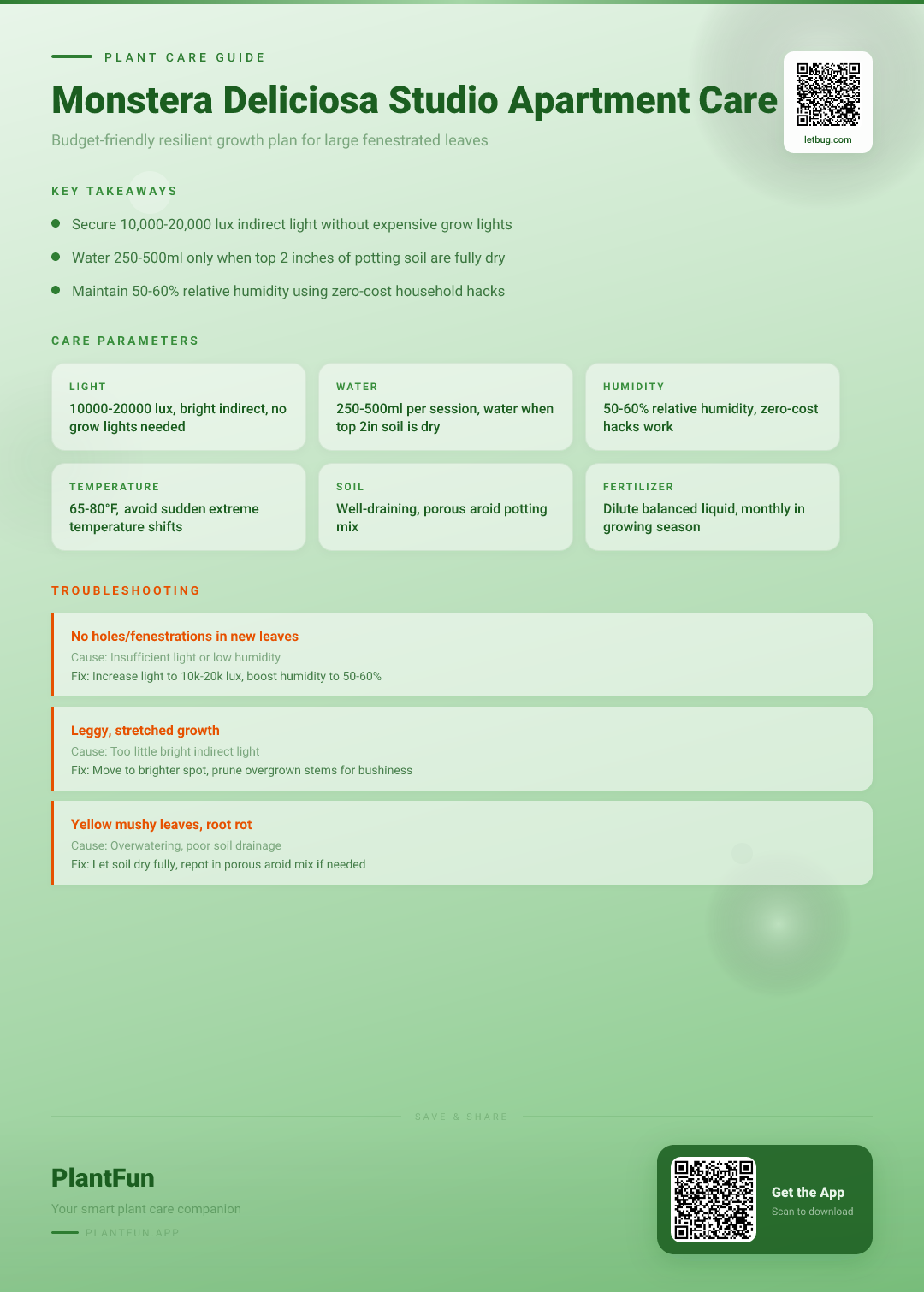
Quick Care Card: Essential Data for Rapid Reference
| Feature | Requirement |
|---|---|
| Light | 10,000–20,000 Lux (Bright, indirect) |
| Water | Allow top 2 inches of soil to dry |
| Humidity | 50–60% Relative Humidity |
| Temperature | 65–80°F (18–27°C) |
| Soil | Well-draining, chunky mix |
| Fertilizer | Balanced NPK (monthly in growing season) |
| Toxicity | Toxic to cats and dogs (ASPCA, 2026) |
TL;DR: The Three Pillars of Resilient Apartment Monsteras
To keep your Monstera thriving in a small apartment, focus on these three fundamentals: consistent bright, indirect light, a disciplined watering schedule based on soil dryness rather than a calendar, and maintaining humidity through grouping plants. Avoiding root rot is the single most important factor in long-term health (NC State Extension, 2026).
Understanding Your Studio Micro-climate: Natural Habitat vs. The Living Room
In the wild, Monstera deliciosa is an understory climber, meaning it gets filtered light through the forest canopy. In a studio, your “canopy” is your window treatment. You are looking to replicate that dappled sunlight, not harsh, direct exposure which can scorch leaves, or deep shade which causes the plant to stall.
Mastering Light: Achieving 10,000-20,000 Lux Without Expensive Grow Lights
Forget high-end LED panels. You can reach the required 10,000–20,000 lux by simply placing your plant within 2-3 feet of a south or east-facing window. If the light is too harsh, use a sheer curtain as a natural diffuser. I rotate my Monstera 90 degrees every time I water it to ensure even growth on all sides, preventing it from leaning exclusively toward the glass.
Budget Watering Strategy: Using the 2-inch Soil Check and 250ml-500ml Precision
Overwatering is the primary killer of indoor Monsteras. Instead of following a strict calendar, use the “Finger Test”: insert your finger 2 inches into the soil. If it feels damp, wait. If it is dry, provide 250ml–500ml of water, ensuring the pot drains fully into a saucer. Never let the plant sit in standing water, as this invites fungal pathogens (Shaw, 1992).
The Humidity Hack: Creating 50-60% Relative Humidity on a $0 Budget
While tropical plants love humidity, you don’t need a pricey humidifier. Simply grouping your Monstera with other foliage plants creates a micro-climate where moisture released through transpiration raises the localized relative humidity. Keep them away from direct AC vents or heaters, which desiccate the leaves.
Seasonal Care Calendar: Navigating Temperature Shifts (65-80°F range)
- Spring/Summer: This is the growing season. Increase water frequency slightly if the plant is growing rapidly. Keep between 70-80°F (21-27°C).
- Fall/Winter: Growth slows down. Reduce watering; the soil will take longer to dry out. Aim to keep the room above 65°F (18°C) (NC State Extension, 2026).
Why is my Monstera not getting holes in its leaves?
This is known as fenestration. It is primarily a function of light intensity and plant maturity. If your plant is receiving less than 10,000 lux consistently, it won’t produce these iconic splits. Patience is also key; juvenile plants often need to reach a certain size before they begin to split their leaves.
How do I keep my Monstera upright in a small space?
Use a simple bamboo stake or a DIY moss pole to mimic the tree trunks they climb in the wild. Secure the main stem—not the petioles (leaf stalks)—to the support using soft twine or strips of old cotton fabric. This saves floor space by encouraging upward, rather than outward, growth.
Common Mistakes: Avoiding Root Rot and ‘Apartment Legginess’
- Mistake: Using a pot without drainage holes. What happens: Water pools at the bottom, rotting roots. Instead: Always use a nursery pot inside a decorative pot so you can remove the plant to drain it.
- Mistake: Over-fertilizing in winter. What happens: Nutrient salt buildup in the soil. Instead: Only fertilize from late spring to early autumn.
The Growth Checklist: A Monthly Maintenance Routine
- Dust the leaves: Use a damp cloth to wipe dust off, which allows for better photosynthesis.
- Inspect for pests: Check the undersides of leaves for spider mites or scale.
- Soil Aeration: Use a chopstick to gently poke holes in the top 2 inches of soil to improve oxygen flow to the roots.
Frequently Asked Questions
- Can I put my Monstera in the bedroom? Yes, as long as it gets sufficient natural light. Just be mindful if you have pets, as the ASPCA (2026) notes it is toxic to animals.
- How often should I move it to a bigger pot? Usually once every 18-24 months. Only move up one pot size (1-2 inches larger in diameter).
- Why are the tips of my leaves brown? This is often a sign of low humidity or irregular watering patterns.
References
- Haydon, G.; Shaw, D. (1991). Zinc Accumulation in Monstera Deliciosa Near Brisbane. Australasian Plant Pathology. https://doi.org/10.1071/app9910125. Accessed 2026-03-16.
- Shaw, D. (1992). Abnormal Internal Sori of Puccinia Paullula F.sp. Monsterae on Monstera Deliciosa. Australasian Plant Pathology. https://doi.org/10.1071/app9920123. Accessed 2026-03-16.
- ASPCA. (2026). Toxic and Non-Toxic Plants List — ASPCA. https://www.aspca.org/pet-care/animal-poison-control/toxic-and-non-toxic-plants. Accessed 2026-03-16.
- NC State Extension. (2026). Monstera Deliciosa — NC State Extension Gardener Plant Toolbox. https://plants.ces.ncsu.edu/plants/deliciosa-care/. Accessed 2026-03-16.
Optional Helper: Plantfun.App
Plantfun.App identifies your plants by photo, diagnoses pests and diseases with clear fixes, and creates personalised watering and light schedules that adapt to your home conditions — a handy companion for putting this guide into daily practice.
Found an error or have suggestions? We'd love your feedback.
Need help identifying this problem?
Get instant identification, personalized care schedules, and effective pest treatment plans directly on your phone.
Sponsored • We may earn a commission from app downloads
Related Guides
Monstera Deliciosa in Apartment Living: The Resilient Growth Guide for Consistent, Lush Foliage
Unlock lush Monstera growth in your apartment. Master seasonal watering, specific light thresholds, and foliage care to keep your plant vibrant all year round.
Care GuideSwiss Cheese Plant Care in Low-Light Apartments: A Resilient Growth Strategy for Monstera deliciosa
Transform your dim apartment into a lush jungle. Follow these 5 proven steps to keep your Monstera deliciosa thriving, fenestrated, and vibrant all year long.
Care GuideMonstera Deliciosa in a Low-Light Apartment: The Complete Care Guide for Resilient Growth
Transform your dim apartment into a tropical oasis. Master Monstera deliciosa care with 4 exact light-to-water ratios and a growth schedule that ensures fenestrations.
ToolMonstera Deliciosa in East-Facing Apartments: Budget & Pro Tools for Perfect Light & Water
Stop guessing light and water for your east-facing Monstera deliciosa. Get budget and pro tool picks, exact care thresholds, and a seasonal guide to keep leaves lush and full of fenestrations.