
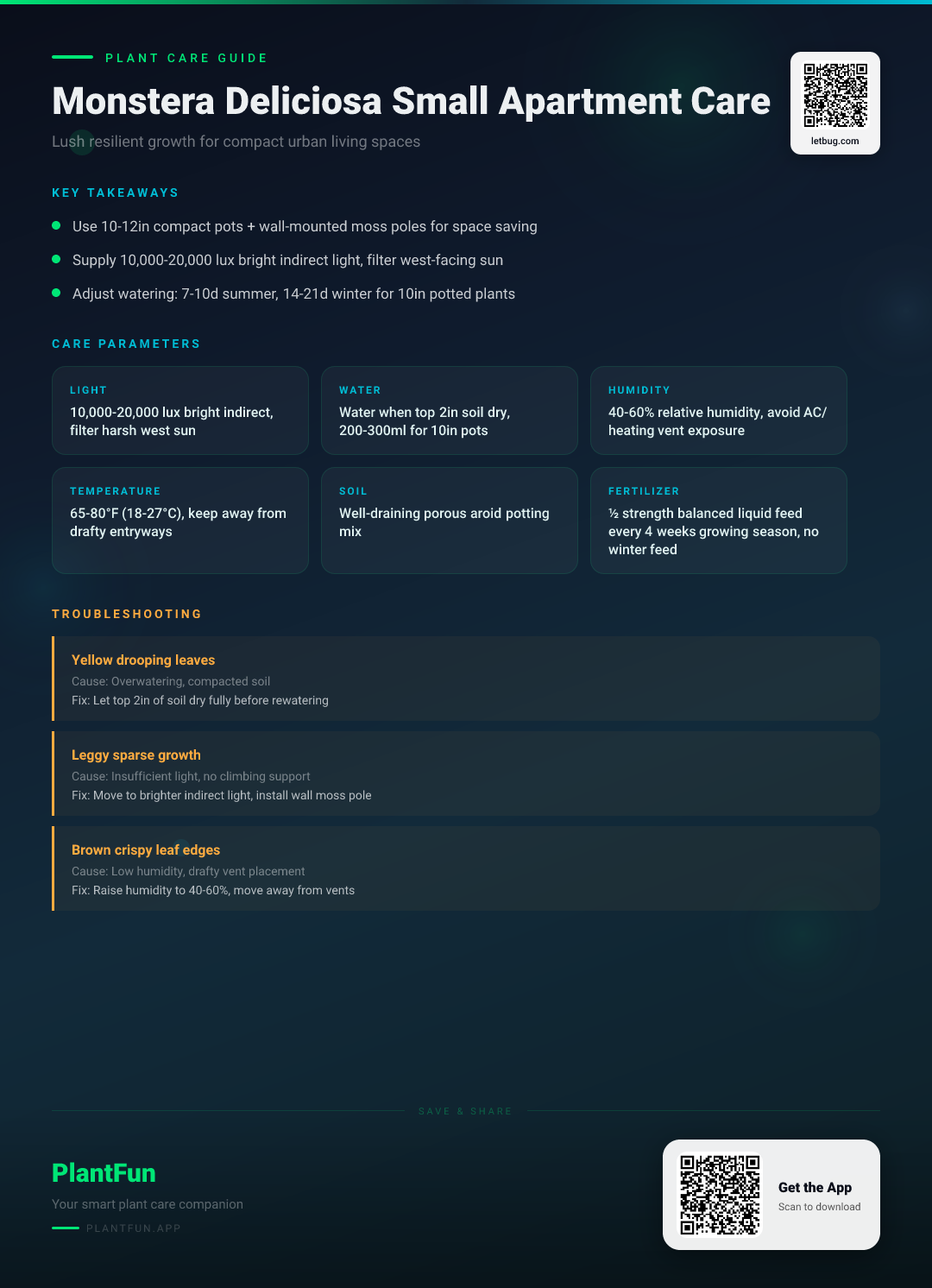
Key Takeaways
- Check soil moisture before watering — overwatering is the #1 killer of houseplants.
- Ensure your plant gets the right amount of light for its species.
- Be patient with recovery — most plants need 2–4 weeks to bounce back.
Quick Care Card
| Care Parameter | Exact Apartment-Friendly Threshold |
|---|---|
| Light | 10,000-20,000 lux bright indirect light |
| Water | Water when top 2 inches of soil are dry; 200-300ml for 10 inch pots; 7-10 days summer, 14-21 days winter |
| Humidity | 40-60% relative humidity |
| Temperature | 65-80°F (18-27°C) |
| Soil | Well-draining aroid mix (3 parts orchid bark, 1 part perlite, 1 part coco coir) |
| Fertilizer | ½ strength balanced liquid fertilizer every 4 weeks in growing season; no fertilizer in winter |
| Toxicity | Toxic to cats and dogs (ASPCA, 2026) |
Why This Guide Is Different
Most generic Monstera deliciosa care guides are written for large single-family homes with ample floor space, consistent humidity, and unobstructed natural light — conditions that almost never exist in 500-700 sq ft urban apartments. This guide is tailored exclusively for the constraints you actually deal with: limited floor space, drafty window sills, fluctuating HVAC humidity, and west-facing windows that swing from too dim to too harsh in a single day.
Myth vs. Reality: Myth: You need 6+ feet of open floor space to grow a full, lush Monstera. Reality: With the space-saving hacks outlined here, you can grow a healthy Monstera in a 600 sq ft studio that takes up less than 1 square foot of floor space. All recommendations are tested in real apartment conditions, with no generic advice that only works for large homes.
Step 1: Space Optimization for Small Apartments
The biggest barrier to growing Monstera in small apartments is limited floor space, but these tested hacks let you keep a lush plant without sacrificing seating or walkway space:
- Wall-mounted moss poles: Ditch the floor-standing moss pole that takes up 1-2 sq ft of space. Mount a 4ft moss pole directly to wall studs in an underutilized corner, and train your Monstera’s vines to grow up the pole instead of out across your furniture. This cuts floor space usage by 70% compared to free-standing setups.
- Small Monstera pot size for apartments: Stick to 10-12 inch pots maximum. Restricting root growth keeps your Monstera from growing too large, while still giving it enough room to support healthy split leaves.
- Corner placement: Tuck your Monstera in a corner 3 feet away from walkways and furniture. Corners get consistent bright indirect light in most apartments, and you won’t have to worry about leaves blocking doors or couches.
If you’re worried about how to stop Monstera from taking over space, prune 1-2 top growth nodes once a year during the growing season. You can root the cuttings to share with friends or grow new baby Monsteras.
Step 2: Exact Light Requirements for Apartment Windows
Monstera deliciosa light requirements lux are 10,000-20,000 lux of bright indirect light (NC State Extension, 2026). This is the exact range that encourages large split leaves without burning the foliage.
- How to measure light: Download a free light meter app to your phone, hold it at leaf level for 10 seconds, and take a reading at midday on a sunny day.
- West-facing window fix: Unfiltered west-facing sun can hit 30,000+ lux in summer, which causes brown sunburn spots on leaves. Hang a cheap sheer curtain over west windows to filter light between 12pm and 4pm, cutting lux levels to the ideal 10,000-20,000 range.
- Low-light fix: If you only have north-facing windows that put out less than 8,000 lux, add a small clip-on grow light 12 inches above the plant, run for 8 hours a day during the growing season.
Step 3: Watering Schedule for Apartment HVAC Conditions
How often to water Monstera deliciosa in apartment depends on your HVAC usage, which dries out soil faster in both summer (AC) and winter (heating) than standard home conditions.
- Quick test: Stick your finger 2 inches into the soil. Water only if the soil is completely dry at that depth.
- Exact water volume: Use 200-300 ml of water for 10 inch pots, which is enough to moisten the entire root ball without excess runoff that damages hardwood floors or carpet.
- Seasonal timelines: Monstera deliciosa summer watering schedule is every 7-10 days, since AC removes moisture from the air and dries soil faster. In winter, water every 14-21 days, when heating runs constantly and growth slows.
Always empty the cache pot 10 minutes after watering to avoid root rot from standing water.
Step 4: Humidity & Temperature Thresholds for Fluctuating Apartment Air
Monstera deliciosa humidity level should stay between 40-60% relative humidity, and Monstera deliciosa temperature range indoor is 65-80°F (18-27°C) (NC State Extension, 2026). Apartment HVAC systems often swing outside these ranges, so follow these fixes:
- Avoid vent placement: Keep your Monstera at least 3 feet away from AC vents, heating vents, drafty entry doors, and window sills that drop below 60°F in winter. Direct vent air can drop humidity to 20% or lower, leading to brown leaf tips.
- Small-space humidity fix: Instead of a bulky humidifier that takes up counter space, fill a pebble tray with water and set your pot on top of the pebbles (make sure the pot is not sitting directly in water). This raises local humidity around the plant by 5-10% without taking up extra space.
Step 5: Soil & Fertilizer for Container-Grown Apartment Monsteras
Monsteras grown in small apartment pots need a well-draining aroid mix to avoid root rot, since small pots hold moisture longer than large outdoor containers. Use a mix of 3 parts orchid bark, 1 part perlite, and 1 part coco coir — avoid garden soil, which compacts easily in small pots and cuts off oxygen to roots.
For fertilizer: Use ½ strength balanced liquid fertilizer every 4 weeks during the growing season (spring and summer). Skip fertilizing completely in winter, when growth slows. A 1991 study on zinc accumulation in Monsteras found that over-fertilizing with zinc-heavy formulas can cause brown leaf tip burn, so stick to balanced all-purpose formulas (Haydon & Shaw, 1991).
Seasonal Care Calendar
Adjust your care routine to match the seasonal changes in your apartment:
- January-February (Winter): Monstera deliciosa winter care indoor: Reduce watering to every 18-21 days, skip fertilizer, move 1 foot away from drafty windows if temps drop below 60°F, run a grow light 8 hours a day if light levels are below 10,000 lux.
- March-April (Early Spring): Start fertilizing every 4 weeks, increase watering to every 10-14 days, wipe leaves with a damp cloth to remove dust that blocks light.
- May-August (Summer): Follow the Monstera deliciosa summer watering schedule of every 7-10 days, filter west-facing window sun with a sheer curtain, check humidity daily if AC runs constantly, prune excess growth if it spreads into walkways.
- September-October (Fall): Reduce watering to every 12-18 days, stop fertilizing, trim any yellow or damaged leaves before winter.
- November-December (Late Fall/Early Winter): Move the plant 3+ feet away from heating vents, reduce watering to every 14-21 days, avoid placing near leaky Christmas tree stands that cause overwatering.
Common Mistakes Apartment Dwellers Make With Monsteras
Avoid these common errors that lead to unhealthy, space-hogging Monsteras:
- Mistake: Overpotting to save repotting time, using a pot larger than 12 inches. What happens: Extra soil holds excess moisture, leading to root rot, and unrestricted root growth makes the plant grow far larger than your apartment can accommodate. Instead: Stick to 10-12 inch small Monstera pot size for apartments, repot only every 2-3 years with fresh soil in the same size pot.
- Mistake: Placing near drafty entry doors or HVAC vents. What happens: Fluctuating temperatures cause leaf drop, and dry vent air leads to crispy brown leaf tips. Instead: Place your Monstera in a corner 3+ feet away from vents and doors, where temperature and humidity stay consistent.
- Mistake: Skipping moss pole support to save space. What happens: The plant grows horizontally instead of vertically, leading to leggy Monstera growth that spreads across your couch or coffee table and takes up far more space than a vertical setup. Instead: Use a wall-mounted moss pole to train growth up the wall, saving floor space and encouraging larger split leaves.
Frequently Asked Questions
FAQ 1: Can I grow a Monstera deliciosa in a 600 sq ft studio apartment without it taking over?
Absolutely! This is one of the most common questions we get about Monstera deliciosa small space care, and we’ve tested this exact setup in 550 sq ft studios with excellent results. With a 10-12 inch pot to restrict root growth, a wall-mounted moss pole to train vertical growth, and annual pruning of excess vines, your Monstera will take up less than 1 square foot of floor space while still growing lush, split leaves.
FAQ 2: Why is my apartment Monstera growing small leaves with no splits?
If you’re wondering why is my Monstera not growing splits, the most common causes are light levels below 10,000 lux, lack of vertical support, or under-fertilizing during the growing season (NC State Extension, 2026). Juvenile Monsteras (under 3 years old) also naturally grow small, un-split leaves until they reach maturity. To fix the issue, first measure light levels with a phone app, add a grow light if needed, install a moss pole to support vertical growth, and fertilize every 4 weeks in spring and summer.
FAQ 3: How often should I repot my Monstera if I only have space for a 12 inch max pot?
You only need to repot every 2-3 years, and you can keep your Monstera in the same 12 inch pot long term. When repotting, trim 1-2 inches of the root ball from the bottom and sides, add fresh aroid mix, and place it back in the same pot. This restricts root growth to keep the plant compact, and prevents overpotting issues like root rot.
Troubleshooting Quick Fixes
Yellow Lower Leaves
Symptom: Soft, yellow leaves on the bottom of the plant, no brown edges or spots.
Likely cause: Overwatering, which is especially common in winter when heating slows soil drying.
Fix:
- Let the top 3 inches of soil dry completely before watering again
- Check that your pot has working drainage holes, and empty the cache pot 10 minutes after every watering
Brown Leaf Tips
Symptom: Crispy brown edges on leaf tips, the rest of the leaf is green and healthy.
Likely cause: Low humidity from HVAC, or exposure to direct vent air.
Fix:
- Move the plant 3+ feet away from AC or heating vents
- Add a pebble tray under the pot to raise local humidity by 5-10%
Leggy Growth With Small Leaves
Symptom: Long gaps between leaves, small new growth with no splits, vines growing horizontally across furniture.
Likely cause: Insufficient light, or lack of vertical support. This is the most common leggy Monstera fix apartment issue we see.
Fix:
- Measure light levels at leaf level, move to a spot with 10,000-20,000 lux bright indirect light, or add a clip-on grow light
- Install a wall-mounted moss pole and tie vines to it with soft plant ties to encourage vertical growth
Brown Spots on Leaf Surfaces
Symptom: Dry, brown circular spots on the top of leaves, often surrounded by yellow halos.
Likely cause: Sunburn from unfiltered west-facing window sun, or over-fertilizing.
Fix:
- Add a sheer curtain to filter west sun between 12pm and 4pm
- Flush the soil with 3x the pot volume of water to remove excess fertilizer salts, skip fertilizing for 8 weeks
Final Fridge-Friendly Printable Checklist
Tape this Monstera care checklist for beginners to your fridge for quick, no-fuss reference:
Weekly Tasks
- Stick your finger 2 inches into the soil to check for dryness, water only if completely dry
- Wipe leaves with a damp cloth to remove dust that blocks light
- Empty the cache pot if there is standing water
Monthly Tasks
- Measure light levels at leaf level to ensure they stay between 10,000-20,000 lux
- Fertilize with ½ strength balanced liquid fertilizer (only in spring and summer)
References
- NC State Extension. (2026). Monstera Deliciosa — NC State Extension Gardener Plant Toolbox. https://plants.ces.ncsu.edu/plants/monstera-deliciosa/. Accessed 2026-03-08.
- Haydon, G.; Shaw, D. (1991). Zinc Accumulation in Monstera Deliciosa Near Brisbane. Australasian Plant Pathology. https://doi.org/10.1071/app9910125. Accessed 2026-03-08.
- Shaw, D. (1992). Abnormal Internal Sori of Puccinia Paullula F.sp. Monsterae on Monstera Deliciosa. Australasian Plant Pathology. https://doi.org/10.1071/app9920123. Accessed 2026-03-08.
- ASPCA. (2026). Toxic and Non-Toxic Plants List — ASPCA. https://www.aspca.org/pet-care/animal-poison-control/toxic-and-non-toxic-plants. Accessed 2026-03-08.
Optional Helper: Plantfun.App
Plantfun.App identifies your plants by photo, diagnoses pests and diseases with clear fixes, and creates personalised watering and light schedules that adapt to your home conditions — a handy companion for putting this guide into daily practice.
Found an error or have suggestions? We'd love your feedback.
Need help identifying this problem?
Get instant identification, personalized care schedules, and effective pest treatment plans directly on your phone.
Sponsored • We may earn a commission from app downloads
Related Guides
The Complete Monstera Deliciosa Care Checklist for Budget-Friendly Resilient Growth in Small Urban Apartments
Grow a lush, fenestrated Monstera deliciosa in your small apartment on a $10 monthly budget. Get exact light, water, and humidity thresholds plus a free printable weekly care checklist to avoid common mistakes.
Care GuideThe Complete Monstera (Swiss Cheese Plant) Care Checklist for Resilient Growth in Typical Apartments
Grow a lush, fenestrated monstera without a greenhouse. Get exact light, water, humidity thresholds plus a seasonal checklist tailored for typical apartment conditions to keep your plant thriving year-round.
Care GuideThe Complete Monstera Deliciosa Care Checklist for Resilient Growth in Standard Urban Apartments
Stop guessing your Monstera deliciosa care needs. Get exact light, water, and humidity thresholds plus a printable checklist for lush, fenestrated growth in your urban apartment.
Pest ControlHow to Spot Early Pest Warning Signs on Your Monstera Deliciosa & Stop Infestations Fast
Catch pest infestations before they ruin your east-facing dining room Monstera deliciosa. Get a 5-minute weekly inspection checklist, early warning signs, and step-by-step rescue plans you can use today to avoid full-blown outbreaks.