
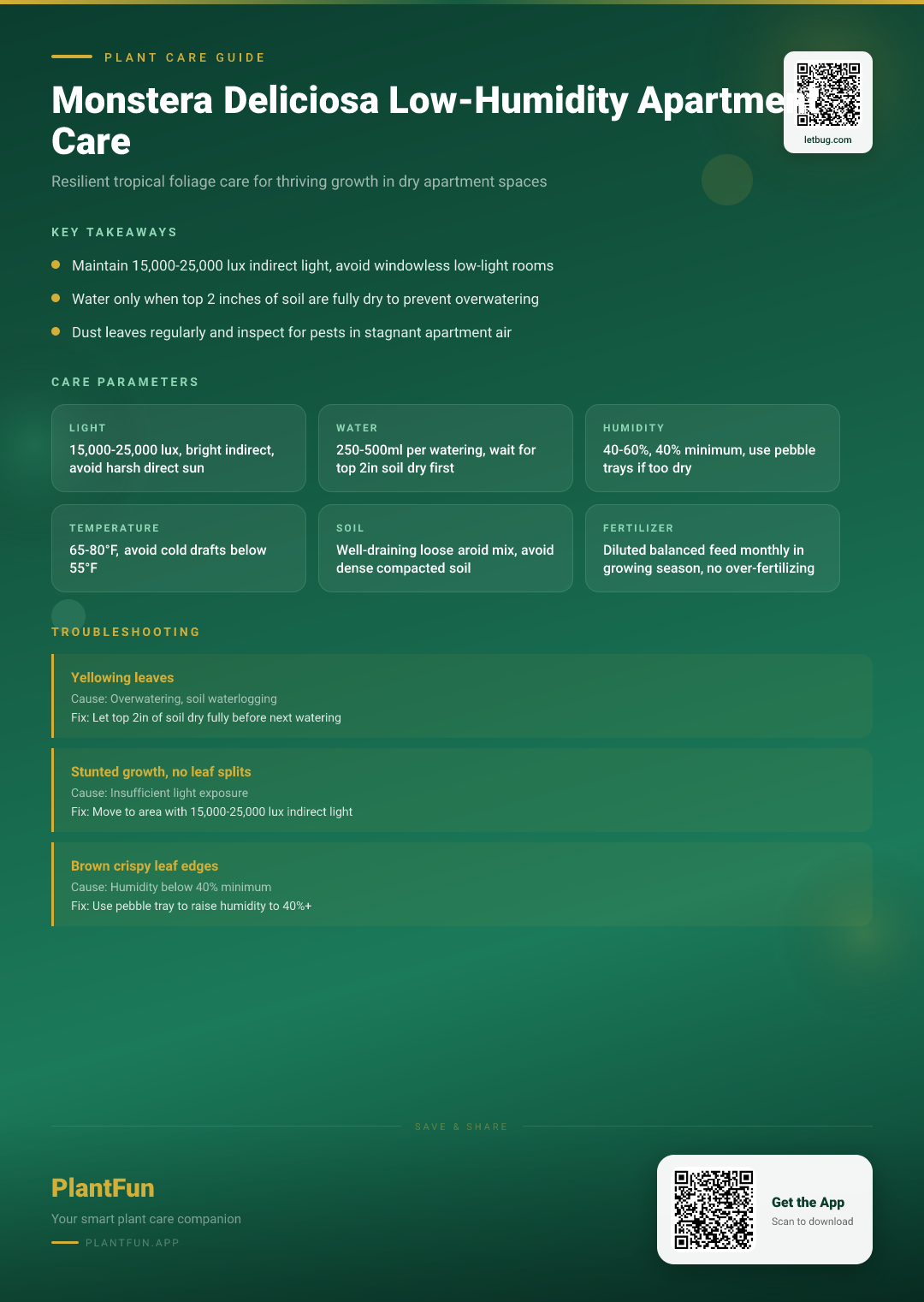
Key Takeaways
- Check soil moisture before watering — overwatering is the #1 killer of houseplants.
- Ensure your plant gets the right amount of light for its species.
- Be patient with recovery — most plants need 2–4 weeks to bounce back.
Quick Care Card
| Feature | Requirement |
|---|---|
| Light | 15,000–25,000 lux (bright, indirect) |
| Water | 250–500ml (when top 2” dry) |
| Humidity | 40–60% target |
| Temperature | 65–80°F (18–27°C) |
| Soil | Chunky, well-draining aroid mix |
| Fertilizer | Balanced liquid (10-10-10) monthly in growing season |
| Toxicity | Toxic to cats and dogs (ASPCA, 2026) |
TL;DR
Apartment living is actually ideal for the Monstera deliciosa. These plants thrive in stable, climate-controlled environments. By mimicking a natural cycle—providing bright, indirect light, avoiding soggy soil, and maintaining a 40% humidity baseline—your plant will produce signature fenestrated leaves regardless of your zip code.
My Experience
When I first brought home my Monstera deliciosa, I made the mistake of placing it in a dark corner, thinking it was a “low-light plant” simply because it lived under a jungle canopy in nature. I was wrong. It languished, stopped producing new leaves, and became leggy. Once I moved it to a bright spot near a south-facing window (with a sheer curtain) and adjusted my watering to a strict “top-two-inch” check, the plant exploded with growth. I learned that your apartment’s climate is a partnership: you provide the light, and the plant provides the drama.
Understanding Your Monstera
There is a persistent myth that you need a greenhouse to keep a Monstera happy. In reality, the species is remarkably adaptable. While it originates from tropical rainforests (NC State Extension, 2026), its resilience comes from its ability to store water in its petioles. You aren’t recreating a jungle; you are providing a stable, well-lit habitat that avoids the extreme temperature fluctuations the plant dislikes.
The Lighting Strategy
To achieve those iconic split leaves, your plant needs light intensity—specifically, 15,000 to 25,000 lux. In a typical apartment, place your plant within 3–5 feet of a bright window. If you don’t have a “bright” window, use a light meter app to ensure you are hitting the target range. If the light is too harsh, use a sheer curtain to diffuse the rays; direct, unfiltered sun will scorch the leaves.
Hydration for Dry Air
Low humidity (under 40%) is the biggest challenge in modern apartments. If your air is bone-dry, your plant may develop brown, crispy tips.
- The Pebble Tray Trick: Place your pot on a tray filled with pebbles and water. As the water evaporates, it creates a micro-climate around the leaves. Ensure the bottom of the pot never touches the standing water to prevent root rot.
- Grouping: Keep your plants together; they transpire and create a localized humid zone.
Seasonal Routine
- Spring-Summer: This is the growth flush. Increase watering frequency and use a balanced fertilizer (NC State Extension, 2026). The higher metabolic rate requires more hydration.
- Fall-Winter: The plant enters dormancy. Growth slows significantly. Reduce water by 30-50% and cease fertilization. Over-watering during this time is the most common cause of plant decline.
Why is my Monstera yellowing? Troubleshooting common apartment water-logging issues
Yellowing Leaves
Symptom: Leaves turn yellow, starting from the lower ones.
Likely cause: Over-watering or poor soil drainage causing root suffocation.
Fix:
- Check the soil moisture; if wet, stop watering immediately.
- Repot into a chunkier mix with orchid bark and perlite for aeration.
Brown Leaf Tips
Symptom: Crispy, brown edges on otherwise healthy leaves.
Likely cause: Low humidity or salt buildup from tap water.
Fix:
- Increase ambient humidity to at least 40%.
- Flush the soil with distilled water once a month to remove mineral salts.
Can I keep my Monstera in a room without windows?
If you are wondering, “Can I put my Monstera in a dark bathroom?” the answer is generally no. While the plant can survive for a short time, it will not thrive or grow. If you lack natural light, you must supplement with a full-spectrum LED grow light for 8–10 hours a day to simulate the 15,000 lux threshold.
How do I know if my Monstera is thirsty?
Do not rely on a schedule. Instead, use the “finger test”: push your index finger 2 inches into the soil. If it feels dry, it is time to water. If it feels damp, wait two more days. According to the ASPCA (2026), you must keep this plant out of reach of pets, so ensure your chosen spot is secure.
Essential Maintenance
Dust accumulates quickly in stagnant apartment air, blocking photosynthesis. Use a damp microfiber cloth to wipe leaves monthly. This also allows you to inspect the undersides of leaves for pests, which thrive in dry, indoor conditions. For specialized concerns regarding leaf health, proper diagnostic protocols are essential (Shaw, 1992).
Common Mistakes to Avoid
- Mistake: Using a pot without drainage holes.
- What happens: Water collects at the bottom, leading to root rot (Haydon & Shaw, 1991).
- Instead: Always use a pot with drainage; if you use a decorative cachepot, ensure the nursery pot is inside it with space at the bottom.
- Mistake: Over-fertilizing.
- What happens: Fertilizer burn leaves the plant stressed and vulnerable to disease.
- Instead: Only fertilize when the plant is actively pushing out new growth.
References
- Haydon, G.; Shaw, D. (1991). Zinc Accumulation in Monstera Deliciosa Near Brisbane. Australasian Plant Pathology. https://doi.org/10.1071/app9910125. Accessed 2026-03-13.
- Shaw, D. (1992). Abnormal Internal Sori of Puccinia Paullula F.sp. Monsterae on Monstera Deliciosa. Australasian Plant Pathology. https://doi.org/10.1071/app9920123. Accessed 2026-03-13.
- ASPCA. (2026). Toxic and Non-Toxic Plants List — ASPCA. https://www.aspca.org/pet-care/animal-poison-control/toxic-and-non-toxic-plants. Accessed 2026-03-13.
- NC State Extension. (2026). Monstera Deliciosa — NC State Extension Gardener Plant Toolbox. https://plants.ces.ncsu.edu/plants/deliciosa-care/. Accessed 2026-03-13.
Optional Helper: Plantfun.App
Plantfun.App identifies your plants by photo, diagnoses pests and diseases with clear fixes, and creates personalised watering and light schedules that adapt to your home conditions — a handy companion for putting this guide into daily practice.
Found an error or have suggestions? We'd love your feedback.
Need help identifying this problem?
Get instant identification, personalized care schedules, and effective pest treatment plans directly on your phone.
Sponsored • We may earn a commission from app downloads
Related Guides
Monstera Deliciosa Care Checklist: Grow Lush Leaves in Typical Small Urban Apartments
Grow lush, holey Monstera deliciosa leaves even in a small urban apartment. Get exact light, water, humidity thresholds plus a symptom-to-action checklist for stress-free resilient growth.
Care GuideThe Complete Monstera Deliciosa Care Checklist for Resilient Growth in Standard Urban Apartments
Stop guessing your Monstera deliciosa care needs. Get exact light, water, and humidity thresholds plus a printable checklist for lush, fenestrated growth in your urban apartment.
Care GuideThe Complete Monstera Deliciosa Care Checklist for Resilient Growth in Small Urban Apartments
Grow a lush, fenestrated Monstera even in a tiny urban apartment. Get a free printable checklist, exact light, water, and humidity thresholds, plus quick fixes for 7 common care mistakes.
Pest ControlHow to Spot Early Pest Signs on Your Monstera Deliciosa: A Weekly Inspection & Rescue Plan
Catch Monstera deliciosa pest infestations before they permanently damage your prized fenestrated leaves. Get a 5-minute weekly inspection routine, easy-to-spot early warning signs, and non-toxic rescue steps you can implement today to stop spread to other houseplants.