
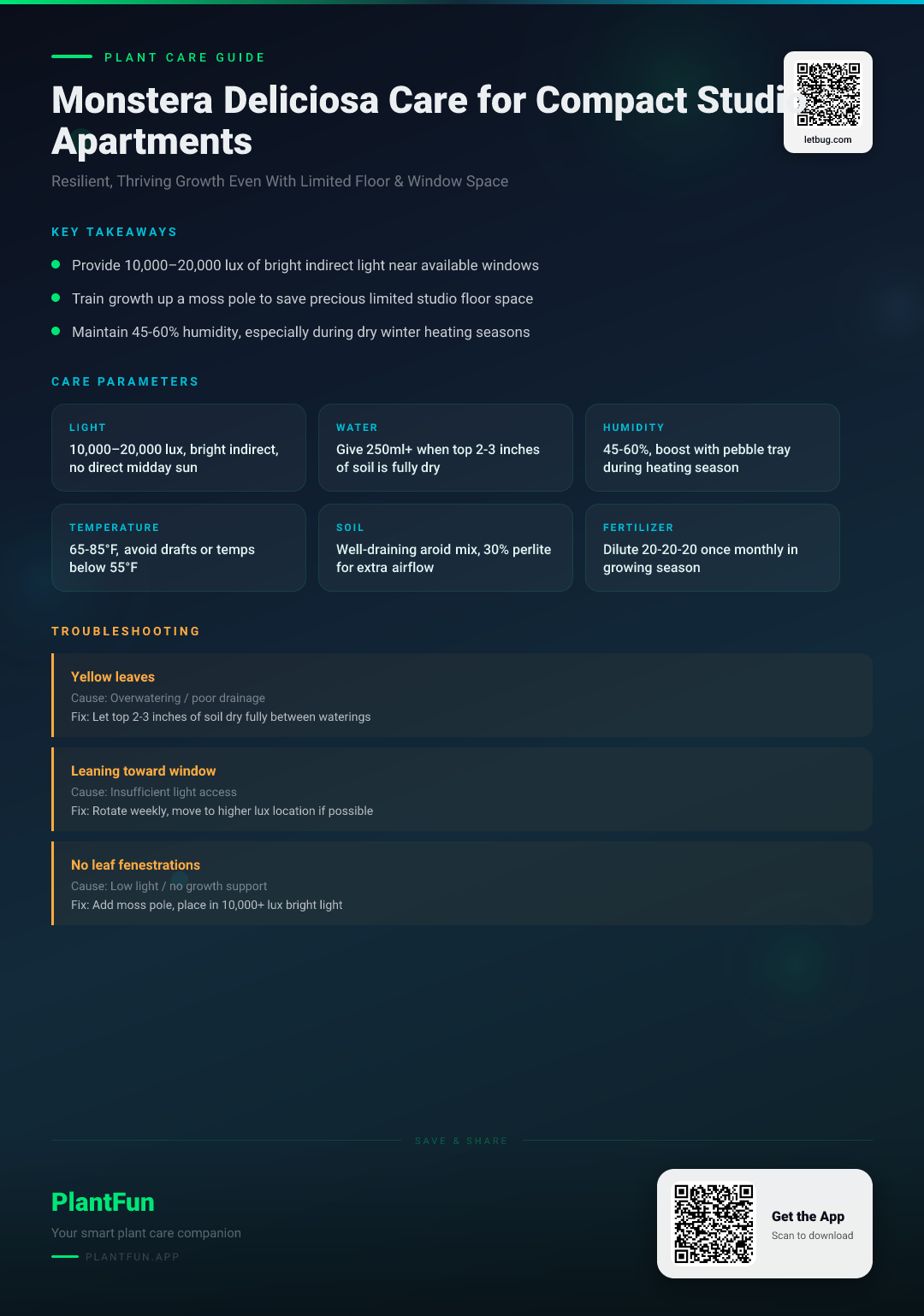
Key Takeaways
- Check soil moisture before watering — overwatering is the #1 killer of houseplants.
- Ensure your plant gets the right amount of light for its species.
- Be patient with recovery — most plants need 2–4 weeks to bounce back.
Quick Care Card: Essential Thresholds for Your Studio Monstera
| Feature | Requirement |
|---|---|
| Light | 10,000–20,000 lux (Bright, indirect) |
| Water | When top 2-3 inches of soil feel dry |
| Humidity | 45–60% (Optimal for growth) |
| Temperature | 65°F–80°F (18°C–27°C) |
| Soil | Chunky, well-draining aroid mix |
| Fertilizer | Balanced liquid feed monthly (Spring/Summer) |
| Toxicity | Toxic to cats and dogs (ASPCA, 2026) |
TL;DR: The Small-Space Reality Check for Monstera Deliciosa
Your Monstera deliciosa doesn’t need a greenhouse to thrive. In a studio, the secret is verticality. By using a support structure, you stop the plant from sprawling across your floor, keeping your square footage clear. Focus on 10,000+ lux, consistent but moderate watering, and air circulation to mimic its tropical origins without turning your home into a swamp (NC State Extension, 2026).
Understanding Your Light: Optimizing 10,000–20,000 Lux in Limited Windows
When I first brought my Monstera into my studio, I made the mistake of pushing it into a dark corner. I learned quickly that while they tolerate lower light, they won’t grow those signature fenestrations (the beautiful holes in the leaves) without sufficient photons. You need roughly 10,000 to 20,000 lux. If your window faces north, keep the plant directly on the sill. If it’s south-facing, use a sheer curtain to diffuse the intensity. Use a free light meter app to check your levels; if you’re under 5,000 lux, consider a supplemental grow light.
Watering Mastery: Avoiding Root Rot in Low-Ventilation Apartments
Studio apartments often have stagnant air, which means your soil stays wet longer. Forget the calendar; use the “finger test.” Stick your finger two inches into the soil. If it’s damp, wait. If it’s dry, water it. Overwatering is the leading cause of root rot—a common issue when airflow is restricted (NC State Extension, 2026). Always ensure your pot has drainage holes, as excess water sitting in the saucer is a recipe for failure.
Format A: Step-by-Step Training for Vertical Growth (Using Moss Poles)
- Select a sturdy stake: Use a coco-coir or sphagnum moss pole at least 3-4 feet tall.
- Insert early: Place the pole into the pot during repotting to avoid damaging established roots.
- Identify the “back”: The Monstera has a front (leaves) and a back (aerial roots). Align the aerial roots toward the pole.
- Secure gently: Use green garden ties to hold the main stem against the pole. Do not tie the petioles (leaf stalks) themselves.
- Encourage climbing: As the plant grows, continue tying it to the pole to maintain an upward trajectory, saving your valuable floor space.
Seasonal Adjustments: Managing 45-60% Humidity During Heating Season
Heating systems in small apartments dry the air out significantly, often dropping levels below 30%. I keep a humidifier running near my Monstera during the winter to maintain that 45-60% sweet spot. If a humidifier isn’t an option, a pebble tray with water can help locally increase humidity, though it is less effective than a dedicated unit (NC State Extension, 2026).
Yellowing Leaves
Symptom: Leaves turn yellow, starting from the edges or bottom.
Likely cause: Overwatering or poor drainage leading to root stress.
Fix:
- Check for soggy soil.
- Repot into a chunkier mix with perlite if the soil stays wet for more than 7 days.
Leaning Growth
Symptom: Plant is stretching excessively toward the window.
Likely cause: Insufficient ambient light forcing the plant to “search” for more.
Fix:
- Move the plant closer to the light source.
- Rotate the pot 90 degrees weekly to ensure even growth.
Brown Leaf Tips
Symptom: Crispy, brown tips on otherwise healthy leaves.
Likely cause: Low humidity or inconsistent watering schedules.
Fix:
- Increase humidity with a humidifier.
- Implement a stricter monitoring schedule for soil moisture.
Why is my Monstera leaning toward the window in my small apartment?
It’s phototropism—the plant is literally trying to survive. In a small space, walls and furniture block secondary light. If it’s leaning heavily, move it within 3 feet of a bright window.
How do I know when my Monstera needs more than 250ml of water?
Don’t measure by ml. Measure by need. If you lift the pot and it feels significantly lighter than when it was watered, or the top 2 inches of soil are dry, the plant is ready. For more on seasonal habits, see my guide on mastering indoor plant care for beginners.
Can I keep my Monstera in a windowless studio corner?
Technically, it will survive for a short time, but it will not grow. To achieve the lush jungle look, you must provide a full-spectrum LED grow light for 8–10 hours a day.
Common Mistakes: Potting Geometry and Airflow Obstructions
- Mistake: Using a pot that is too large.
- What happens: Excess soil holds too much water, inviting root rot (NC State Extension, 2026).
- Instead: Use a pot only 2 inches wider than the root ball.
- Mistake: Placing the plant in a tight corner between two walls.
- What happens: Poor air exchange increases the risk of fungal pathogens (Shaw, 1992).
- Instead: Keep at least 6 inches of space between the plant and walls to allow air movement.
Seasonal Care Calendar: A Month-by-Month Growth Strategy
- Spring: Repot if root-bound; begin fertilizing once monthly.
- Summer: Peak growth. Increase watering frequency and check for pests.
- Autumn: Reduce water as light levels drop; discontinue fertilizer.
- Winter: Focus on humidity and supplemental light. Keep away from drafts (Haydon & Shaw, 1991).
References and Botanical Sources
- ASPCA. (2026). Toxic and Non-Toxic Plants List — ASPCA. https://www.aspca.org/pet-care/animal-poison-control/toxic-and-non-toxic-plants. Accessed 2026-03-14.
- Haydon, G.; Shaw, D. (1991). Zinc Accumulation in Monstera Deliciosa Near Brisbane. Australasian Plant Pathology. https://doi.org/10.1071/app9910125. Accessed 2026-03-14.
- NC State Extension. (2026). Monstera Deliciosa — NC State Extension Gardener Plant Toolbox. https://plants.ces.ncsu.edu/plants/deliciosa-care/. Accessed 2026-03-14.
- Shaw, D. (1992). Abnormal Internal Sori of Puccinia Paullula F.sp. Monsterae on Monstera Deliciosa. Australasian Plant Pathology. https://doi.org/10.1071/app9920123. Accessed 2026-03-14.
Optional Helper: Plantfun.App
Plantfun.App identifies your plants by photo, diagnoses pests and diseases with clear fixes, and creates personalised watering and light schedules that adapt to your home conditions — a handy companion for putting this guide into daily practice.
Found an error or have suggestions? We'd love your feedback.
Need help identifying this problem?
Get instant identification, personalized care schedules, and effective pest treatment plans directly on your phone.
Sponsored • We may earn a commission from app downloads
Related Guides
The Complete Monstera (Swiss Cheese Plant) Care Checklist for Resilient Growth in Typical Apartments
Grow a lush, fenestrated monstera without a greenhouse. Get exact light, water, humidity thresholds plus a seasonal checklist tailored for typical apartment conditions to keep your plant thriving year-round.
Care GuideMonstera Deliciosa Care Checklist: Grow Lush Leaves in Typical Small Urban Apartments
Grow lush, holey Monstera deliciosa leaves even in a small urban apartment. Get exact light, water, humidity thresholds plus a symptom-to-action checklist for stress-free resilient growth.
Care GuideMonstera Deliciosa in a Typical Apartment: The Only Resilience Care Guide You Need
Revive your Monstera with precise, apartment-friendly care. Learn exact lux needs, 7-day watering intervals, and how to prevent brown edges for lush growth.
Pest ControlHow to Spot Early Pest Warning Signs on Your Monstera Deliciosa & Stop Infestations Fast
Catch pest infestations before they ruin your east-facing dining room Monstera deliciosa. Get a 5-minute weekly inspection checklist, early warning signs, and step-by-step rescue plans you can use today to avoid full-blown outbreaks.