
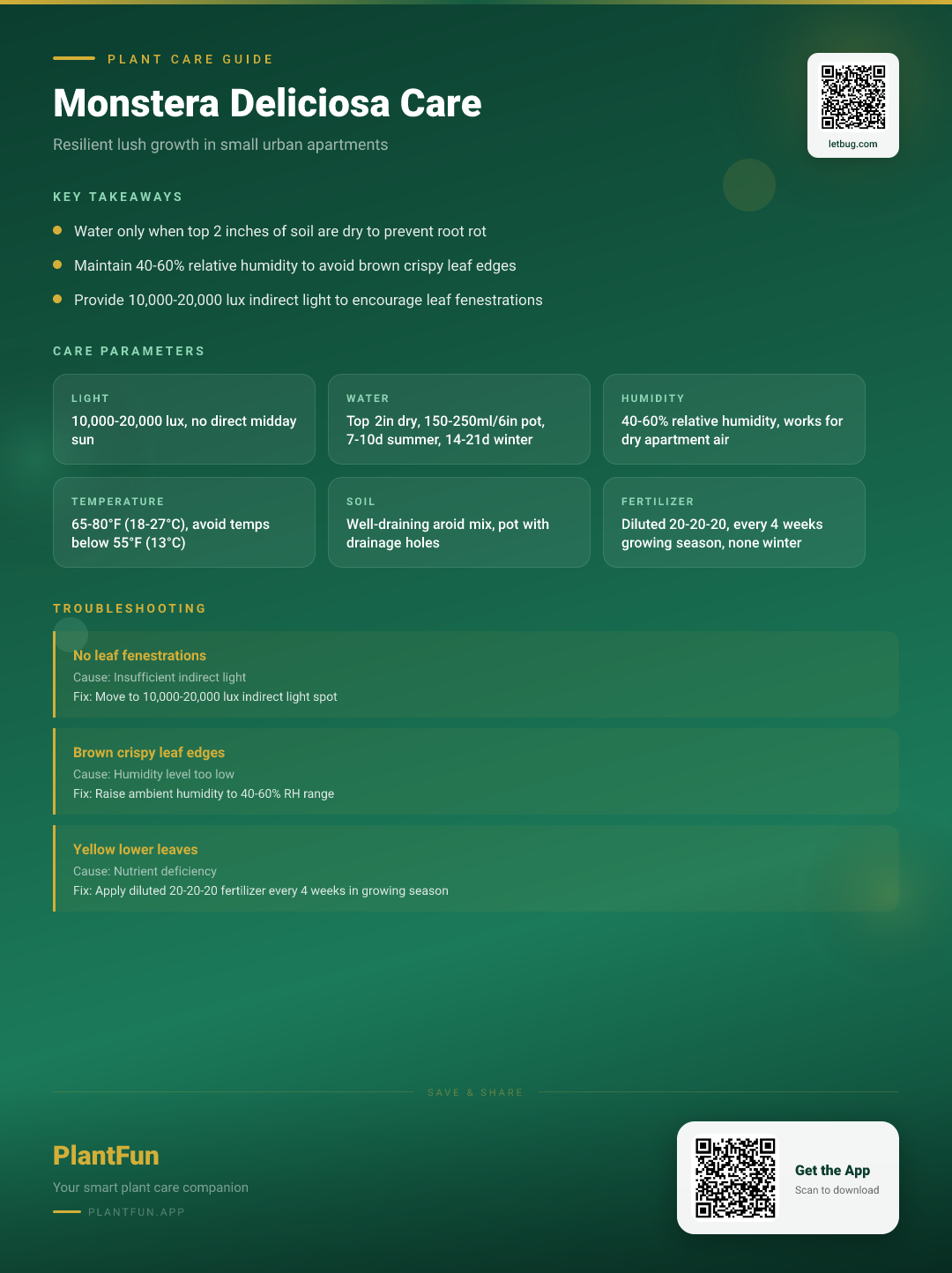
Key Takeaways
- Check soil moisture before watering — overwatering is the #1 killer of houseplants.
- Ensure your plant gets the right amount of light for its species.
- Be patient with recovery — most plants need 2–4 weeks to bounce back.
Quick Care Card
| Care Factor | Measurable Threshold for Urban Apartments |
|---|---|
| Light | 10,000-20,000 lux, no direct midday sun (NC State Extension, 2026) |
| Water | Top 2 inches of soil fully dry; 150-250ml for 6” pots; 7-10 days summer, 14-21 days winter |
| Humidity | 40-60% relative humidity |
| Temperature | 65-80°F (18-27°C), no drops below 55°F (13°C) (NC State Extension, 2026) |
| Soil | Well-draining aroid mix (3 parts orchid bark, 1 part perlite, 1 part coco coir) |
| Fertilizer | Half-strength 20-20-20 liquid every 4 weeks growing season, no fertilizer winter |
| Toxicity | Toxic to cats, dogs, and humans if ingested (ASPCA, 2026) |
Why This Guide Is Different for Urban Apartment Dwellers
Native Monstera deliciosa grow in tropical understories with consistent 70%+ humidity, warm temperatures, and filtered bright light — conditions almost unheard of in standard small urban apartments. Most generic Monstera care guides use greenhouse thresholds that don’t account for drafty windows, dry forced air, low natural light, and fluctuating HVAC temperatures that are common in city homes.
This Swiss cheese plant care for apartments guide uses a symptom-first, checklist structure with measurable, testable thresholds tailored explicitly to your space, so you never have to guess why your plant is stressed or how to fix it. It’s optimized for Monstera care for beginners and intermediate owners alike, no fancy equipment required.
Myth vs Reality: Myth: You need a sunroom to grow a Monstera with holes. Reality: Monstera adapt well to apartment conditions if you hit the minimum thresholds in this checklist (NC State Extension, 2026).
Step 1: Light Setup Checklist for Consistent Growth
Monstera light lux levels are the most important factor for fenestration (leaf hole) growth. Follow these steps for your apartment window orientation:
- Test light levels with a free lux meter app: aim for 10,000-20,000 lux at the plant’s leaf level, no more than 25,000 lux to avoid scorch.
- Placement by window direction:
- North-facing: 1-2ft from the window, supplement with a grow light if levels are below 8,000 lux
- East-facing: 2-3ft from the window (ideal, gets soft morning sun, no harsh midday rays)
- West-facing: 3-4ft from the window, add a sheer curtain to block 1pm-4pm sun
Symptom Fix: No Fenestrations Forming
Symptom: New leaves grow in solid, no holes or splits. Likely cause: Light levels below 10,000 lux, or plant is less than 2-3 years old.
Fix:
- Move plant 1ft closer to the window or add a full-spectrum grow light 12-18 inches above the foliage, run for 10 hours daily
- If your plant is young, wait 1-2 more years for natural maturity to trigger fenestration
Symptom Fix: Yellow Leaves with Brown Scorch Spots
Symptom: Yellowing leaves with dry, brown patches on sun-exposed sides. Likely cause: Direct midday sun exceeding 25,000 lux.
Fix:
- Move plant 2ft further from the window or add a sheer curtain to filter light
- Trim severely damaged leaves at the stem base to redirect energy to new growth
Step 2: Watering Schedule Checklist to Avoid Root Rot
Monstera root rot prevention is 90% about correct watering for apartment conditions. Follow these rules:
- Quick test: Stick your index finger 2 inches into the soil — only water if it is completely dry, no dampness.
- Volume: For a standard 6-inch pot, use 150-250ml of room temperature water, pour slowly until water runs out the drainage hole.
- Frequency: Monstera summer watering schedule = every 7-10 days; winter = every 14-21 days (NC State Extension, 2026). Adjust for cooler apartments by adding 3-5 days between waterings.
Symptom Fix: Overwatered Plant
Symptom: Mushy yellow lower leaves, soggy soil, rotten smell coming from the pot. Likely cause: Standing water in the pot or watering too frequently.
Fix:
- Tip all excess water out of the saucer immediately, do not let the pot sit in standing water
- Let soil dry completely before watering again, or repot into fresh dry aroid mix if root rot is advanced. For more tips, see our Monstera root rot prevention guide.
Symptom Fix: Underwatered Plant
Symptom: Curling, crispy leaves, soil pulling away from the edges of the pot. Likely cause: Extended periods between waterings.
Fix:
- Water thoroughly with 250ml of room temperature water, making sure all soil is evenly moistened
- Set a calendar reminder to check soil moisture every 7 days in summer, 14 days in winter
Step 3: Humidity & Temperature Maintenance Checklist
Monstera humidity requirements are lower than many tropical plants, but dry forced air in apartments can cause stress. Follow these steps:
- Test humidity with a $10 hygrometer: aim for 40-60% relative humidity, no lower than 30%
- Keep temperatures between 65-80°F (18-27°C), no exposure to temperatures below 55°F (13°C) (NC State Extension, 2026)
- Easy DIY humidity hacks for apartments: Use a pebble tray (fill a tray with pebbles and water, set pot on top, ensure pot is not sitting in water) or group your Monstera with other tropical plants to raise ambient humidity by 5-10%.
Symptom Fix: Brown Crispy Leaf Edges
Symptom: Dry, brown edges on otherwise healthy green leaves. Likely cause: Humidity below 30% or exposure to cold/hot drafts from HVAC vents.
Fix:
- Move plant at least 3ft away from AC, heating vents, drafty window sills, and exterior doors
- Add a pebble tray or small humidifier if humidity is consistently below 40% RH. For more tips, see our Monstera brown leaf edges fix guide.
Step 4: Soil & Potting Checklist for Healthy Root Growth
Correct soil and potting prevent 80% of root-related Monstera issues in apartments:
- Soil: Use a well-draining aroid mix: 3 parts orchid bark, 1 part perlite, 1 part coco coir. Avoid regular potting soil, which retains too much moisture. You can make your own with our DIY aroid soil mix recipe.
- Pot requirements: Must have at least 1 drainage hole, 1-2 inches larger than the current root ball
- Repotting schedule: Every 2-3 years in spring, when you see roots growing out of the drainage holes
Symptom Fix: Stunted Growth
Symptom: No new leaves grow during spring and summer, roots are visible growing out of drainage holes. Likely cause: Root bound, no space for new root growth.
Fix:
- Repot into a pot 2 inches larger than the current one, using fresh aroid soil mix
- Water lightly after repotting, wait 4 weeks before fertilizing to avoid burning new roots
Step 5: Feeding & Pruning Checklist for Lush Foliage
Monstera are light feeders, so overfertilizing is a common apartment mistake:
- Fertilizing schedule: Use half-strength 20-20-20 liquid fertilizer every 4 weeks during spring and summer, no fertilizer in fall and winter (Monstera winter care best practice, NC State Extension, 2026)
- Pruning best practices: Trim yellow or damaged leaves at the base of the stem with clean sharp scissors. You can trim aerial roots if they get too long, or tuck them back into the soil to support growth.
Symptom Fix: Pale New Growth, Yellow Lower Leaves
Symptom: New leaves grow in pale green, lower older leaves turn uniform yellow. Likely cause: Nutrient deficiency from lack of fertilizing in growing season.
Fix:
- Apply half-strength 20-20-20 fertilizer once a month for 2 months, stop immediately if you see brown leaf tips (a sign of overfertilizing)
- Leach soil once a year by running water through the pot for 2 minutes to flush excess salt buildup
Seasonal Care Adjustment Calendar
This 12-month calendar is tailored to temperature-controlled urban apartments:
- Jan-Feb (Winter): Water every 14-21 days, no fertilizer, keep 3ft away from heating vents, ensure light levels stay above 8,000 lux
- Mar-Apr (Spring): Increase watering to every 10-14 days, start fertilizing every 4 weeks, rotate plant 1/4 turn every 2 weeks for even growth
- May-Aug (Summer): Water every 7-10 days, fertilize every 4 weeks, add a sheer curtain to west-facing windows to block midday sun, use a pebble tray if humidity drops below 40%
- Sep-Oct (Fall): Reduce watering to every 10-14 days, stop fertilizing by the end of October, move plant away from drafty windows as outdoor temperatures drop
- Nov-Dec (Winter): Water every 14-21 days, no fertilizer, keep away from drafty exterior doors and heating vents. For more seasonal tips, see our Monstera winter care guide.
Common Apartment Monstera Mistakes to Avoid
- Mistake: Placing Monstera next to AC or heating vents. What happens: Fluctuating temperatures and dry air cause brown leaf edges and leaf drop. Instead: Keep plant at least 3ft away from all HVAC vents, drafty window sills, and exterior doors.
- Mistake: Overfertilizing, especially in winter. What happens: Salt buildup in soil burns roots, leading to brown leaf tips and stunted growth. Instead: Only fertilize in spring and summer, use half-strength liquid fertilizer, and leach soil once a year to flush excess salts.
- Mistake: Using regular potting soil for your Monstera. What happens: Regular soil retains too much moisture, leading to root rot even if you water correctly. Instead: Use a well-draining aroid mix with orchid bark and perlite to ensure excess water drains quickly.
- Mistake: Using a pot with no drainage holes. What happens: Excess water gets trapped at the bottom of the pot, causing root rot in 90% of apartment Monstera cases. Instead: Always use a pot with at least one drainage hole, and empty the saucer 30 minutes after watering to remove standing water.
- Mistake: Overwatering in winter. What happens: Monstera growth slows in winter, so it needs far less water, leading to soggy soil and root rot. Instead: Double the time between waterings in winter, only water when the top 3 inches of soil are completely dry.
Voice Search FAQ
Why is my Monstera not growing any holes?
First, check your plant’s age: Monstera typically start growing fenestrations when they are 2-3 years old. If your plant is mature enough, the most common cause is insufficient light: you need 10,000-20,000 lux of filtered bright light for fenestration (NC State Extension, 2026). Test your light levels with a lux meter app, move your plant closer to an east-facing window, or add a grow light if levels are below threshold. For more tips, see the Monstera fenestration tips in the Light Setup Checklist section.
How often do I need to water my Monstera in an apartment?
The exact frequency depends on the season, but always use the finger test first: only water when the top 2 inches of soil are completely dry. For a standard 6 inch pot in an apartment, this works out to every 7-10 days in summer, and every 14-21 days in winter (NC State Extension, 2026). Use 150-250ml of room temperature water per watering, pouring slowly until water runs out the drainage holes.
Can I keep my Monstera in a low light apartment?
Yes, as long as you meet the minimum light requirement of 8,000 lux (NC State Extension, 2026). If your north-facing apartment only gets 5,000-7,000 lux of natural light, add a full-spectrum grow light placed 12-18 inches above the plant, run it for 10-12 hours a day during the growing season. Monstera in low light apartments will grow slower and have fewer fenestrations, but they will stay healthy as long as you avoid overwatering.
References
- NC State Extension. (2026). Monstera Deliciosa Care — NC State Extension Gardener Plant Toolbox. https://plants.ces.ncsu.edu/plants/monstera-deliciosa/. Accessed 2026-03-08.
- Haydon, G.; Shaw, D. (1991). Zinc Accumulation in Monstera Deliciosa Near Brisbane. Australasian Plant Pathology. https://doi.org/10.1071/app9910125. Accessed 2026-03-08.
- Shaw, D. (1992). Abnormal Internal Sori of Puccinia Paullula F.sp. Monsterae on Monstera Deliciosa. Australasian Plant Pathology. https://doi.org/10.1071/app9920123. Accessed 2026-03-08.
- ASPCA. (2026). Toxic and Non-Toxic Plants List — ASPCA. https://www.aspca.org/pet-care/animal-poison-control/toxic-and-non-toxic-plants. Accessed 2026-03-08.
Optional Helper: Plantfun.App
Plantfun.App identifies your plants by photo, diagnoses pests and diseases with clear fixes, and creates personalised watering and light schedules that adapt to your home conditions — a handy companion for putting this guide into daily practice.
Found an error or have suggestions? We'd love your feedback.
Need help identifying this problem?
Get instant identification, personalized care schedules, and effective pest treatment plans directly on your phone.
Sponsored • We may earn a commission from app downloads
Related Guides
The Complete Monstera Deliciosa Care Checklist for Resilient Growth in Small Urban Apartments
Grow a lush, fenestrated Monstera even in a tiny urban apartment. Get a free printable checklist, exact light, water, and humidity thresholds, plus quick fixes for 7 common care mistakes.
Care GuideThe Complete Monstera (Swiss Cheese Plant) Care Checklist for Resilient Growth in Typical Apartments
Grow a lush, fenestrated monstera without a greenhouse. Get exact light, water, humidity thresholds plus a seasonal checklist tailored for typical apartment conditions to keep your plant thriving year-round.
Care GuideThe Complete Monstera Deliciosa Care Checklist for Resilient Growth in Typical Apartments
Grow a lush, holey Monstera without fancy expensive gear. Grab our free printable checklist with exact light, water, and soil specs for resilient growth in your typical apartment.
ToolMonstera Deliciosa in East-Facing Apartments: Budget & Pro Tools for Perfect Light & Water
Stop guessing light and water for your east-facing Monstera deliciosa. Get budget and pro tool picks, exact care thresholds, and a seasonal guide to keep leaves lush and full of fenestrations.