
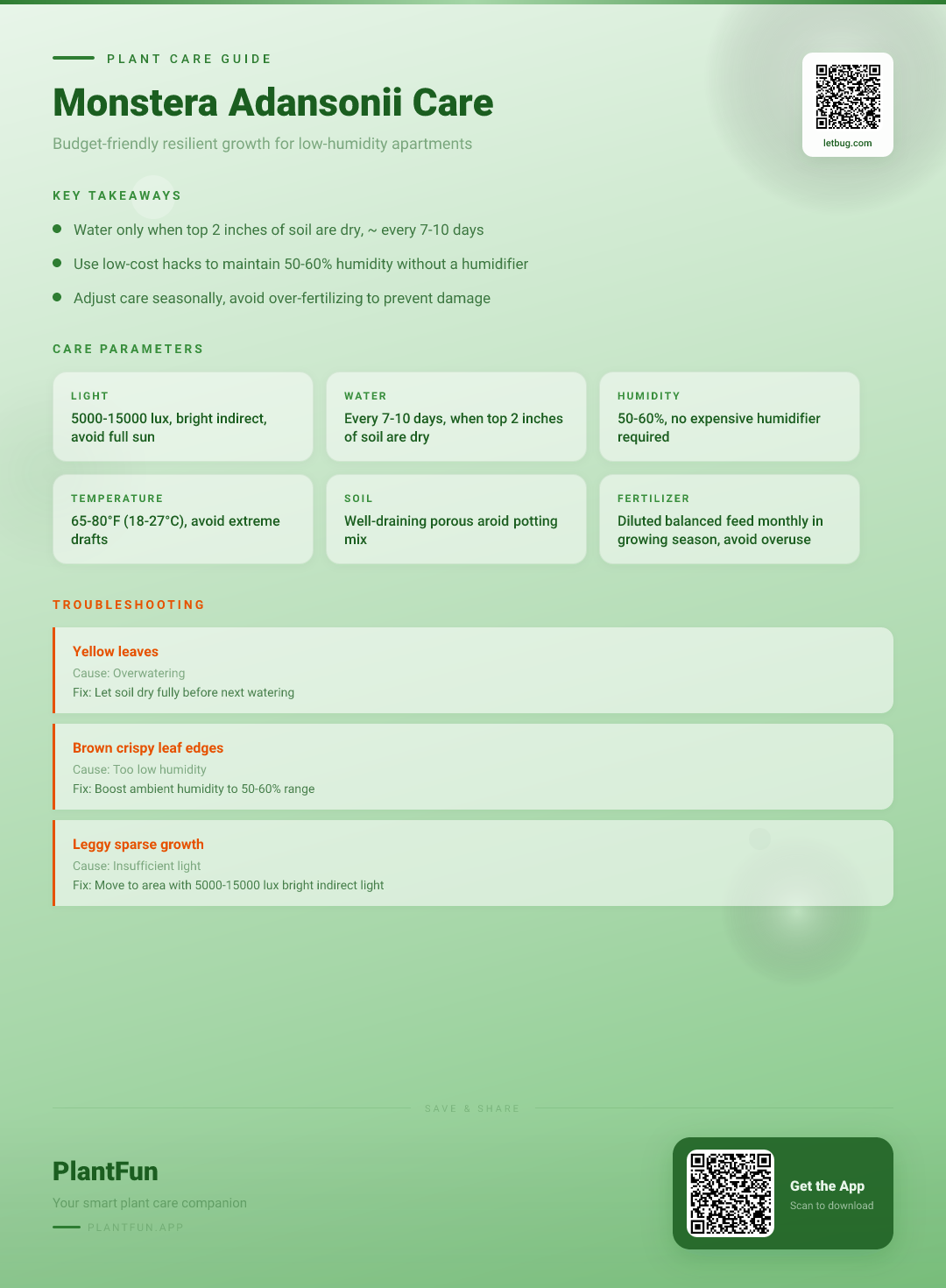
Key Takeaways
- Check soil moisture before watering — overwatering is the #1 killer of houseplants.
- Ensure your plant gets the right amount of light for its species.
- Be patient with recovery — most plants need 2–4 weeks to bounce back.
Quick Care Card: Essential Metrics for Success
| Feature | Requirement |
|---|---|
| Light | 5,000–15,000 Lux (Bright, indirect light) |
| Water | When top 2 inches of soil are dry |
| Humidity | 50–60% (Moderate) |
| Temperature | 65–80°F (18–27°C) |
| Soil | Chunky, well-draining aroid mix |
| Fertilizer | Balanced liquid feed during growing season |
| Toxicity | Toxic to pets (ASPCA, 2026) |
TL;DR: The Reality of Apartment Growing
Growing a Monstera adansonii in an apartment is entirely achievable without expensive gadgets. Focus on consistent moisture levels, bright indirect light, and maximizing ambient humidity through grouping plants. If the top two inches of soil are dry, it is time to water. Keep your plant away from direct drafts and heating vents to avoid crispy edges.
My Experience: The “Crispy Leaf” Lesson
When I first brought home my Monstera adansonii, I placed it directly above my radiator. Within weeks, the beautiful, fenestrated leaves began developing brown, crunchy halos. I thought I was underwatering, but the issue was atmospheric. I learned that Monstera adansonii in an apartment doesn’t need an expensive humidifier; it needs stability. By moving it away from the heater and grouping it with my other tropicals, the growth rate normalized.
Why Your Monstera adansonii Needs Humidity (And How to Fake It)
Native to tropical ecosystems, the Swiss Cheese Plant thrives in environments where moisture is consistently available in the air. Dry apartment air disrupts the plant’s ability to manage transpiration. While expensive humidifiers are popular, you can create a micro-climate by grouping your plants together to create a localized humidity bubble.
Light Requirements: Targeting 5,000-15,000 Lux for Compact Growth
Light is the engine for your plant’s growth. According to (Jacobi, 2024), light levels significantly dictate leaf morphology and physical defenses. To prevent leggy growth, position your plant near a bright window where it receives indirect light. If you are in a small apartment, a sheer curtain can help diffuse harsh sun rays to hit that sweet spot of 5,000–15,000 lux.
Watering Strategy: When the Top 2 Inches of Soil Feel Dry (Every 7-10 Days)
Determining how often to water Monstera adansonii is best done by touch rather than a schedule. I always use the “finger test”: push your finger into the soil up to the second knuckle. If it feels dry, irrigate until water drains freely from the bottom (NC State Extension, 2026). This typically happens every 7–10 days depending on your home’s ambient temperature.
Temperature Management: Staying Between 65-80°F (18-27°C)
As a tropical species, the Swiss Cheese plant prefers stable temperatures. Avoid placing it in front of air conditioning units or near furnace vents. Sudden temperature shifts cause cellular stress, which can manifest as stunted leaf development.
Humidity Hacks: Maintaining 50-60% Without Breaking the Bank
- The Pebble Tray: Fill a shallow tray with stones and water, then set your pot on top. Ensure the base of the pot isn’t touching the water to prevent root rot.
- Plant Grouping: Clustering plants creates a shared micro-climate where transpiration from one leaf benefits its neighbors.
- Bathroom Placement: If your bathroom has a window, the steam from daily showers creates an ideal, free humidity source.
- Wiping Leaves: Use a damp cloth to wipe down leaves; this cleans pores (stomata) and adds a quick burst of surface moisture.
Troubleshooting Guide
Yellowing Leaves
Symptom: Lower leaves turn yellow and soft.
Likely cause: Overwatering leading to waterlogged roots.
Fix:
- Check soil drainage and ensure the pot has holes.
- Reduce watering frequency until the top two inches are fully dry.
Brown Crispy Edges
Symptom: Browning on the tips or margins of leaves.
Likely cause: Low environmental humidity or inconsistent watering.
Fix:
- Move the plant away from drafty windows or heating vents.
- Increase ambient humidity using a pebble tray.
FAQ
Why is my Monstera adansonii turning yellow in my apartment? Yellowing is frequently a sign of soil moisture imbalance. Check if your pot is sitting in standing water after you finish watering; if so, dump the excess to prevent root rot.
Can I keep my Swiss Cheese plant on a bookshelf away from a window? It is not ideal. If the plant is too far from a light source, it will stretch toward the light, resulting in leggy, weak stems and small leaves. Try to keep it within 3 feet of a bright window.
How do I prevent brown crispy edges on the leaves? This is usually a humidity issue. Ensure your plant isn’t getting hit by direct blasts of dry air from an HVAC system, and consider grouping it with other plants to increase local humidity.
Seasonal Adjustments: Changing Your Routine from Summer to Winter
During winter, your plant’s metabolic rate slows down. Reduce fertilization and monitor the soil moisture closely, as it will likely stay damp for longer periods. Be extra vigilant about keeping the plant away from cold window drafts during these months.
Common Mistakes: Avoiding the Over-Fertilization Trap
- Mistake: Over-fertilizing in winter. What happens: Nutrient salt buildup damages roots. Instead: Only fertilize during the active growing season (Gani et al., 2023).
- Mistake: Using dense, garden soil. What happens: Compaction chokes the root system. Instead: Use a specialized aroid mix with bark and perlite.
References
- Jacobi, A. (2024). Effects of Sun vs Shade and Leaf Age on Leaf Morphology, Herbivory, and Physical Defenses in the Swiss Cheese Plant (Monstera adansonii). University of Colorado Honors Journal. https://doi.org/10.33011/cuhj20242283. Accessed 2026-03-10.
- Gani, I.; Subaedah, S.; Ralle, A. (2023). PENGARUH BERBAGAI KONSENTRASI PUPUK DAUN GROWMORE TERHADAP PERTUMBUHAN TANAMAN HIAS MONSTERA (Monstera adansonii). AGrotekMAS Jurnal Indonesia: Jurnal Ilmu Peranian. https://doi.org/10.33096/agrotekmas.v4i2.334. Accessed 2026-03-10.
- ASPCA. (2026). Toxic and Non-Toxic Plants List — ASPCA. https://www.aspca.org/pet-care/animal-poison-control/toxic-and-non-toxic-plants. Accessed 2026-03-10.
- NC State Extension. (2026). Monstera adansonii — NC State Extension Gardener Plant Toolbox. https://plants.ces.ncsu.edu/plants/monstera-adansonii/. Accessed 2026-03-10.
Optional Helper: Plantfun.App
Plantfun.App identifies your plants by photo, diagnoses pests and diseases with clear fixes, and creates personalised watering and light schedules that adapt to your home conditions — a handy companion for putting this guide into daily practice.
Found an error or have suggestions? We'd love your feedback.
Need help identifying this problem?
Get instant identification, personalized care schedules, and effective pest treatment plans directly on your phone.
Sponsored • We may earn a commission from app downloads
Related Guides
Swiss Cheese Plant in Low-Light Apartments: The Complete Rescue and Growth Care Guide
Revive your struggling Monstera adansonii with our proven apartment care system. Master precise watering, ideal lux levels, and 3 steps to stop yellowing leaves.
Care GuideThe Complete Swiss Cheese Plant Care Checklist for Resilient Growth in Budget Urban Apartments
Grow a lush, holey Swiss Cheese Plant in your apartment without spending a fortune. Get exact light levels, watering amounts, and a free 4-season care checklist you can implement today.
Care GuideThe Complete Swiss Cheese Plant (Monstera) Care Checklist for Thriving in Small Apartments
Skip the guesswork growing your Swiss Cheese Plant in a small apartment. Get exact light levels, watering amounts, and a 12-month care calendar for resilient, holey growth year-round.
Pest ControlAnts on Plants: What They Mean and What to Do
Ants usually aren't eating your plant. They are farming other pests.