
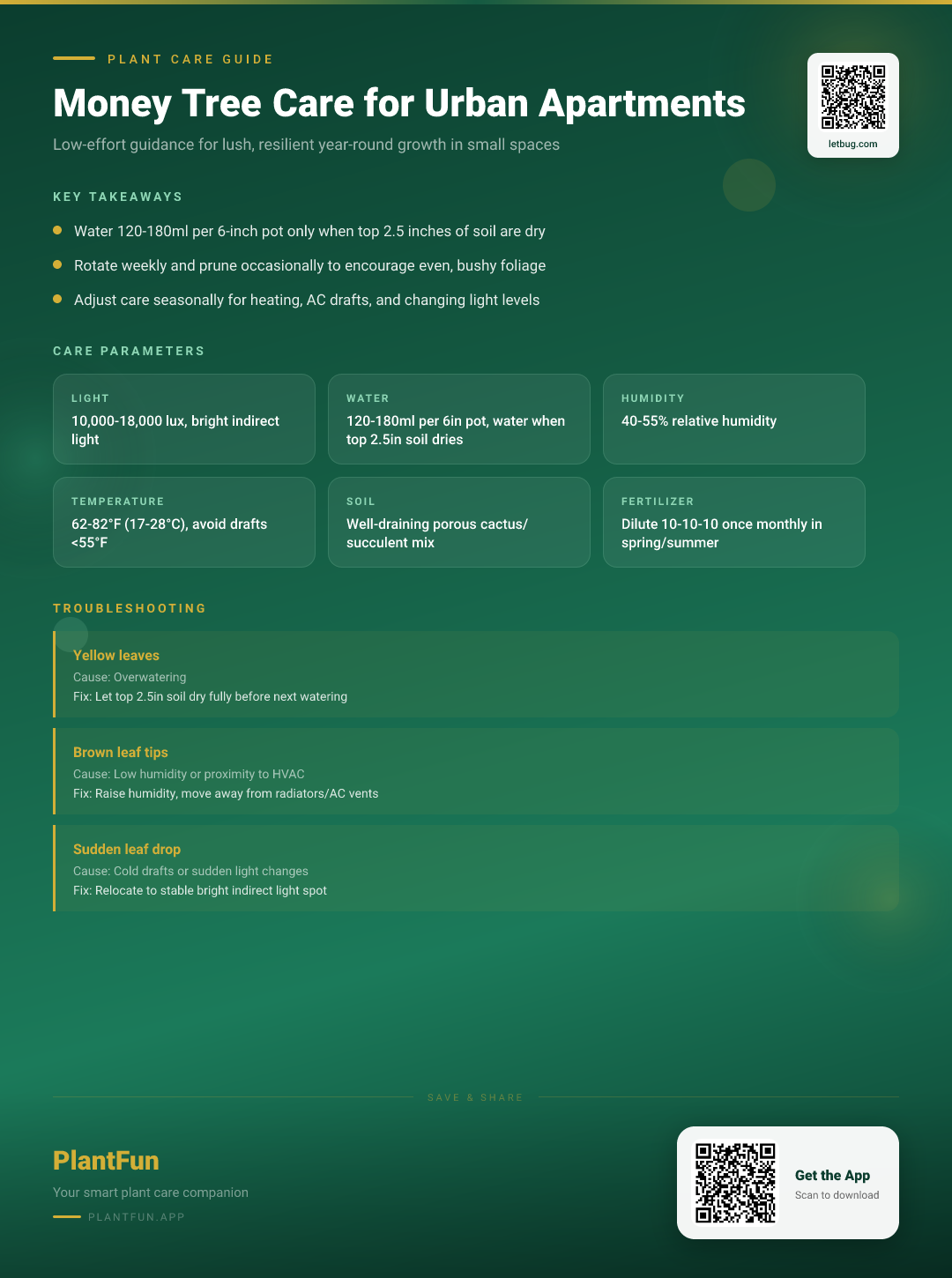
Key Takeaways
- Check soil moisture before watering — overwatering is the #1 killer of houseplants.
- Ensure your plant gets the right amount of light for its species.
- Be patient with recovery — most plants need 2–4 weeks to bounce back.
Quick Care Card: Printable 1-Page At-A-Glance Checklist
This no-fluff, measurable checklist is perfect for money tree care for beginners. Print it and tape it to your fridge to eliminate guesswork.
| Parameter | Exact Apartment-Specific Threshold |
|---|---|
| Light | 10,000-18,000 lux bright indirect light, no direct midday sun |
| Water | 120-180ml per 6-inch pot, only when top 2.5 inches of soil are completely dry |
| Humidity | 40-55% relative humidity |
| Temperature | 62-82°F (17-28°C), no fluctuations over 10°F in 24 hours |
| Soil | Well-draining cactus/succulent mix with 20% perlite for aeration |
| Fertilizer | Half-strength 10-10-10 houseplant fertilizer, once every 2 months in spring/summer only |
| Toxicity | Non-toxic to cats, dogs, and humans (ASPCA, 2026) |
Why Generic Money Tree Care Advice Fails In Typical Apartments
Most standard money tree care guidance is written for homeowners with sunrooms, consistent ambient humidity, and unlimited space — not 500 sq ft urban apartments with low winter light, forced-air heating/cooling, drafty window sills, and limited counter space.
A common myth vs reality: Generic guides say “place in bright light” and “water when dry,” but these vague phrases don’t account for the fact that forced-air heating dries the top 1 inch of soil in 48 hours while the root zone stays wet, or that a north-facing window only delivers 8,000 lux of light in winter, far below the minimum for healthy growth. This is exactly why so many apartment dwellers struggle to keep their money trees alive long-term.
7 Most Common Apartment Money Tree Care Mistakes (And Easy Fixes)
These are the most frequent errors we see leading to sick or dying money trees in urban units, with simple, actionable corrections:
-
Mistake: Watering on a fixed weekly schedule regardless of season or indoor conditions What happens: Overwatering is the top cause of money tree death in apartments, leading to root rot, soft trunks, and yellow dropping leaves Instead: Test soil moisture by sticking your index finger 2.5 inches deep before watering, and adjust frequency for seasonal heating/cooling changes (NC State Extension, 2026). For guidance on adjusting schedules, check our guide to apartment plant watering schedules.
-
Mistake: Placing directly on drafty window sills or within 2 feet of AC/heating vents What happens: Sudden 10+°F temperature fluctuations cause widespread, sudden leaf drop and scorched foliage Instead: Keep the plant 2+ feet away from all draft sources, and use a floating wall shelf if you have limited floor or counter space.
-
Mistake: Assuming “low light tolerant” means the plant can survive in dark corners with no natural light What happens: Stunted, leggy growth, sparse foliage, and increased risk of pest infestations Instead: Verify your plant gets a minimum of 10,000 lux of light with a cheap $10 light meter (Falkenstrom, 1995).
-
Mistake: Misting leaves to increase humidity instead of adjusting ambient air moisture What happens: Misting only raises humidity for 10-15 minutes, and excess moisture on leaves can lead to fungal leaf spot Instead: Use a pebble tray under the pot or a small, low-wattage humidifier nearby to hit the 40-55% RH threshold. Learn more easy hacks in our guide to increasing humidity for apartment plants.
-
Mistake: Repotting into a pot more than 2 inches larger than the current root ball What happens: Excess unused soil holds stagnant moisture around the roots, leading to root rot even if you follow watering guidelines Instead: Only repot when roots are growing out of the drainage holes, and size up by 1 inch maximum.
-
Mistake: Fertilizing in winter when the plant is dormant What happens: Salt buildup in the soil causes brown leaf tips and burnt root tissue Instead: Stop all fertilizing by mid-October, and resume only when new growth appears in early spring.
-
Mistake: Ignoring early signs of spider mite or mealybug infestations What happens: Warm, dry forced-air apartment air lets pests spread rapidly, leading to total defoliation in 2-3 weeks Instead: Wipe leaves with a damp cloth once a month to catch pests early. For natural treatment options, see our guide to apartment-friendly pest control.
Exact Measurable Care Thresholds For Apartment Success
These 4 non-negotiable parameters are backed by horticultural research and extension data, tailored to urban apartment conditions:
- Light: 10,000-18,000 lux bright indirect light (Falkenstrom, 1995) This is equivalent to light 3 feet away from an unobstructed south-facing window, or 1 foot away from a west-facing window. Quick test: Hold your hand up at midday in the plant’s spot — if you see a faint, soft shadow, you’re in the ideal range.
- Humidity: 40-55% relative humidity (NC State Extension, 2026) This is the money tree humidity requirements indoors standard. Most urban apartments sit at 20-30% RH in winter with forced heating, so small adjustments are usually needed.
- Temperature: 62-82°F (17-28°C) (Day Care and Early Education, 1974) Never let temperatures drop below 55°F (13°C) for more than 2 hours, as this can cause permanent cold damage to foliage.
- Water: 120-180ml per 6-inch pot only when the top 2.5 inches of soil are dry (NC State Extension, 2026) For larger pots, add 60ml of water per extra 2 inches of pot diameter. This answers the common question of how often to water money tree in apartment: usually every 10-21 days, depending on season.
Step-by-Step Weekly & Monthly Care Routine
All tasks take 5 minutes or less per week, perfect for busy apartment dwellers:
Weekly (3 minutes total)
- Test soil moisture by sticking your index finger 2.5 inches deep into the potting mix. If completely dry, water with the measured amount for your pot size.
- Scan leaves for early signs of pests, brown tips, or yellowing.
- Rotate the pot 1/4 turn to encourage even, symmetric growth.
Monthly (5 minutes total)
- Wipe both sides of all leaves with a damp microfiber cloth to remove dust, which blocks light absorption.
- Check humidity and temperature levels with a cheap digital monitor, adjust if needed.
- Fertilize only during spring and summer, using half-strength diluted houseplant fertilizer.
Seasonal Care Calendar For Apartment Dwellers
Adjust your routine to account for common apartment seasonal conditions:
- Winter (Dec-Feb): Money tree winter care apartment guide Forced heating lowers ambient humidity by 30-40% on average. Cut watering frequency by 50% (e.g., if you watered every 10 days in fall, water every 20 days in winter). Keep plants 3+ feet away from radiators, and use a pebble tray to boost humidity.
- Spring (Mar-May) New growth spurts start as light levels rise. Gradually increase watering frequency as the soil dries out faster. Resume fertilizing at half strength once every 2 months starting in late March. Prune any leggy growth from winter low light.
- Summer (Jun-Aug): Money tree summer watering tips AC drafts are the biggest risk, so keep plants 2+ feet away from AC units. Water may be needed every 7-10 days, but always test soil moisture first to avoid overwatering.
- Fall (Sep-Nov) Light levels drop 40-50% as days shorten. Move your money tree to the brightest spot in your apartment if possible. Stop all fertilizing by mid-October, and gradually reduce watering frequency as growth slows.
How To Encourage Bushy Resilient Growth (No Fancy Tools Required)
You don’t need expensive fertilizers or grow lights to get a full, bushy money tree:
- Pinch new growth tips: When you see a new, unfurled leaf at the top of a stem, pinch it off with clean fingers or sharp scissors. This forces the plant to grow two new stems below the cut, doubling foliage density over time (NC State Extension, 2026). This is the easiest answer to how to make money tree grow bushier.
- Rotate weekly: As noted in your routine, rotating 1/4 turn every week ensures all sides of the plant get equal light, preventing lopsided, sparse growth.
- Avoid over-fertilizing: More fertilizer does not equal more growth. Stick to the twice-yearly half-strength schedule to avoid salt buildup that damages roots.
FAQ
How do I keep my money tree alive in my dark apartment with no south-facing windows?
First, test your light levels with a cheap light meter to confirm you hit the minimum 10,000 lux threshold for money tree low light care. If you fall below that, add a budget LED grow light 12 inches above the plant, set to run 8 hours a day during the growing season. Avoid placing the plant in completely dark corners with no natural light, as this will lead to stunted growth and eventual death.
Why is my apartment money tree dropping leaves all of a sudden?
The most common cause is sudden temperature fluctuations from drafts, AC, or heating vents (NC State Extension, 2026). Check if the plant is within 2 feet of any draft source, and move it immediately to a spot with consistent temperatures. Other possible causes include overwatering, a recent move to a spot with drastically lower light levels, or a rapid drop in humidity.
Can I put my money tree next to my apartment radiator in winter?
No, radiators blow dry, hot air that can drop ambient humidity below 20% and scorch foliage, leading to widespread leaf drop and brown tips. This is one of the top money tree brown tips causes for apartment dwellers. Keep your money tree at least 3 feet away from all heating sources in winter, and use a pebble tray or small humidifier to maintain 40-55% RH.
Troubleshooting Quick Reference
Yellow Lower Leaves
Symptom: Soft, yellow leaves starting at the bottom of the plant, often accompanied by mushy, soft trunk tissue.
Likely cause: Overwatering leading to early root rot.
Fix:
- Stop watering immediately, and let the top 4 inches of soil dry completely before watering again.
- If the trunk feels soft, remove the plant from its pot, cut off any rotted black roots with sterile scissors, and repot in fresh, dry well-draining soil. This is the standard protocol for how to fix overwatered money tree.
Brown Leaf Tips
Symptom: Crispy, brown edges on leaf tips, with the rest of the leaf remaining green and healthy.
Likely cause: Low ambient humidity from forced air heating/cooling, or salt buildup from over-fertilizing.
Fix:
- Add a pebble tray under the pot or run a small humidifier nearby to hit the 40-55% RH threshold.
- Flush the soil with 3x the pot volume of distilled water once every 6 months to remove excess salt buildup.
Sudden Leaf Drop
Symptom: Healthy green leaves dropping off the plant within 24-48 hours, no yellowing or browning before falling.
Likely cause: Sudden temperature fluctuation from drafts, or a recent move to a spot with drastically different light levels.
Fix:
- Move the plant to a spot with consistent 62-82°F temperatures, at least 2 feet away from all draft sources.
- Avoid moving the plant more than 1 foot at a time if adjusting light levels, to reduce transplant shock.
Leggy Sparse Growth
Symptom: Long, thin stems with large gaps between leaves, with growth only appearing on the side of the plant facing the window.
Likely cause: Insufficient light levels below 10,000 lux, or no regular rotation.
Fix:
- Move to a brighter spot, or add a budget grow light to hit the minimum 10,000 lux threshold.
- Rotate the pot 1/4 turn every week to ensure even light exposure across all sides of the plant.
References
- ASPCA. (2026). Toxic and Non-Toxic Plants List — ASPCA. https://www.aspca.org/pet-care/animal-poison-control/toxic-and-non-toxic-plants. Accessed 2026-03-05.
- Falkenstrom, K. (1995). The money tree plant. Rhetoric Review. https://doi.org/10.1080/07350199509359197. Accessed 2026-03-05.
- Day Care and Early Education. (1974). How to grow a money tree. https://doi.org/10.1007/bf02353449. Accessed 2026-03-05.
- NC State Extension. (2026). Money Tree — NC State Extension Gardener Plant Toolbox. https://plants.ces.ncsu.edu/plants/money-tree/. Accessed 2026-03-05.
Optional Helper: Plantfun.App
Plantfun.App identifies your plants by photo, diagnoses pests and diseases with clear fixes, and creates personalised watering and light schedules that adapt to your home conditions — a handy companion for putting this guide into daily practice.
Found an error or have suggestions? We'd love your feedback.
Need help identifying this problem?
Get instant identification, personalized care schedules, and effective pest treatment plans directly on your phone.
Sponsored • We may earn a commission from app downloads
Related Guides
The Complete Money Tree Care Checklist for Resilient Growth in Small Urban Apartments
Stop guessing at money tree care for your small urban apartment. Use this 12-item checklist with exact light, water, and humidity parameters to grow thick, vibrant, resilient foliage year-round.
Care GuideThe Complete Pachira Aquatica (Money Tree) Care Checklist for Apartments: Grow Resilient Lush Plants Easily
Stop guessing at your money tree care. Grab this apartment-specific checklist with exact light, water, and humidity parameters to grow resilient, lush Pachira aquatica all year round.
Care GuideThe Complete Money Tree Care Checklist for Resilient Growth in Typical Apartments
Stop guessing at money tree care. Get a 12-step apartment-specific checklist, exact light, water, and humidity thresholds to grow a lush, resilient plant with zero extra effort.
Pest ControlAnts on Plants: What They Mean and What to Do
Ants usually aren't eating your plant. They are farming other pests.