
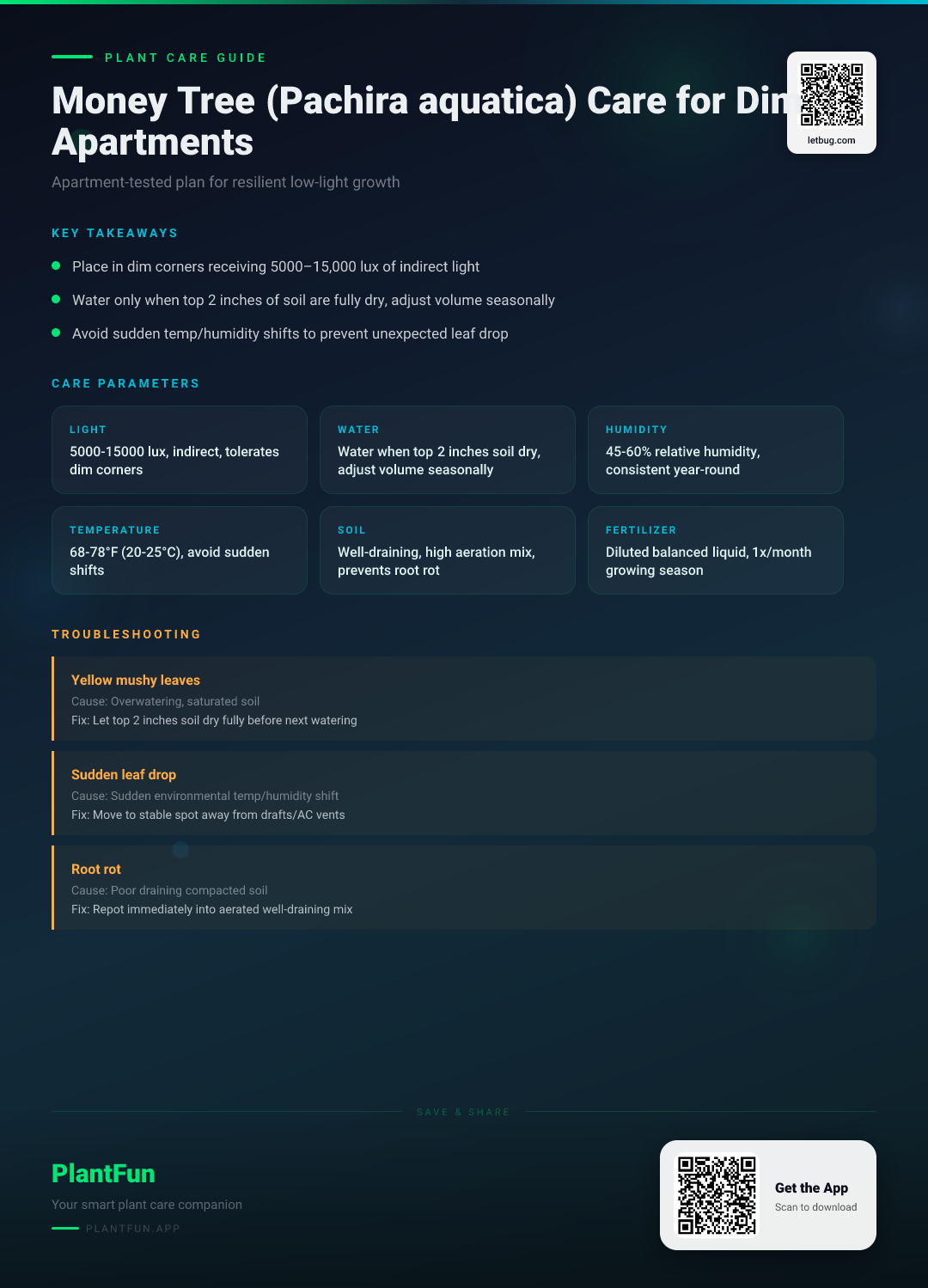
Key Takeaways
- Check soil moisture before watering — overwatering is the #1 killer of houseplants.
- Ensure your plant gets the right amount of light for its species.
- Be patient with recovery — most plants need 2–4 weeks to bounce back.
TL;DR: The Apartment Survival Strategy
If you want your Money Tree (Pachira aquatica) to thrive in a dim apartment, keep it simple: place it near a window, water only when the top 2 inches of soil are dry, and avoid temperature fluctuations. This tropical native prefers consistent moisture but hates “wet feet.” Follow the 2-inch rule and monitor for yellowing leaves to catch issues before they turn into major health crises.
My Experience
When I first got my Money Tree, I made the mistake of placing it in a dark hallway corner, thinking it was a “low-light” plant. Within three weeks, the leaves began to yellow and drop rapidly. It wasn’t until I moved it within 3 feet of a south-facing window and adjusted my watering routine to match the lower evaporation rates of my apartment that it finally bounced back. I learned that “low light” for a Pachira is very different from “no light.”
Quick Care Card: Essential Data Points
| Feature | Requirement |
|---|---|
| Light | 5,000–15,000 Lux (Bright, indirect) |
| Watering | When top 2 inches of soil are dry |
| Humidity | 45–60% |
| Temperature | 68–78°F (20–25°C) |
| Soil | Well-draining peat or coco-coir mix |
| Fertilizer | Balanced liquid 10-10-10 (Monthly in summer) |
| Toxicity | Non-toxic (ASPCA, 2026) |
Why Apartments Challenge the Pachira aquatica: Understanding Natural Habitat vs. Living Room
In its native Central and South American wetlands, Pachira aquatica thrives in humid, high-light environments (NC State Extension, 2026). Apartments, by contrast, are typically climate-controlled with low humidity and lower light intensity. This mismatch often leads to root rot or leaf drop if we treat the plant like a desert succulent. To succeed, we must mimic its natural wetland tendencies—high moisture but excellent drainage—without suffocating the root system in dense, water-logged potting media.
Light Requirements: Achieving 5,000–15,000 Lux in Dim Corners
Money Trees require significant light to maintain their canopy. If you live in a dim apartment, you need to maximize every photon. Use a light meter app or sensor to aim for 5,000–15,000 Lux.
- Placement: Position your plant within 3 feet of an unobstructed window.
- Rotation: Turn the pot 45 degrees every time you water to ensure all sides receive equal light.
- Light Quality: If your windows are small, avoid heavy curtains that block natural rays.
Precision Watering: The 2-Inch Rule and Seasonal ml Adjustments
Overwatering is the primary cause of failure for Pachira aquatica indoor care.
- The Test: Stick your index finger 2 inches into the soil. If it feels damp, do not water.
- The Volume: During summer, a medium-sized plant might need 300–500ml, but in winter, reduce this by half to account for lower metabolic rates (Falkenstrom, 1995).
- Consistency: Always pour excess water out of the saucer immediately; standing water is the death knell for indoor roots.
Humidity & Temperature: Maintaining 45-60% Humidity and 68-78°F (20-25°C) Year-Round
Fluctuating temperatures near heaters or air conditioning vents stress the plant. Aim to keep the ambient temperature steady between 68–78°F (20–25°C). Since most apartments fall below 40% humidity, use a pebble tray or a small humidifier near the plant to maintain a consistent 45–60% range, which mimics the natural environment described in early horticultural studies (Day Care and Early Education, 1974).
Soil Science for Apartments: Why Drainage and Aeration Prevent Root Rot
Standard potting soil is often too dense for a Money Tree. I recommend a mix of 50% high-quality peat moss, 25% perlite for aeration, and 25% orchid bark. This “chunky” composition allows oxygen to reach the roots, which is critical in the lower-light conditions of an apartment where soil takes longer to dry out.
Can I keep my Money Tree in a room with only one small window?
Yes, but you must move it as close to the glass as possible. If the plant continues to stretch or lose leaves, supplement with a full-spectrum LED grow light for 6–8 hours daily to bridge the gap.
Why is my Money Tree losing leaves despite regular watering?
Leaf Drop in Healthy Soil
Symptom: Leaves turn yellow or fall off despite the soil feeling moist.
Likely cause: Overwatering leading to incipient root suffocation.
Fix:
- Stop watering immediately.
- Inspect drainage holes for blockages.
- Aerate the top inch of soil with a chopstick to encourage drying.
How do I know when my Money Tree needs to be repotted?
If you see roots growing out of the bottom drainage holes or if water pools on the surface for more than a minute, the plant is root-bound. Repot only in the spring using a pot that is just 1–2 inches wider in diameter than the previous one.
Seasonal Care Calendar: A Month-by-Month Maintenance Schedule
- Spring: Repot if necessary; begin increasing fertilizer.
- Summer: Maintain high light; keep soil consistently moist but never soggy.
- Autumn: Gradually reduce watering frequency as growth slows.
- Winter: Keep away from drafts; monitor for spider mites if the air is too dry.
Common Mistakes to Avoid: Overwatering and Sudden Environmental Shifts
- Mistake: Watering on a strict calendar schedule regardless of soil moisture. What happens: The roots suffocate from lack of oxygen. Instead: Always check the soil moisture manually before adding water.
- Mistake: Moving the plant between rooms frequently. What happens: Sudden changes in light intensity cause “shock” and leaf drop. Instead: Choose one consistent spot and leave it there.
References
- ASPCA. (2026). Toxic and Non-Toxic Plants List — ASPCA. https://www.aspca.org/pet-care/animal-poison-control/toxic-and-non-toxic-plants. Accessed 2026-03-15.
- Day Care and Early Education. (1974). How to grow a money tree. https://doi.org/10.1007/bf02353449. Accessed 2026-03-15.
- Falkenstrom, K. (1995). The money tree plant. Rhetoric Review. https://doi.org/10.1080/07350199509359197. Accessed 2026-03-15.
- NC State Extension. (2026). Money Tree — NC State Extension Gardener Plant Toolbox. https://plants.ces.ncsu.edu/plants/tree-care/. Accessed 2026-03-15.
Optional Helper: Plantfun.App
Plantfun.App identifies your plants by photo, diagnoses pests and diseases with clear fixes, and creates personalised watering and light schedules that adapt to your home conditions — a handy companion for putting this guide into daily practice.
Found an error or have suggestions? We'd love your feedback.
Need help identifying this problem?
Get instant identification, personalized care schedules, and effective pest treatment plans directly on your phone.
Sponsored • We may earn a commission from app downloads
Related Guides
The Complete Money Tree Care Guide for Typical Apartments: Light, Water, Soil & More
Transform your Money Tree into a resilient apartment centerpiece. Follow these 4 vital care thresholds and our seasonal routine to stop yellowing leaves today.
Care GuideMoney Tree Care for Small Apartments: The Essential Guide for Resilient Growth
Revitalize your Money Tree with precise care. Learn exact lux needs, watering schedules, and humidity hacks to grow a lush, resilient plant in any apartment.
Care GuideMoney Tree Care for Small Apartments: A 5-Step Guide to Resilient Indoor Growth
Revive your Money Tree with our simple 5-step checklist. Get exact lux, watering ml, and apartment-specific tips to ensure resilient growth all year long.
Pest ControlAnts on Plants: What They Mean and What to Do
Ants usually aren't eating your plant. They are farming other pests.