
Key Takeaways
- Check soil moisture before watering — overwatering is the #1 killer of houseplants.
- Ensure your plant gets the right amount of light for its species.
- Be patient with recovery — most plants need 2–4 weeks to bounce back.
TL;DR: Quick Success Summary
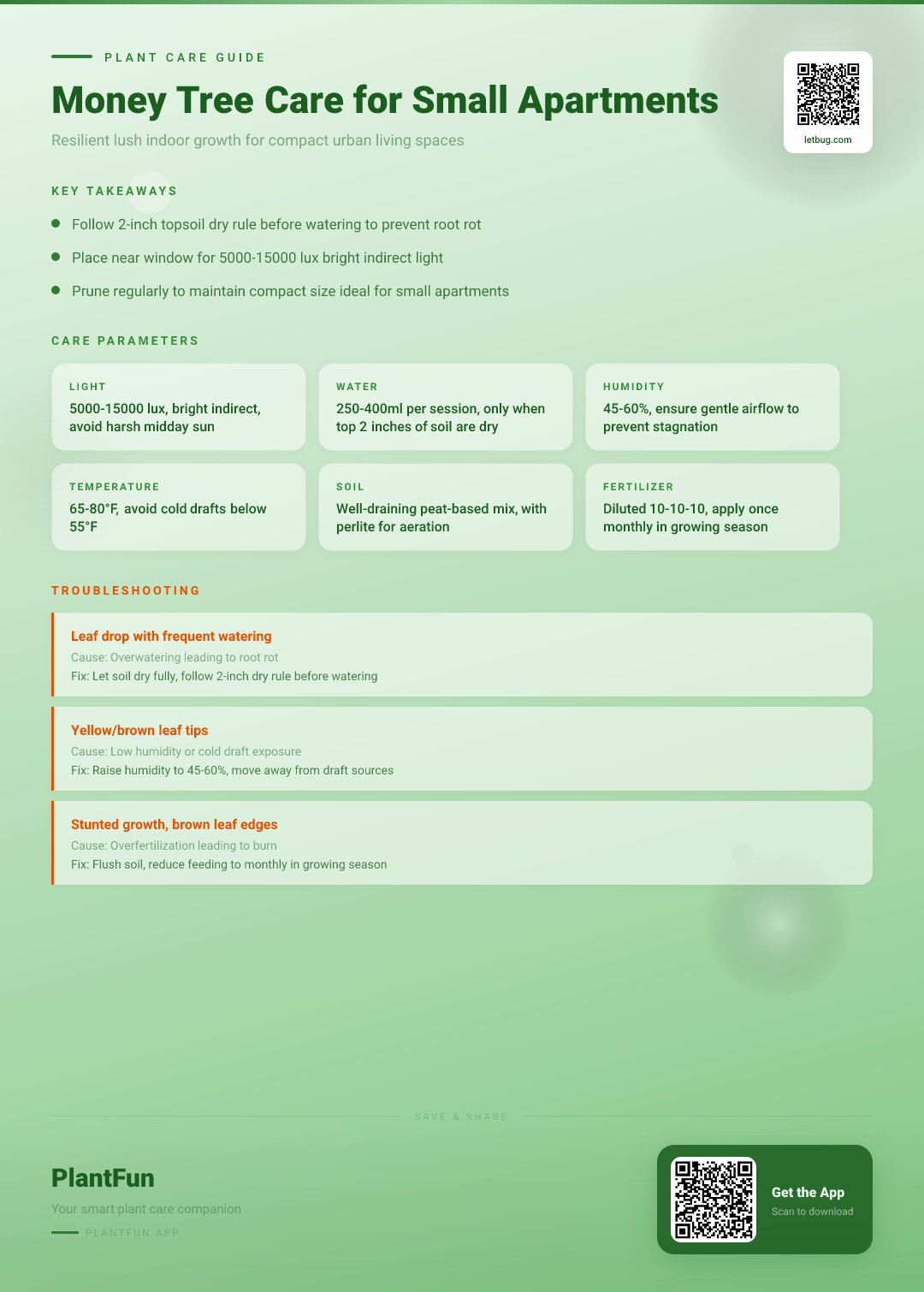
To keep your Pachira aquatica thriving in an apartment, place it in bright, indirect light (5,000–15,000 lux). Water only when the top 2 inches of soil are dry, using roughly 250–400ml depending on your pot size. Maintain 45–60% humidity and keep temperatures between 65–80°F (NC State Extension, 2026). Always ensure your pot has drainage to avoid root rot.
Quick Care Card: Essential Data
| Category | Requirement |
|---|---|
| Light | 5,000–15,000 lux (Bright indirect) |
| Water | 250–400ml when top 2” dry |
| Humidity | 45–60% |
| Temperature | 65–80°F |
| Soil | Well-draining peat-based mix |
| Fertilizer | Balanced liquid (10-10-10) monthly in growing season |
| Toxicity | Non-toxic (ASPCA, 2026) |
My Experience: Learning the Hard Way
When I first brought home my Pachira aquatica, I made the mistake of treating it like a cactus, letting the soil dry out completely for weeks. I also placed it in a dark corner of my studio apartment. Within a month, the beautiful braided trunk was shedding leaves like confetti. I learned that while they are resilient, these trees thrive on consistency rather than neglect. Once I moved it to a window ledge and established a watering rhythm based on soil moisture rather than the calendar, the plant began pushing out new, vibrant growth.
Why Your Money Tree Struggles in Small Apartments: Understanding the Urban Micro-climate
In cramped urban living, your plant faces challenges like poor airflow, unstable heating/cooling, and light blocked by nearby buildings. Unlike a greenhouse, an apartment creates a stagnant micro-climate. According to NC State Extension (2026), these plants are native to wetland regions; they crave stability. When air is trapped, moisture remains in the soil longer, often leading to the dreaded root rot.
Decoding Light Requirements: Finding the Bright Indirect Sweet Spot Near a Window
Money Tree light requirements are often misunderstood. While they can survive in lower light, they will only thrive in the 5,000–15,000 lux range. I suggest placing yours within 2–3 feet of a south or east-facing window. Use a sheer curtain if the sun hits the foliage directly during high noon to prevent leaf scorch.
The Watering Science: How to Use the 2-Inch Rule to Prevent Root Rot
Watering correctly is the most important aspect of Pachira aquatica care.
- The Test: Insert your index finger 2 inches into the soil.
- The Decision: If the soil feels damp or cool, wait. If it is dry, it is time to hydrate.
- The Application: Use 250–400ml of water, pouring slowly around the base until it drains out the bottom. Empty your saucer immediately; leaving the plant in standing water is a recipe for disaster.
Humidity & Airflow: Protecting Your Tree from Stagnant Apartment Air
These trees love a humidity level of 45–60% (NC State Extension, 2026). In winter, when apartment heating dries the air, I use a small humidifier nearby. Good airflow is equally critical—if your apartment is stuffy, consider running a small fan for a few hours a day to prevent fungal issues.
Seasonal Adjustment Calendar: Adapting Your Care from Summer Growth to Winter Dormancy
- Spring/Summer (Growth): Increase watering frequency and apply a balanced liquid fertilizer monthly.
- Fall/Winter (Dormancy): Growth slows down. Reduce watering by half and stop fertilizing entirely until days lengthen in February.
Can I keep my Money Tree in a room without windows?
No. While it may survive for a few weeks in low light, it will eventually lose its vigor. If your space lacks natural light, you must invest in a high-quality full-spectrum LED grow light set to an 8–10 hour timer to meet its energy needs.
Why is my Money Tree losing leaves despite frequent watering?
It is likely the opposite of what you think: the plant is likely overwatered. Excess water creates anaerobic conditions in the root zone, preventing oxygen uptake (NC State Extension, 2026). If the leaves yellow and fall, check for moisture in the bottom of the pot.
How do I prune my Money Tree to keep it compact for my small home?
Pruning is essential for apartment dwellers. Use sterilized shears to remove leggy growth just above a leaf node. This encourages branching, resulting in a fuller, bushier tree rather than a tall, spindly one.
Common Mistakes: Over-potting, Cold Drafts, and Fertilizer Burn
- Mistake: Using a pot much larger than the root ball.
- What happens: Excess soil holds too much water, inviting rot.
- Instead: Only repot to a container 1–2 inches wider than the previous one.
- Mistake: Placing the tree next to an AC vent or drafty door.
- What happens: Rapid temperature swings cause leaf drop.
- Instead: Keep it in a draft-free location with stable temperatures.
Troubleshooting Guide: Identifying Pest Infestations and Nutrient Deficiencies
Root Rot
Symptom: Mushy stems at the base and yellowing leaves.
Likely cause: Overwatering and poor drainage.
Fix:
- Remove the plant and trim away black, mushy roots.
- Repot in fresh, well-draining succulent-type soil.
Spider Mites
Symptom: Tiny webbing between leaves and speckled, dull foliage.
Likely cause: Dry, stagnant apartment air.
Fix:
- Wipe leaves with a damp cloth.
- Increase humidity and use a diluted neem oil treatment.
Nutrient Deficiency
Symptom: Uniformly pale leaves during the growing season.
Likely cause: Exhausted soil nutrients.
Fix:
- Apply a balanced, water-soluble fertilizer at half-strength.
- Maintain a consistent feeding schedule through the summer.
References
- ASPCA. (2026). Toxic and Non-Toxic Plants List — ASPCA. https://www.aspca.org/pet-care/animal-poison-control/toxic-and-non-toxic-plants. Accessed 2026-03-19.
- NC State Extension. (2026). Money Tree Care — NC State Extension Gardener Plant Toolbox. https://plants.ces.ncsu.edu/plants/tree-care/. Accessed 2026-03-19.
- Sharpe, D. (2011). Money, money, money. Child Care. https://doi.org/10.12968/chca.2011.8.10.6. Accessed 2026-03-19.
- Zhao, Y.; Quan, X.; Wang, T. (2024). Food poisoning due to money tree seeds: a case report of toxic encephalopathy. Emergency and Critical Care Medicine. https://doi.org/10.1097/ec9.0000000000000119. Accessed 2026-03-19.
Optional Helper: Plantfun.App
Plantfun.App identifies your plants by photo, diagnoses pests and diseases with clear fixes, and creates personalised watering and light schedules that adapt to your home conditions — a handy companion for putting this guide into daily practice.
Found an error or have suggestions? We'd love your feedback.
Need help identifying this problem?
Get instant identification, personalized care schedules, and effective pest treatment plans directly on your phone.
Sponsored • We may earn a commission from app downloads
Related Guides
Money Tree Care for Busy Apartments: The Complete Guide to Resilient Indoor Growth
Transform your apartment into a lush sanctuary. Master Money Tree care with expert light, water, and humidity thresholds designed to keep your plant thriving.
Care GuideMoney Tree Care for Small Apartments: The Essential Guide for Resilient Growth
Revitalize your Money Tree with precise care. Learn exact lux needs, watering schedules, and humidity hacks to grow a lush, resilient plant in any apartment.
Care GuideMoney Tree Care for Small Apartments: A 4-Season Guide to Resilient Indoor Growth
Revitalize your apartment Money Tree with this 4-season care guide. Get precise watering schedules, light lux requirements, and tips for year-round resilience.
Pest ControlAnts on Plants: What They Mean and What to Do
Ants usually aren't eating your plant. They are farming other pests.